
Winter weather has a way of changing our plans.
A forecast that calls for snow or ice can mean crowded grocery stores, empty shelves, and last-minute decisions about what to make for supper. Sometimes the weather turns out to be milder than expected. Other times, roads become difficult to travel, and a quick trip to the store isn’t such a good idea.
A little preparation can make those situations easier to manage.
You don’t need a basement full of supplies or months of food stored away. For a small household, a modest collection of familiar foods, a few convenient meals, and some basic household supplies can provide peace of mind when winter weather approaches.
The goal isn’t to prepare for every imaginable emergency. It’s to make ordinary disruptions easier to handle.
And there’s a bonus: the same pantry that helps you get through a snowy weekend can also make everyday cooking more convenient.
Start with the Food You Already Have
Before buying anything new, take a look at your pantry, refrigerator, and freezer.
You may already have more useful ingredients than you realize.
Check for:
- Canned soups and stews.
- Canned chicken, tuna, salmon, or other proteins you enjoy.
- Canned beans and vegetables.
- Rice, pasta, and other grains.
- Potatoes and other vegetables that store well under suitable conditions.
- Crackers, bread, and other convenient foods.
- Peanut butter and other familiar spreads.
- Shelf-stable milk or another milk alternative you use.
- Ingredients for simple meals you already know how to prepare.
Look at your freezer, too. Identify meats, vegetables, and prepared meals that could provide several days of meals.
You don’t need to make an elaborate inventory. A quick list of what’s available can help you plan meals around the food you already own.
Why it works: When you know what you have, you’re less likely to buy duplicate items or overlook ingredients that should be used first.
Build a Pantry Around Meals, Not Just Ingredients
It’s easy to collect individual cans and packages without thinking about how they’ll become supper.
Instead, consider a few complete meal combinations.
For example:
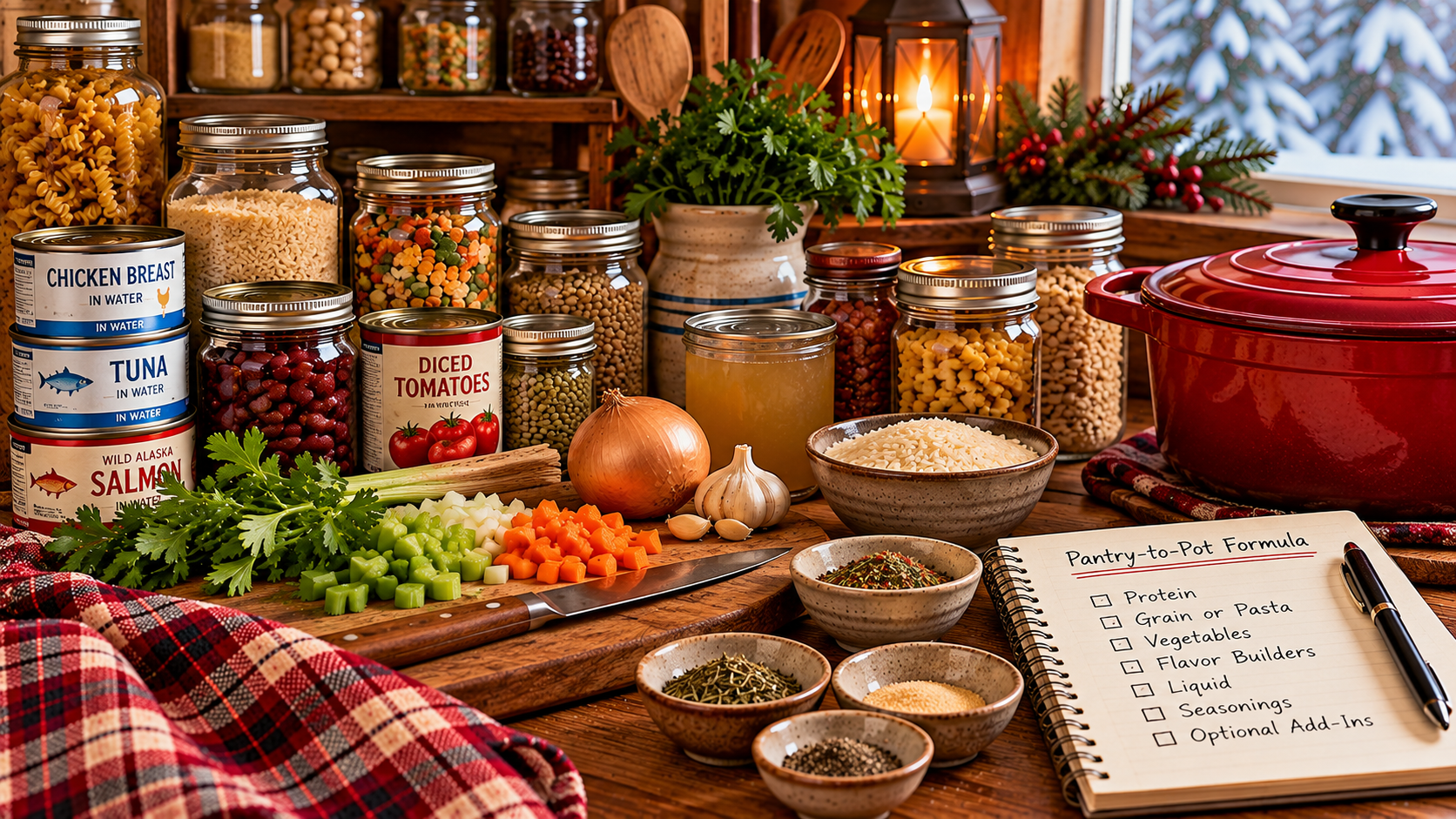
Chicken and rice: Canned chicken, rice, broth, and vegetables.
A simple soup: Broth, canned chicken or beans, vegetables, and noodles or rice.
A quick pasta supper: Pasta, a suitable sauce, and canned tuna or another protein you enjoy.
A pantry chili: Canned beans, tomatoes, and seasonings, with ground meat if available and desired.
A no-cook meal: Crackers or bread, peanut butter, canned fruit, and another ready-to-eat food that suits your needs.
These are starting points, not rigid menus. Use combinations that reflect your household’s tastes.
When possible, keep ingredients together in your planning notes so you can see which meals are available without making another trip to the store.
Keep a Few Ready-to-Eat Foods Available
Not every meal during a winter storm needs to involve cooking.
If the power goes out, or you simply don’t feel like preparing a full meal, ready-to-eat foods can be particularly useful.
Consider keeping some of the following:
- Crackers.
- Bread or rolls.
- Peanut butter.
- Canned fruit.
- Shelf-stable milk.
- Ready-to-eat canned foods that can be opened and eaten without heating.
- Individually packaged snacks you enjoy.
- Drinking water.
Choose foods that you can eat safely without relying on an oven, microwave, or refrigerator.
Remember that many canned foods are best eaten after heating, even though they are technically safe to eat straight from the can. Check the product instructions and decide which options would actually work for your household.
Also consider any special dietary needs when choosing supplies. A pantry is most useful when it contains foods you can comfortably eat.
Check Your Freezer Before the Forecast Changes
Your freezer can be an important part of winter meal planning.
Make a quick list of the meat, vegetables, and prepared meals you already have. Think about which items could be combined into simple dinners.
For example, a package of ground turkey, frozen vegetables, and potatoes might provide the basis for a skillet meal. Frozen chicken, broth, and rice could become a simple chicken and rice supper.
You can also group ingredients mentally or on paper by the meals they could make.
A Lesson from Storms Past
I remember a time or two when I was a teenager and a storm knocked out our electricity. My dad would take the heaviest blanket we had and lay it over the freezer, hoping to help hold the cold inside.
Years later, Craig and I faced a much longer outage after Hurricane Irma. We were without electricity for six days.
When the power finally came back, we began going through the freezer and assessing what we had left. We ended up discarding more than half of its contents.
Losing that much food was disappointing, but we were comfortable using what remained after we had finished sorting through everything.
Those experiences taught me how much we depend on our freezers to preserve the food we buy and prepare. They also reminded me that an extended power outage can turn a well-stocked freezer into a food-safety concern.
Today, I’d encourage anyone preparing for winter weather to keep a freezer thermometer on hand, leave the freezer door closed as much as possible during an outage, and follow current food-safety guidance before deciding what to keep.
A little preparation can help protect both your food and your grocery budget.
What If the Power Goes Out?
Food safety becomes particularly important during an extended outage.
Keep refrigerator and freezer doors closed as much as possible. A closed refrigerator generally keeps food cold for about four hours. A full freezer can maintain its temperature for approximately 48 hours, and a half-full freezer for approximately 24 hours, provided the doors remain closed.
These are general estimates, not guarantees. Actual conditions vary with the appliance, room temperature, how often the door is opened, and how well the freezer is packed.
A refrigerator or freezer thermometer can help you determine whether food has remained at a safe temperature.
Refrigerated perishable food that has been above 40°F for more than two hours should generally be discarded. Don’t rely on smell, appearance, or taste to determine whether food is safe.
Frozen food that still contains ice crystals or is at 40°F or below can generally be refrozen, although its quality may suffer.
If an outage continues, follow current food-safety guidance rather than assuming everything in the refrigerator or freezer will remain safe indefinitely.
Does Your Freezer Open from the Top or the Front?
There’s a difference between a chest freezer and an upright freezer beyond their orientation.
A chest freezer opens from the top. Because cold air is denser than warm air, it tends to remain inside the freezer when the lid is lifted. An upright freezer opens from the front, allowing cold air to spill out more readily when the door is opened.
As a result, chest freezers generally retain cold better during a power outage, although the actual performance depends on the appliance, how full it is, the surrounding temperature, and how often it is opened.
Regardless of the type of freezer you own, keep the door or lid closed as much as possible during an outage. A freezer thermometer can help you determine whether food has remained at a safe temperature.
A full freezer that remains closed can generally maintain its temperature for about 48 hours, while a half-full freezer can generally do so for about 24 hours. These are estimates, not guarantees.
If you have an upright freezer, don’t assume the food will become unsafe immediately when the power goes out. Keeping the door closed and checking temperatures when possible are important for either type of freezer.
Don’t Forget Drinking Water
Food is only one part of winter preparation.
Keep drinking water available in case a storm disrupts the water supply or makes it difficult to obtain additional supplies.
A commonly recommended emergency allowance is one gallon of water per person per day for at least three days, for drinking and basic sanitation. Individual needs may be greater depending on health, activity, weather, and other circumstances.
Store water in appropriate, food-grade containers and follow current public-health guidance for safe storage.
If you rely on a private well, consider what happens if the pump loses power. A well may stop delivering water during an outage even if the well itself is unaffected.
Make Sure You Can Receive Information
Winter storms can change quickly, and reliable information helps you make better decisions.
Consider keeping:
- A battery-powered or hand-crank radio.
- Flashlights or battery-powered lanterns.
- Spare batteries or a suitable way to recharge devices.
- A charged mobile phone and a backup charging method.
- Important telephone numbers written on paper.
Don’t depend entirely on an internet connection or a phone battery that may run down during an extended outage.
A flashlight is also safer than relying on candles for routine lighting.
Think About Medications and Everyday Essentials
If you take prescription medication or rely on medical equipment, include those needs in your winter preparations.
Check your supplies before severe weather is forecast, and refill prescriptions in advance when possible and permitted.
Keep necessary medications in their required storage conditions. Some medications need refrigeration or protection from extreme temperatures, so follow the pharmacist’s or manufacturer’s instructions.
Other useful supplies may include:
- A basic first-aid kit.
- Personal hygiene products.
- Pet food and necessary pet supplies.
- Extra supplies for infants or other household members who need them.
- Warm clothing and blankets.
The idea is to identify what your household depends on every day and consider what would happen if you couldn’t get to a store for several days.
Understand Your Cooking and Heating Options
One of the most useful things you can do before winter arrives is understand which household appliances will work during a power outage.
Don’t assume that a gas appliance, generator, or other fuel-burning device is safe to operate indoors just because it normally provides heat or cooking power.
Never use an outdoor grill, camping stove, charcoal burner, or outdoor generator inside a home, camper, garage, or other enclosed space. These devices can produce deadly carbon monoxide.
A carbon monoxide alarm is an important safety measure wherever fuel-burning appliances are used.
If you have a gas stove, learn what the manufacturer says about its operation during an outage. Some appliances require electricity for ignition or other functions. Never improvise a method of lighting or operating an appliance that isn’t approved by the manufacturer.
If you use a wood stove or another alternative heating system, make sure it is properly installed, maintained, and operated according to its instructions.
Before severe weather arrives, think through the practical questions:
- Can I prepare food safely if the electricity goes out?
- Do I have meals that don’t require cooking?
- Will my refrigerator or freezer continue operating?
- Do I have safe ways to stay warm?
- Can I receive weather and emergency information?
Knowing the answers ahead of time is much easier than figuring everything out in the middle of a storm.
Build Your Supplies Gradually
You don’t need to buy everything at once.
As you do your ordinary shopping, add an extra can of soup, another package of rice, or a few shelf-stable foods that your household regularly uses.
Replace what you use and check expiration dates and product quality periodically.
This approach spreads the cost over time and reduces the temptation to make a large, expensive shopping trip just because a storm is in the forecast.
It also helps prevent food waste because you’re stocking ingredients you already know how to use.
A Simple Winter Pantry Checklist
Use this checklist as a starting point, adjusting it to suit your household, storage space, budget, and dietary needs.
Food
- Familiar canned meals or ingredients for simple meals.
- Shelf-stable proteins you enjoy.
- Rice, pasta, or other useful starches.
- Canned or frozen vegetables.
- Fruit and convenient snacks.
- Bread, crackers, or other ready-to-eat foods.
- Shelf-stable milk or another suitable alternative.
- Foods that don’t require cooking.
- A few meals planned around your existing freezer supplies.
Water and Information
- Drinking water.
- Flashlights or battery-powered lanterns.
- Spare batteries or charging options.
- A way to receive weather and emergency information.
- Important telephone numbers.
Household Needs
- Necessary medications and medical supplies.
- First-aid supplies.
- Personal hygiene items.
- Pet supplies, if applicable.
- Warm clothing and blankets.
- A clear understanding of safe cooking and heating options.
This is a planning aid, not a list of items everyone must purchase. Start with what you have and fill the gaps that matter to your household.
Cooking for One or Two
For a small household, winter preparation can be simpler than you might think.
You don’t need to store enormous quantities of food or buy family-sized packages of everything.
Instead, keep a modest selection of ingredients that can be combined in several ways. A few cans of protein, some vegetables, rice, pasta, broth, and familiar seasonings can provide a surprising number of meal options.
If you have room in your freezer, consider storing a few individual portions of homemade soup, stew, or casserole. Label each container with its contents and date so you can identify it easily.
Small portions also thaw and reheat more conveniently than a large container of food.
The best plan is one that fits your kitchen, your budget, and the way you actually eat.
Waste Not, Want Not
Winter preparation and everyday meal planning can work together.
Use older pantry supplies first when they remain safe and suitable. Replace the foods you use during ordinary shopping trips. Check your freezer periodically so that packages don’t disappear beneath newer purchases.
If you buy something specifically for emergencies, choose a product you would also use in ordinary cooking whenever possible.
That way, your supplies remain part of your regular meal rotation rather than becoming forgotten food at the back of a cupboard.
Prepare Ahead and Enjoy the Peace of Mind
A winter pantry doesn’t need to be complicated.
A few familiar foods, some drinking water, basic household supplies, and a little advance planning can make a storm-related disruption easier to manage.
You may never need to rely on those supplies for more than a day or two. But knowing they’re available can help you avoid unnecessary shopping trips and crowded stores when winter weather approaches.
More importantly, it gives you the freedom to stay home when conditions make travel unpleasant or unsafe.
Start small, build gradually, and choose supplies that make sense for your household.
A little preparation today can make tomorrow’s supper—and the rest of a snowy day—much less stressful.
Discover more from Simple, Practical Meals for Real Life
Subscribe to get the latest posts sent to your email.
