You don’t need a pantry full of food to have a well-stocked pantry. Sometimes, a few small jars of useful ingredients can make all the difference.
There is something satisfying about putting a little food away for later.
Not a year’s supply. Not a basement full of buckets. Not a pantry that looks like you’re preparing for the end of the world.
Just a little something put back while it’s inexpensive and available, so that when you need it later, part of dinner is already waiting for you.
That is the kind of pantry I’m interested in building.
Especially when you don’t have a lot of refrigerator, freezer, or storage space, every little bit counts.
A Pantry Doesn’t Have to Be Big
I’ve come to think of a practical pantry less as a collection of things I might need someday and more as a collection of ingredients I know I’ll actually use.
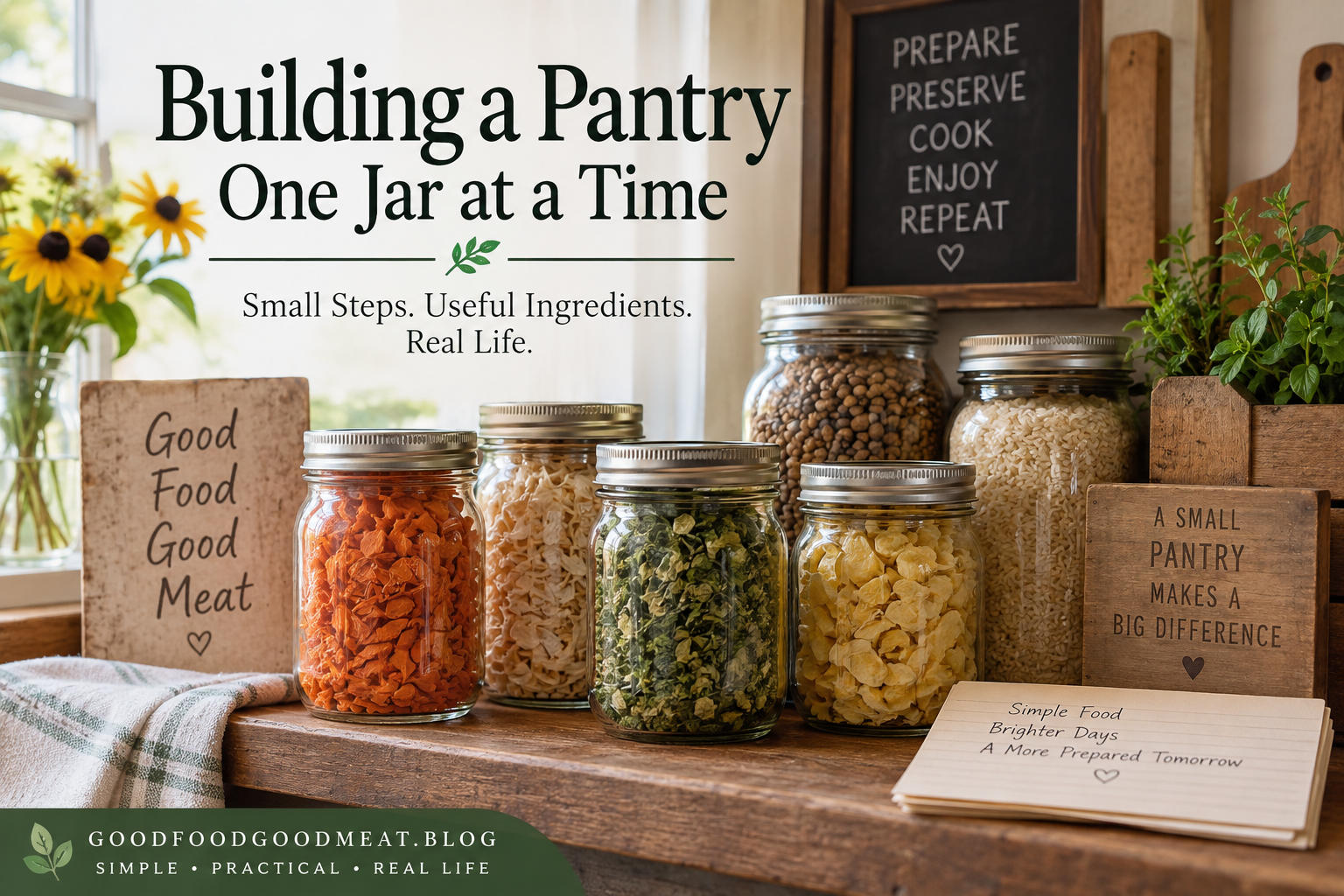
A jar of dehydrated carrots.
Some dried onions.
A little celery.
A few potatoes.
A bag of lentils.
A can of chicken.
None of those things takes up much room individually. But put them together and they can become a meal.
That’s where the idea of building a pantry one jar at a time really starts to make sense.
You aren’t trying to store everything.
You’re simply creating a little breathing room between buying the food and needing the food.
Put a Little Back
This is the idea behind this month’s Put a Little Back theme.
When produce is plentiful and reasonably priced, preserve some.
When you have a little extra time, prepare something for later.
When you find a shelf-stable ingredient that fits the way you cook, keep a little on hand.
It doesn’t have to be complicated.
It doesn’t even have to involve preserving food yourself.
Sometimes buying a shelf-stable ingredient is the practical choice.
That’s an important part of pantry building, too.
Think Ingredients, Not Just Food
One of the biggest shifts in the way I think about a pantry is to stop asking:
“What foods should I store?”
and start asking:
“What ingredients would make a future meal easier?”
That’s a very different question.
A jar of dehydrated carrots isn’t necessarily exciting by itself.
But those carrots could become part of:
- Vegetable soup
- Chicken and rice
- A stew
- A pot pie
- A casserole
- A skillet meal
Suddenly, that little jar has possibilities.
And that’s what I want from the food taking up my limited storage space: possibilities.
Small Jars Can Do a Lot
This week I’m experimenting with small-batch dehydrated vegetables and a little 1–2 quart slow cooker.
The first experiment was a simple lentil and vegetable soup.
The dry ingredients fit into a 1-pint Mason jar. Once broth and cooked chicken were added and everything had time to cook, that little collection of dried ingredients turned into four cups of soup—two generous servings.
That surprised me a little.
It also made me think about how useful small pantry projects can be.
The jar didn’t contain a complete meal in the traditional sense. It contained the ingredients that made the meal easy to put together later.
That’s the distinction I want to explore this week.
You Don’t Have to Preserve Everything
I also don’t think every ingredient needs to be dehydrated at home.
I’ve dehydrated meat before, and while it can certainly be done, I’ve found that it takes considerably more time than I want to spend for the way I cook.
For me, buying some cooked rotisserie chicken and using it for several meals makes more sense.
Commercially canned meats can serve a similar purpose.
Canned chicken, tuna, salmon, or other shelf-stable proteins can give you options without taking up valuable freezer space.
The same principle applies to dried beans and lentils. They’re already shelf-stable pantry ingredients. They don’t need to be dehydrated to earn their place on the shelf.
Preserving food isn’t about doing everything yourself. It’s about making good use of what you have.
Build Around the Way You Actually Cook
This might be the most important pantry rule of all:
Don’t build a pantry for the person you think you should be. Build one for the person you actually are.
If you make soup often, keep ingredients for soup.
If you eat a lot of rice bowls, keep ingredients that can become rice bowls.
If you cook for one or two, don’t fill your shelves with ingredients designed for feeding twelve people.
If freezer space is limited, look for shelf-stable ingredients that can take some of the pressure off the freezer.
And if you have limited storage space, small jars and small batches can be an advantage rather than a limitation.
You can put away a little at a time without having to find room for a mountain of food.
The Pantry Is There to Help You
A well-stocked pantry shouldn’t become another source of work.
It should make life easier.
Maybe it’s a night when you don’t feel like going to the grocery store.
Maybe the weather makes a trip inconvenient.
Maybe you’re trying to stretch the grocery budget until payday.
Maybe you simply have a little chicken left over and a jar of vegetables waiting on the shelf.
That’s when the pantry earns its keep.
A few ingredients that have already been put away can turn “What are we going to have for dinner?” into a much easier question.
One Jar at a Time
I don’t expect to build my pantry all at once.
I don’t need to.
A jar of dehydrated vegetables here.
A few dried beans there.
Some rice.
A can or two of chicken.
A little something preserved when it’s in season.
Over time, those small additions begin to add up.
And that’s really the heart of Put a Little Back:
You don’t have to put away a lot. You just have to put away something useful.
One jar at a time.
A Simple Way to Start
If you’re interested in building a small pantry of your own, start with something you already eat.
Choose one vegetable that’s inexpensive and plentiful.
Dehydrate a small batch.
Store it properly.
Label it.
Then, sometime later, actually cook with it.
That’s the part that matters.
Because the goal isn’t to have jars sitting on a shelf.
The goal is to have ingredients waiting to become dinner. 🍲
And that’s exactly what we’ll be exploring throughout this week.