
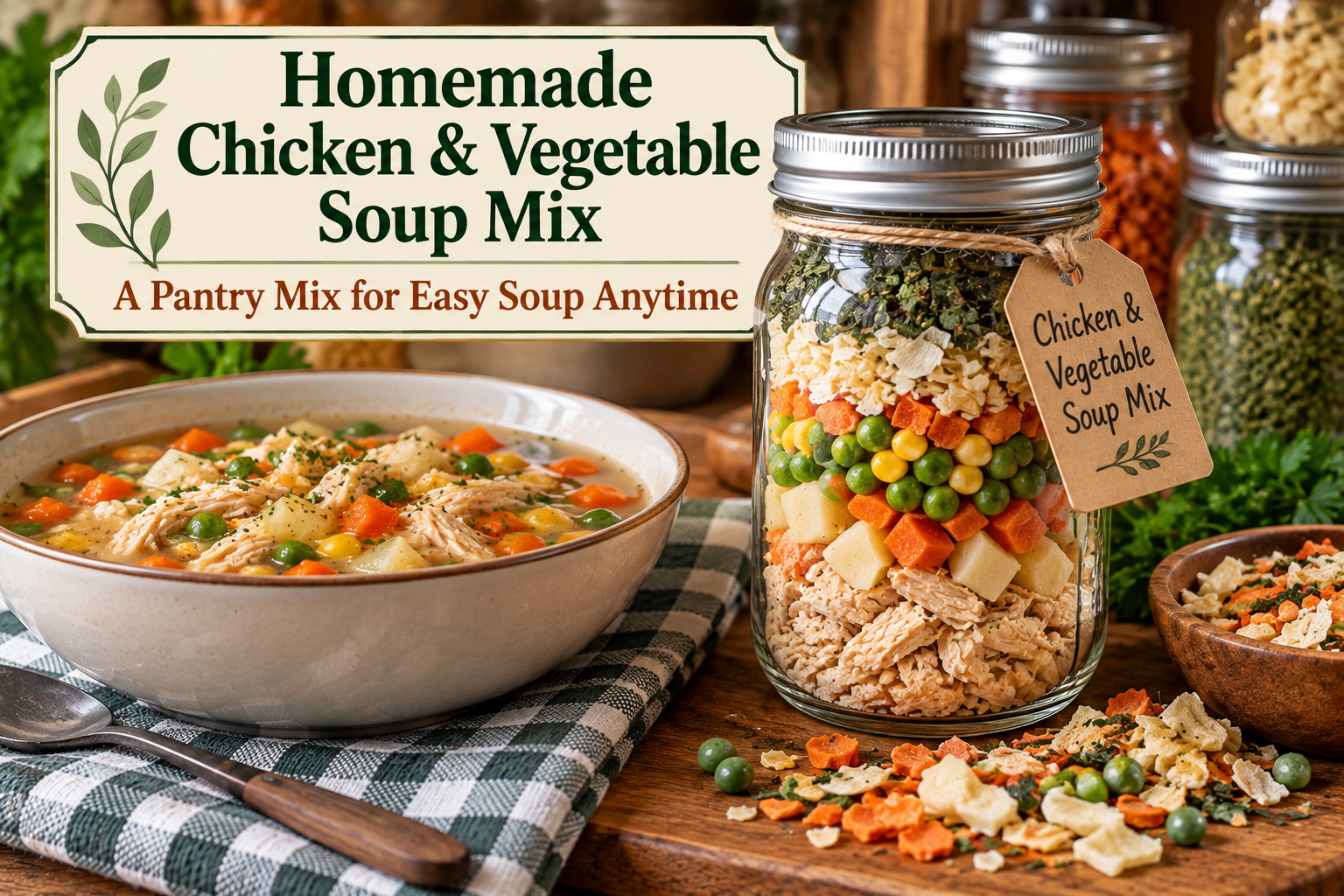
There is something wonderfully practical about having a jar on the pantry shelf that can become dinner.
This Homemade Chicken & Vegetable Soup Mix is built from dehydrated and shelf-stable ingredients, portioned specifically for a small household.
Instead of opening several cans of vegetables every time you want soup, you measure the dry ingredients into a jar ahead of time. When you’re ready for soup, add water or broth, simmer until the vegetables are tender, and add chicken.
It’s the kind of pantry convenience that makes sense to me: make it once, store it, and have a small meal ready when you need it.
Why You’ll Love This Soup Mix
- Makes a small batch suitable for one or two people
- Uses dehydrated and pantry ingredients
- Doesn’t require refrigerator or freezer space for the mix
- Lets you use your own dehydrated vegetables
- Can be prepared several jars at a time
- Makes a practical lunch or light dinner
- Easy to customize
- A good way to use small amounts of dehydrated vegetables
Recipe Information
Yield: 1 soup mix
Mix Container: 1 half-pint (8-ounce) Mason jar
Finished Servings: 2
Serving Size: About 1½ cups prepared soup
Prep Time: 10 minutes
Cook Time: 25–35 minutes
Total Time: About 40 minutes
Meal Category: Soups, Stews & Chili
Main Protein: Chicken
Estimated Calories: About 250–300 per serving, depending on the chicken and broth used


Homemade Chicken & Vegetable soup
Ingredients
Method
- You will need one clean, completely dry 8-ounce (half-pint) Mason jar with a tight-fitting lid.
- Place all of the dry ingredients into the jar.
- Layering the ingredients can make the jar look attractive, but mixing everything together is perfectly fine.
- Seal the container tightly.
- Chicken & Vegetable Soup Mix
- Makes 2 servings
- Add 3 cups water or broth
- Simmer 25–35 minutes
- Add fresh or canned chicken if desired
- Prepared: __________
- Store the finished mix in a cool, dry place according to the storage recommendations for your individual dehydrated ingredients.
- Important: Because the volume of dehydrated ingredients can vary depending on how finely they are cut and how thoroughly they are dried, don’t pack the ingredients tightly into the jar. If your particular batch does not comfortably fit an 8-ounce jar, use the next larger container rather than compressing the ingredients.
- Place the soup mix in a small saucepan.
- Add 3 cups of water or chicken broth.
- Stir well.
- Bring to a boil, then reduce the heat to a gentle simmer.
- Cover loosely and simmer for about 20–25 minutes.
- Stir occasionally.
- The exact cooking time will depend on how finely your vegetables were cut and how thoroughly they were dehydrated.
- The potatoes and carrots should be tender before moving on.
- If you used dehydrated chicken in the mix, continue simmering until the chicken is fully rehydrated and heated through.
- If you’re using canned chicken instead, drain and add it during the last 5–10 minutes of cooking.
- This is also an excellent place to use leftover cooked chicken.
- Taste the broth.
- Add more water or broth if the soup is thicker than you prefer.
- Adjust the seasoning if necessary.
- Serve hot.
Notes
Kitchen Confidence
This is a formula, not a recipe that has to be followed to the teaspoon. That’s one of the advantages of making your own soup mixes. You can change the vegetables based on what you’ve dehydrated. No peas? Use green beans. No celery? Leave it out. Have extra dehydrated onions? Use them. Have dehydrated potatoes but no carrots? That’s perfectly fine. The important thing is keeping the proportions reasonable and making sure all of your ingredients are properly dehydrated and completely dry before assembling the mix.Build Your Own Vegetable Combination
Think of this mix as a starting point.
You might make:
Chicken + Carrot + Pea + Potato
or
Chicken + Corn + Green Bean + Potato
or
Chicken + Mixed Vegetable + Onion
You could even make several different jars so that opening one doesn’t always mean eating exactly the same soup.
That’s the beauty of doing your own preservation.
You’re building a pantry around the foods you like.
Stretch Every Grocery Dollar
This mix is particularly useful for using vegetables that you’ve dehydrated yourself.
A small amount of several different vegetables might not look like much individually.
Together, they make soup.
That’s a great way to get more value from produce purchased when it’s inexpensive or plentiful.
And because you’re making a small jar at a time, you don’t need to commit a huge quantity of your dehydrated food to one recipe.
Waste Not, Want Not
Soup is one of the best ways to use small quantities.
A tablespoon or two of dehydrated vegetables that isn’t enough for another meal can become part of a soup mix.
The same goes for small amounts of dehydrated chicken.
Instead of having several nearly empty jars taking up space, combine compatible ingredients into a meal.
Just be sure that every ingredient going into the mix is completely dry and suitable for long-term storage.
Cooking for One or Two
This recipe intentionally makes only two servings.
For one person, that’s dinner tonight and lunch tomorrow.
Or make half the mix if you prefer truly single-serving portions.
You can also prepare several jars at once and keep them ready for busy days.
That’s where homemade convenience mixes really start to earn their keep.
Meal Prep Note
If you’re already dehydrating vegetables, consider assembling several soup mixes while everything is out.
Prepare the jars, label them, and store them together.
Then you’ve created your own small-batch convenience food without having to purchase a commercial soup mix.
For your own pantry, you could even keep a few different versions:
- Chicken & Vegetable
- Chicken & Potato
- Chicken & Rice
- Chicken & Noodle
That gives you variety without requiring a large collection of ingredients.
Storage & Food Safety
The finished soup mix should be stored only after you are certain that every dehydrated ingredient is properly dried and cooled.
Keep the mix in an airtight container in a cool, dry, dark location.
For specific dehydration temperatures, preparation methods, and storage recommendations, follow tested food-preservation guidance for the individual ingredients.
When working with dehydrated foods, it’s especially important not to improvise on food-safety steps simply because the ingredients are going into a soup mix.
One Jar, Two Bowls of Soup
This is exactly the kind of pantry convenience I want to explore during Pantry to Table.
Not a giant emergency-food bucket.
Not a shelf full of things nobody remembers buying.
Just a small jar containing ingredients you’ve already prepared and know you’ll eat.
Add broth.
Add heat.
Give it time to rehydrate.
And you’ve got soup.
That’s a pantry doing its job.
Discover more from Simple, Practical Meals for Real Life
Subscribe to get the latest posts sent to your email.
