Posted in Jar Mixes (Meal Starters)

Rustic Harvest Chicken & Rice

Dehydrated vegetables make this simple chicken-and-rice skillet a practical small-batch meal—proof that the food you put away today can become dinner later.

Introduction

There is something wonderfully satisfying about opening a little jar of dehydrated vegetables and knowing that it can help make dinner.

That’s exactly what we’re doing with this rustic chicken and rice.

This isn’t a complicated recipe, and it doesn’t require a long list of ingredients. A handful of dehydrated vegetables, some rice, broth, and cooked chicken come together in one skillet for a cozy meal that’s just right for one or two people.

It’s also a good example of why I like to think of dehydrated food as ingredients rather than finished food.

The vegetables have already been preserved. Now they’re ready to become dinner.

Why You’ll Love This Recipe

  • Small-batch friendly — Makes two generous servings.
  • Uses pantry ingredients — Great when refrigerator and freezer space are limited.
  • A practical way to use dehydrated vegetables — No special rehydration step is necessary.
  • Flexible — Use cooked chicken, leftover turkey, or another cooked protein.
  • One skillet — Less cleanup is always welcome.
  • Budget-friendly — A little cooked chicken goes a long way when combined with rice and vegetables.
simplegoodfood's avatarsimplegoodfood

Rustic Harvest Chicken & Rice

Put those dehydrated vegetables to work in a simple, satisfying meal.
Prep Time 10 minutes
Cook Time 30 minutes
Total Time 40 minutes
Servings: 2
Course: Dinner, Lunch
Cuisine: American
Calories: 450

Ingredients
  

  • ½ cup cooked shredded chicken
  • ½ cup long-grain white rice uncooked
  • ¼ cup dehydrated carrots
  • 2 tablespoons dehydrated celery
  • 2 tablespoons dehydrated onion
  • 2 tablespoons dehydrated spinach
  • 2 tablespoons dehydrated green beans
  • cups chicken broth
  • 1 tablespoon olive oil
  • ¼ teaspoon garlic powder
  • ¼ teaspoon dried parsley
  • ¼ teaspoon salt or to taste
  • Black pepper optional

Method
 

Start the vegetables
  1. Heat the olive oil in a medium skillet over medium heat.
  2. Add the dehydrated carrots, celery, onion, and green beans.
  3. Cook for about 2 minutes, stirring frequently.
  4. You aren’t trying to brown the vegetables. You’re simply giving them a little head start.
Add the rice and broth
  1. Stir in the uncooked rice, garlic powder, parsley, salt, and chicken broth.
  2. Bring the mixture to a gentle simmer.
Cover and cook
  1. Reduce the heat to low and cover the skillet.
  2. Cook for approximately 18–20 minutes, or until the rice is tender and most of the liquid has been absorbed.
  3. Avoid lifting the lid repeatedly while the rice cooks.
Add the chicken and spinach
  1. Once the rice is tender, stir in the shredded cooked chicken and dehydrated spinach.
  2. Cover again and cook for 3–5 minutes, just until the chicken is heated through and the spinach has rehydrated.
  3. If the mixture seems dry, add a splash of broth.
Rest and serve
  1. Remove the skillet from the heat and let it rest, covered, for about 5 minutes.
  2. Fluff gently with a fork and serve.

Notes

A Note About the Vegetables
The vegetables don’t need to be rehydrated separately. They’ll absorb some of the broth while the rice cooks.
That’s one of the things that makes dehydrated vegetables so handy for meals like this.
And if your vegetables are cut differently from mine, that’s perfectly fine. The important thing is to use pieces that make sense for the finished dish.
Kitchen Confidence
This is a very forgiving recipe.
If your dehydrated vegetables are particularly dry or chunky, they may need a little additional liquid. If the rice absorbs the broth before it’s completely tender, simply add 2–3 tablespoons of broth at a time and continue cooking.
And remember: dehydrated vegetables don’t always return to the exact color or appearance they had when fresh. That’s okay.
We’re preserving ingredients—not trying to recreate fresh vegetables.

Stretch Every Grocery Dollar

This recipe is a great way to stretch a small amount of cooked chicken.

You only need ½ cup of shredded chicken for two servings. The rice, vegetables, and broth provide the rest of the meal.

It’s also a useful way to turn leftover rotisserie chicken into something that feels completely different from the meal you originally bought it for.

Waste Not, Want Not

Don’t have exactly the vegetables listed?

Use what you have.

A little dehydrated corn, peas, zucchini, or another vegetable can work here.

That’s part of the beauty of building a pantry around ingredients rather than rigid recipes.

Use what you have. Put a little back. Waste a little less.

Cooking for One or Two

This recipe is written for two servings, but it’s easy to divide.

For one serving, use approximately:

  • ¼ cup chicken
  • ¼ cup rice
  • Half the dehydrated vegetables
  • ¾ cup broth

You can cook the single serving in a small skillet with a lid.

Or make the two-serving recipe and save the second portion for another meal.

Meal Prep Note

This recipe is especially useful when you have cooked chicken that needs to be used.

Shred the chicken and portion it into small containers or freezer bags. Then you’ll have cooked protein ready to combine with pantry ingredients when you need a quick meal.

Storage & Freezing

Refrigerate leftovers in a covered container and use within 3–4 days.

For longer storage, portion the cooled chicken and rice into individual freezer-safe containers.

Thaw in the refrigerator and reheat gently, adding a splash of broth or water if needed.


The Pantry Lesson

This little skillet demonstrates something I really like about dehydrating:

The dehydrated vegetables aren’t the meal. They’re what makes the meal easier.

A jar of vegetables sitting on the shelf doesn’t look like much.

But add rice, broth, and a little chicken, and suddenly that small jar has become dinner.

That’s what putting a little back is all about. 🫙🍗🍚

Posted in Preservation

Dehydrating for Real Life: Turning the Harvest into Useful Ingredients

Dehydrating can be a wonderful way to preserve food.

It can turn a basket of garden vegetables into a handful of lightweight ingredients that can sit in your pantry and wait for their turn in dinner.

But here’s the thing I’ve been thinking about lately:

We don’t have to dehydrate everything just because we can.

The goal isn’t to fill every jar.

The goal is to make the food we have work better.

For a small household, that means looking at dehydrating a little differently. Instead of asking, “What can I dehydrate?” I think the better question is:

“What can I preserve now that will make a useful ingredient later?”

And there’s one more question worth asking:

“Is doing it myself actually the thrifty choice?”

Because sometimes the answer is yes.

And sometimes it isn’t.

🥕 Dehydrating for Real Life

Dehydrating is particularly useful when you have more produce than you can reasonably use.

Maybe your garden produced more zucchini than two people could possibly eat.

Maybe onions were on sale and you bought more than you need right now.

Maybe the farmers market has a great price on vegetables at the end of the season.

Those are excellent opportunities to preserve some of that food for later.

The dehydrator lets you turn fresh ingredients into something that takes up much less space and can be used in future meals.

But I don’t want to turn that into a rule that says everything must be homemade.

That’s where real life comes in.

💰 Thrifty Check: Is Homemade Really Cheaper?

Here’s something worth checking before you automatically reach for the dehydrator.

Homemade doesn’t always mean inexpensive.

You can certainly buy onions, dice them yourself and dehydrate them a little at a time.

But if a large container of commercially dried onions costs less than $15, it’s worth asking whether dehydrating your own onions is actually saving you money.

You have to consider:

  • The cost of the fresh onions
  • How much finished dried onion you get
  • Electricity used by the dehydrator
  • Your time and effort
  • Storage space
  • How much of the finished product you’ll actually use

Sometimes homemade wins.

Sometimes commercially prepared wins.

And sometimes the best answer is a combination of the two.

That’s not cutting corners.

That’s being thrifty.

Your Time Counts, Too

We don’t always think about our time when we’re comparing prices.

But if you spend hours chopping, dehydrating, packaging and storing an ingredient that you could buy inexpensively already dried, you haven’t necessarily made the better bargain.

I’d rather use that dehydrator time for something where I get a real benefit.

Maybe that’s preserving produce from the garden.

Maybe it’s turning a great seasonal sale into future ingredients.

Maybe it’s drying something that is expensive or difficult to buy in small quantities.

Or maybe it’s simply making something that I enjoy having on hand.

The goal isn’t maximum preservation. It’s useful preservation.

🧅 Think About How You’ll Use It

Before you put something into the dehydrator, think about the meal you expect to make with it.

This is especially important with vegetables.

If you know you’re going to use onions in soups, stews and skillet meals, dice them before dehydrating.

If you’re making soup starters, prepare carrots, celery and potatoes in pieces that will work in the finished soup.

The same principle applies to almost everything:

Don’t dehydrate food just because you can. Dehydrate it in a form you’ll actually want to use later.

That little bit of planning can make your future pantry much more useful.

🫙 Small Batches Make Sense

One of my favorite things about dehydrating is that you don’t necessarily have to process a huge quantity.

You can do a small batch.

You can use a few vegetables.

You can fill one jar.

Then you can decide whether you actually like having that ingredient available.

That’s particularly helpful when you’re cooking for one or two.

You don’t need twenty jars of dehydrated zucchini if you only use zucchini occasionally.

You might need one.

Or two.

That’s enough.

🏡 Storage Space Is Part of the Equation

Here’s another thing I’ve been thinking about:

Storage space has value, too.

If you have very limited cabinet space, buying several large containers of dried ingredients may not make sense.

But if you have a safe place to store a larger container, the calculation changes.

For example, commercially dried onions may be inexpensive when purchased in a larger container.

If you have somewhere appropriate to store that container, you could bring it into the kitchen when you’re making meal starters, fill several smaller jars, and then put the larger container back into storage.

That can be much more practical than using your dehydrator to make something that is already inexpensive to buy.

The important word here is appropriate.

Commercially shelf-stable foods should be stored in a cool, dry place and protected from high or low temperature extremes. USDA specifically cautions against storing shelf-stable foods in places exposed to extreme temperatures or damp conditions.

So a storage area under a camper might work as seasonal storage if it stays dry and doesn’t experience extreme temperatures. It isn’t automatically a good year-round pantry simply because it is out of sight.

And I wouldn’t deliberately let commercially dried foods freeze.

The same basic principle applies to your home-dehydrated foods. The National Center for Home Food Preservation recommends storing dried foods in cool, dry, dark conditions and protecting them from moisture, since dried foods can reabsorb moisture during storage.

🌱 What Is Worth Dehydrating?

For me, the best candidates fall into a few categories.

Things You Have Too Much Of

This is probably the easiest decision.

If you have more produce than you can eat, preserving some of it keeps that food from going to waste.

Things That Are Expensive to Buy Dried

If the commercially dried version is expensive, homemade may make more financial sense.

Things You Use Frequently

A dried ingredient that goes into soups, stews, casseroles and skillet meals is going to earn its place on the shelf much faster than something you use once every two years.

Things That Save You Space

Dehydrating can be especially useful when fresh vegetables would otherwise take up a lot of refrigerator or freezer space.

Things That Help You Make a Meal

This is my favorite category.

If a handful of dehydrated vegetables can become part of a soup starter, skillet meal or rice dish, that’s more useful to me than a jar that simply looks pretty on the shelf.

🍗 You Don’t Have to Dehydrate the Protein

This is another place where I think practical preservation beats perfection.

I’ve found that dehydrating meat at home simply isn’t worth the time for me.

I’d much rather use a rotisserie chicken, canned chicken, tuna, salmon or another convenient protein when it makes sense.

That doesn’t make the meal less homemade.

It makes it realistic.

You can preserve the vegetables while using a commercially prepared protein.

The important thing is that the combination helps you make a meal.

🥣 Think Ingredients, Not Just Preservation

This is where dehydrating becomes really interesting.

A jar of dehydrated carrots isn’t just a jar of carrots.

It’s an ingredient waiting for soup.

Dried celery can become part of a casserole.

Dehydrated onions can go into a skillet meal.

Potatoes can become part of a soup or stew.

Spinach may practically disappear into a dish—but it can still contribute to the meal.

And when several of those ingredients are combined?

You have the beginnings of a meal starter.

That’s exactly what we’re doing with this week’s Harvest Vegetable Soup Starter.

The goal isn’t simply to have preserved vegetables.

The goal is to have future dinner.

🧮 Before You Preserve It, Price It

This may become one of my favorite rules for building a practical pantry:

Before you preserve it, price it.
Before you buy it, price it.
Before you make it, ask whether you’ll actually use it.

That’s a much better measure of thrift than simply counting how many things you made yourself.

A thrifty kitchen isn’t necessarily the kitchen where everything is homemade.

It’s the kitchen where the cook pays attention.

You compare prices.

You watch waste.

You use what you have.

You consider storage space.

And you recognize that your time has value, too.

♻️ Waste Not, Want Not

Of course, there are still plenty of times when dehydrating can be the perfect answer.

If you have vegetables that would otherwise be wasted, preserving them gives them another chance to become dinner.

That’s the old Waste Not, Want Not philosophy at work.

And I think that’s a much more useful way to look at preservation.

We’re not trying to preserve everything.

We’re trying to preserve what makes sense.

🍳 Cooking for One or Two

Small households have a particular advantage when it comes to dehydrating.

You don’t have to process a bushel of anything.

You can make a small batch and store it in a small jar.

You can combine several ingredients into a meal starter instead of keeping large quantities of every individual vegetable.

And you can decide what deserves your precious storage space.

That’s important when your pantry, refrigerator and freezer aren’t designed for a large family.

Small pantry. Small batches. Useful meals.

That’s the goal.

🌻 Put a Little Back

That’s really what this September series is about.

Put a little back.

But not blindly.

Put back the things that make sense for your kitchen.

Preserve what you have in abundance.

Buy commercially when that is the better bargain.

Dehydrate when it saves money, space, waste or effort.

Freeze when freezing makes more sense.

And don’t be afraid to take a shortcut when the shortcut is actually the thrifty choice.

Because being thrifty isn’t about doing everything the hard way.

It’s about getting the most value from the food, money, space and time you have.

And that’s a pantry I want to build.

One useful ingredient at a time.


Kitchen Confidence

You don’t have to become an expert dehydrator to make dehydrating useful.

Start with one ingredient you already know you’ll use.

Prepare it in a recipe-ready form.

Dry it properly.

Store it well.

Then use it.

If it makes your cooking easier, you’ve learned something valuable.

If you discover that buying the ingredient commercially is cheaper and more convenient?

You’ve learned something valuable there, too.

That’s the whole point.

Stretch Every Grocery Dollar

Preservation is one tool in the thrift toolbox—not the whole toolbox.

Compare prices.

Watch unit costs.

Use seasonal sales.

Take advantage of what you grow.

Buy convenience when convenience is reasonably priced.

And remember that the cheapest ingredient isn’t necessarily the one with the lowest price tag.

The best value is the ingredient that gives you the most useful meals for the money, space and effort you put into it.

Waste Not, Want Not

Before you throw away extra produce, ask whether you can use it another way.

Can you freeze it?

Can you dehydrate it?

Can you turn it into a meal?

Can you use it tomorrow?

And if none of those make sense, don’t feel guilty for letting it go.

Thrift isn’t about saving every single thing.

It’s about using what you can use well.

Posted in Preservation

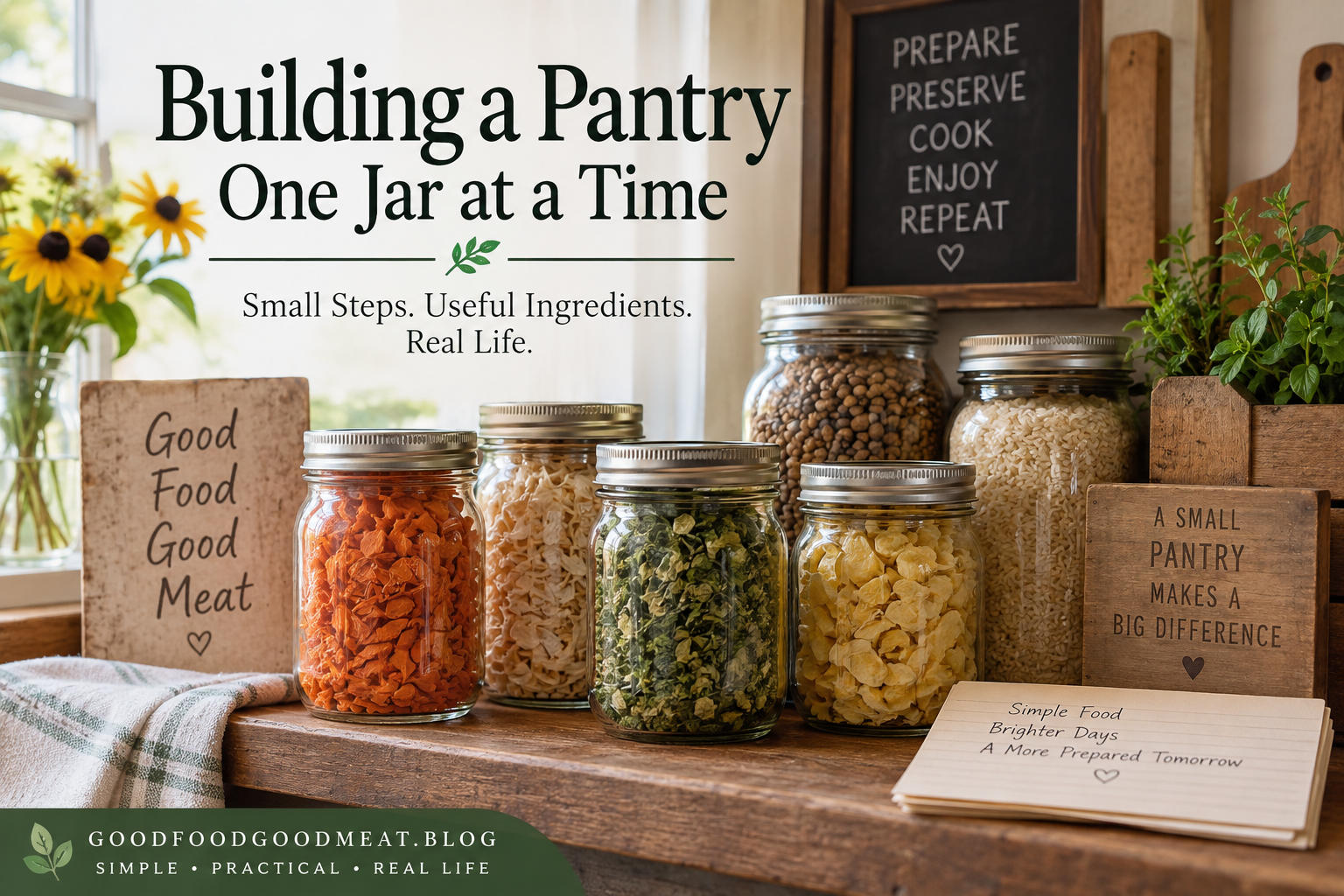
Building a Pantry One Jar at a Time

You don’t need a pantry full of food to have a well-stocked pantry. Sometimes, a few small jars of useful ingredients can make all the difference.

There is something satisfying about putting a little food away for later.

Not a year’s supply. Not a basement full of buckets. Not a pantry that looks like you’re preparing for the end of the world.

Just a little something put back while it’s inexpensive and available, so that when you need it later, part of dinner is already waiting for you.

That is the kind of pantry I’m interested in building.

Especially when you don’t have a lot of refrigerator, freezer, or storage space, every little bit counts.

A Pantry Doesn’t Have to Be Big

I’ve come to think of a practical pantry less as a collection of things I might need someday and more as a collection of ingredients I know I’ll actually use.

A jar of dehydrated carrots.

Some dried onions.

A little celery.

A few potatoes.

A bag of lentils.

A can of chicken.

None of those things takes up much room individually. But put them together and they can become a meal.

That’s where the idea of building a pantry one jar at a time really starts to make sense.

You aren’t trying to store everything.

You’re simply creating a little breathing room between buying the food and needing the food.

Put a Little Back

This is the idea behind this month’s Put a Little Back theme.

When produce is plentiful and reasonably priced, preserve some.

When you have a little extra time, prepare something for later.

When you find a shelf-stable ingredient that fits the way you cook, keep a little on hand.

It doesn’t have to be complicated.

It doesn’t even have to involve preserving food yourself.

Sometimes buying a shelf-stable ingredient is the practical choice.

That’s an important part of pantry building, too.

Think Ingredients, Not Just Food

One of the biggest shifts in the way I think about a pantry is to stop asking:

“What foods should I store?”

and start asking:

“What ingredients would make a future meal easier?”

That’s a very different question.

A jar of dehydrated carrots isn’t necessarily exciting by itself.

But those carrots could become part of:

  • Vegetable soup
  • Chicken and rice
  • A stew
  • A pot pie
  • A casserole
  • A skillet meal

Suddenly, that little jar has possibilities.

And that’s what I want from the food taking up my limited storage space: possibilities.

Small Jars Can Do a Lot

This week I’m experimenting with small-batch dehydrated vegetables and a little 1–2 quart slow cooker.

The first experiment was a simple lentil and vegetable soup.

The dry ingredients fit into a 1-pint Mason jar. Once broth and cooked chicken were added and everything had time to cook, that little collection of dried ingredients turned into four cups of soup—two generous servings.

That surprised me a little.

It also made me think about how useful small pantry projects can be.

The jar didn’t contain a complete meal in the traditional sense. It contained the ingredients that made the meal easy to put together later.

That’s the distinction I want to explore this week.

You Don’t Have to Preserve Everything

I also don’t think every ingredient needs to be dehydrated at home.

I’ve dehydrated meat before, and while it can certainly be done, I’ve found that it takes considerably more time than I want to spend for the way I cook.

For me, buying some cooked rotisserie chicken and using it for several meals makes more sense.

Commercially canned meats can serve a similar purpose.

Canned chicken, tuna, salmon, or other shelf-stable proteins can give you options without taking up valuable freezer space.

The same principle applies to dried beans and lentils. They’re already shelf-stable pantry ingredients. They don’t need to be dehydrated to earn their place on the shelf.

Preserving food isn’t about doing everything yourself. It’s about making good use of what you have.

Build Around the Way You Actually Cook

This might be the most important pantry rule of all:

Don’t build a pantry for the person you think you should be. Build one for the person you actually are.

If you make soup often, keep ingredients for soup.

If you eat a lot of rice bowls, keep ingredients that can become rice bowls.

If you cook for one or two, don’t fill your shelves with ingredients designed for feeding twelve people.

If freezer space is limited, look for shelf-stable ingredients that can take some of the pressure off the freezer.

And if you have limited storage space, small jars and small batches can be an advantage rather than a limitation.

You can put away a little at a time without having to find room for a mountain of food.

The Pantry Is There to Help You

A well-stocked pantry shouldn’t become another source of work.

It should make life easier.

Maybe it’s a night when you don’t feel like going to the grocery store.

Maybe the weather makes a trip inconvenient.

Maybe you’re trying to stretch the grocery budget until payday.

Maybe you simply have a little chicken left over and a jar of vegetables waiting on the shelf.

That’s when the pantry earns its keep.

A few ingredients that have already been put away can turn “What are we going to have for dinner?” into a much easier question.

One Jar at a Time

I don’t expect to build my pantry all at once.

I don’t need to.

A jar of dehydrated vegetables here.

A few dried beans there.

Some rice.

A can or two of chicken.

A little something preserved when it’s in season.

Over time, those small additions begin to add up.

And that’s really the heart of Put a Little Back:

You don’t have to put away a lot. You just have to put away something useful.

One jar at a time.


A Simple Way to Start

If you’re interested in building a small pantry of your own, start with something you already eat.

Choose one vegetable that’s inexpensive and plentiful.

Dehydrate a small batch.

Store it properly.

Label it.

Then, sometime later, actually cook with it.

That’s the part that matters.

Because the goal isn’t to have jars sitting on a shelf.

The goal is to have ingredients waiting to become dinner. 🍲

And that’s exactly what we’ll be exploring throughout this week.