
Some of my earliest memories of family life revolve around the kitchen and the meals my mom prepared. There were six of us in the family, and both of my parents worked while the four children went to school. Getting dinner on the table meant planning ahead, making good use of what we had, and sometimes adjusting when the day didn’t go quite as expected.
One thing I remember is that Mom didn’t necessarily change the meal just because company was coming. If someone stopped by, she found a way to add to what was already cooking.
Looking back, I realize that was a practical kind of hospitality. There wasn’t a separate menu for guests or a requirement that everything be just so. There was simply a meal, a few extra things to put on the table, and room for the people who came to visit.
That was how we did things.
Weekends Were for Family and Visitors
Weekends were often when relatives and friends came to visit. That made sense because weekends were also when we were more likely to have a little extra time for a nicer meal.
Friday was often leftover night. Whatever remained from earlier in the week might find its way back to the table. It was a sensible way to use the food we had, and it meant we could start the weekend without worrying about preparing an entirely new dinner.
Saturday might bring out the Dutch oven. Mom would make a big pot of something that could feed everyone, with enough left over to make another meal possible.
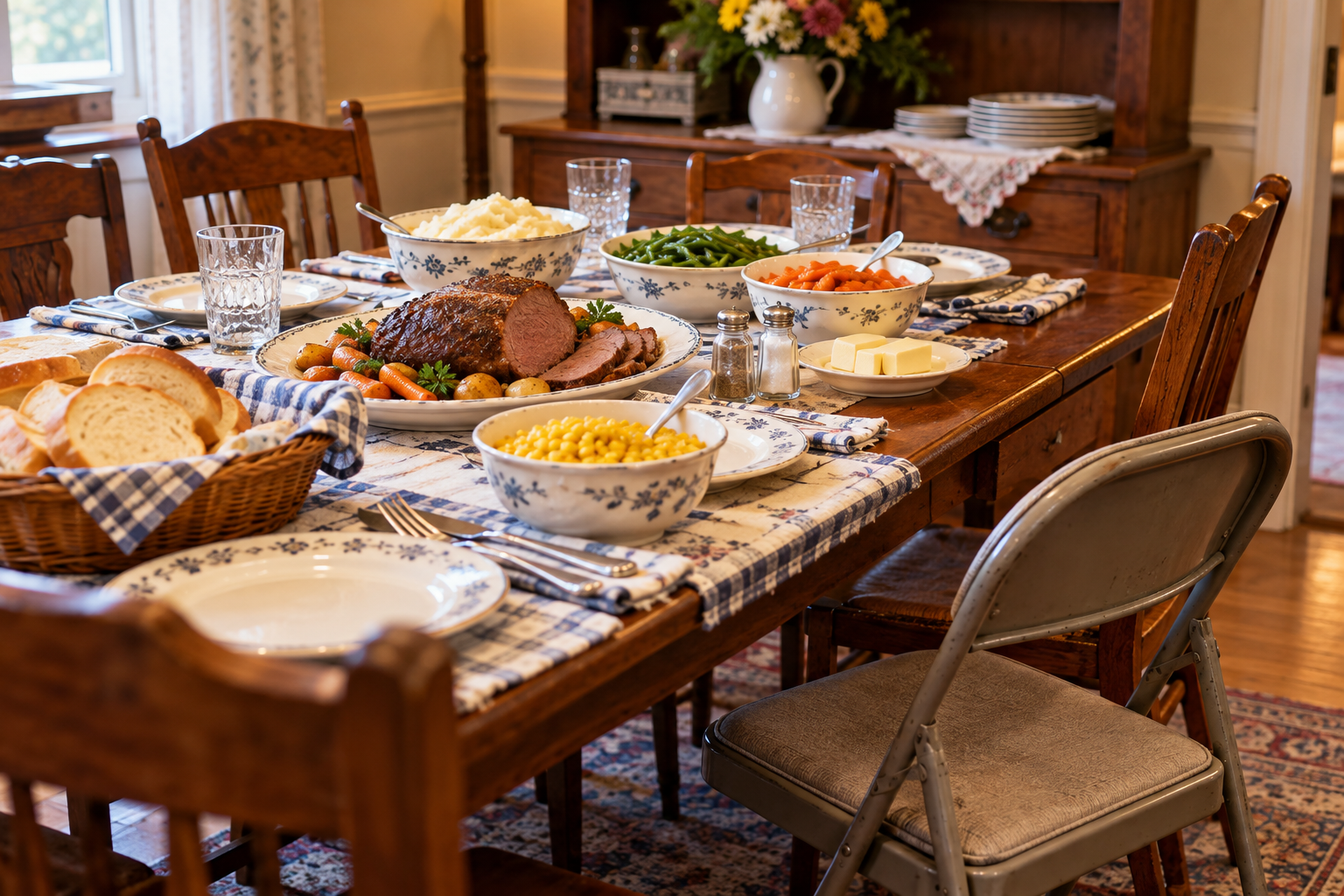
Sunday dinner was often a beef or pork roast. Occasionally, we’d have roasted chicken that Mom started cooking at a low oven temperature before we went to church. By the time we came home, the house smelled wonderful, and dinner was well underway.
Those meals weren’t necessarily elaborate, but they were familiar and satisfying. They were the kinds of dinners that brought everyone to the table.
And if company arrived, the food didn’t have to change completely.
Making What We Had Go a Little Further
Sometimes feeding extra people meant adding another vegetable. Other times, Mom might put out pickles, slice some bread, and set out butter. If we needed a little more to go around, another serving of a familiar starch could help stretch the meal.
These weren’t complicated solutions. They were ordinary things we already had in the kitchen.
When one of my uncles came to visit with his large family from New Jersey, Mom might make a big pot of spaghetti. She’d serve it with salad and bread, and there would be a meal everyone could enjoy.
Spaghetti was a good choice for a crowd. It was economical, filling, and easy to prepare in a quantity that could feed several hungry people. There was no need to fuss over individual servings or prepare a different dish for every person.
Mom knew how to work with what she had. If more people were coming to dinner, she found a way to make the meal accommodate them.
That’s a useful skill, whether you’re feeding six people every day or cooking for two and occasionally finding yourself with an unexpected guest.
There Was Always Room at the Table
Of course, feeding extra people wasn’t just a matter of putting more food on the table. We needed somewhere for everyone to sit, too.
When company arrived, folding chairs came up from the basement. The children used those chairs so the visiting adults could have the nicer dining chairs.
It was a simple arrangement, and nobody seemed to think much about it. We made room, pulled up another chair, and carried on.
Looking back, I smile at that memory. We didn’t have to own a dining room full of matching chairs to welcome a crowd. We just needed enough places for everyone to sit.
I suspect plenty of families have similar memories. Maybe your family had a folding table that appeared when relatives came over. Perhaps someone always had to bring another chair in from the porch, or the children ate at a smaller table while the adults gathered around the big one.
Those little arrangements were simply part of family life.
Dessert Didn’t Have to Be Fancy, Either
Dessert was another place where Mom kept things practical.
Sometimes there was Jell-O, perhaps with fruit. Canned fruit could be dessert, too. And a simple cake was always a welcome sight.
We didn’t need an elaborate dessert after every meal. Something familiar and inexpensive was perfectly suitable, especially when there were several mouths to feed.
That approach makes sense to me even now. A dessert doesn’t have to be complicated to finish a meal nicely. Sometimes the simplest things are the ones people remember.
And when a cake or another dessert lasted into the next day, that was all the better. One preparation could provide a little something sweet for more than one meal.
What I Carried With Me
I don’t remember Mom sitting us down to explain the rules of hospitality. She didn’t need to.
I remember the meals, the extra vegetables, the bread and butter, and the folding chairs coming up from the basement. I remember how a big pot of spaghetti could feed a visiting family and how the usual Sunday roast didn’t have to be replaced just because someone was joining us.
Mom had a household to run, children to feed, and a working life of her own. She made practical decisions because that was what the day required.
Yet those ordinary decisions made room for other people.
That’s what stands out to me now. Hospitality didn’t require a special occasion, a perfect house, or a meal that took all day to prepare. It could happen on an ordinary weekend, with the food already planned and a few adjustments made along the way.
The point wasn’t to impress anyone. It was to welcome them.
A Table With Room for One More
These days, many of us cook for smaller households. We may have a favorite supper planned for two, or we may be making just enough for ourselves. That doesn’t mean we can’t still make room for someone else now and then.
An extra vegetable, a basket of bread, a few pickles, or a simple dessert can help turn an ordinary meal into one we can share.
And if we don’t have enough dining chairs, well, perhaps it’s time to bring up the folding chairs!
As I think about the November theme, A Table With Room for One More, I keep coming back to those memories of Mom. She wasn’t trying to teach us a lesson. She was simply doing what needed to be done, using what she had, and making sure there was food for the people around her table.
That is a kind of hospitality worth carrying forward.
You don’t have to make everything from scratch, prepare a feast, or spend money you don’t have. Start with the meal you’re already making. Add what you can. Pull up another chair.
There’s always something to be said for a table where people know they’re welcome.
And sometimes, the best meals aren’t the ones we plan for company. They’re the ones we learn how to share.
Discover more from Simple, Practical Meals for Real Life
Subscribe to get the latest posts sent to your email.
