Posted in Kitchen Tips

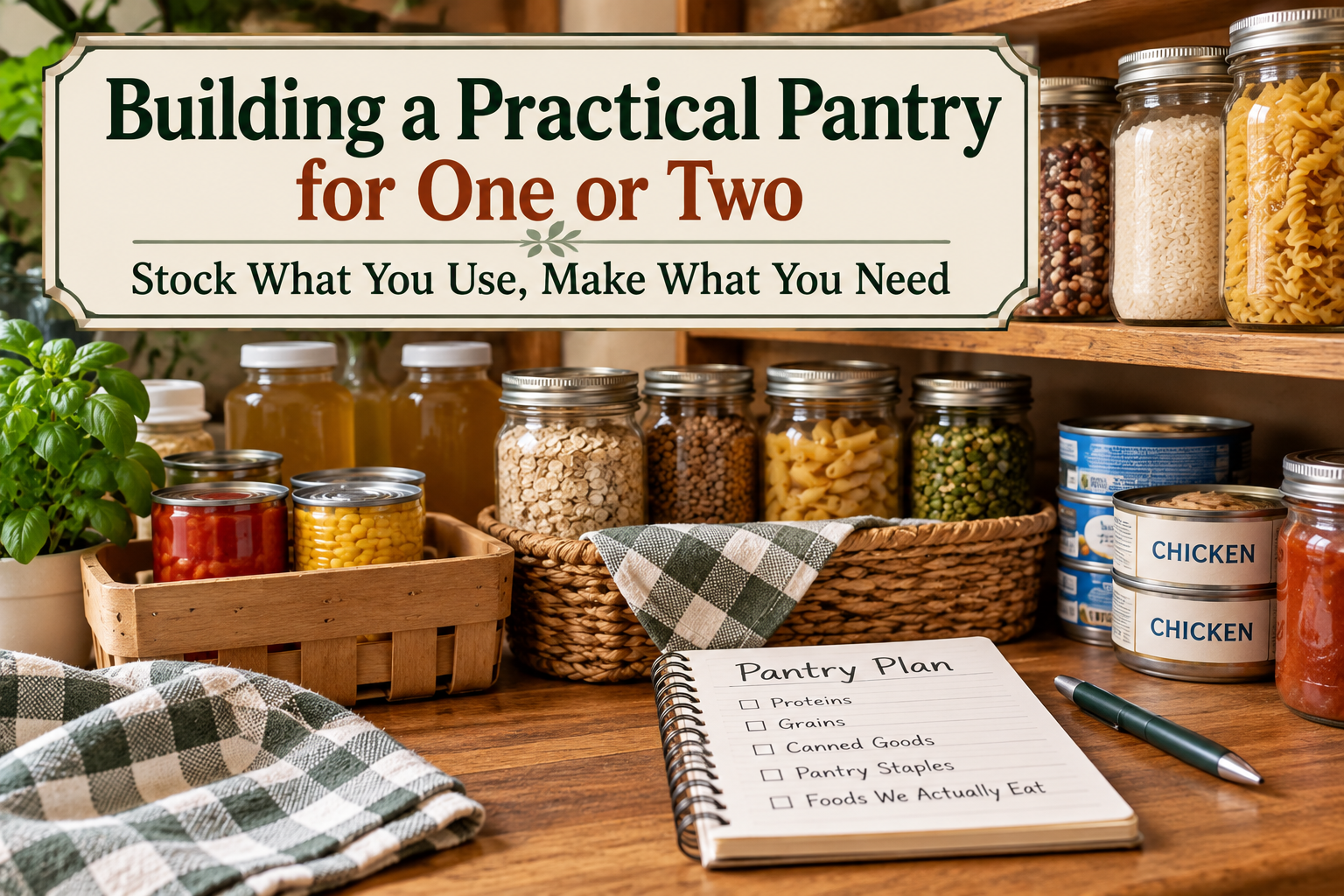
Building a Practical Pantry for One or Two: Stock What You Use, Make What You Need

A lot of pantry advice seems to have been written for somebody with a family of four, a giant kitchen, and enough cupboard space to store every variety of bean ever produced.

That’s not necessarily practical when you’re cooking for one or two.

A useful small-household pantry doesn’t have to be enormous. It needs to contain foods you genuinely use, in amounts that make sense for your cooking habits.

That’s the thinking behind Pantry to Table.

The goal isn’t to fill shelves simply because they’re there. It’s to create a pantry that helps make everyday meals easier, keeps the grocery budget under control, and gives you something useful to work with when another trip to the store isn’t appealing.

Sometimes that means making a few convenience foods yourself.

Begin With the Meals You Already Make

Before buying a collection of “pantry essentials,” look at the meals that already appear on your table.

If soup is a regular part of your menu, you may want broth, canned tomatoes, vegetables, beans, rice or pasta, and a protein you enjoy.

For skillet meals, rice, pasta, canned vegetables, chicken, tomato sauce, broth, and familiar seasonings may be more useful.

For simple breakfasts, oats, pancake ingredients, shelf-stable milk or dry milk, peanut butter, and fruit may be enough.

You don’t need every possible pantry staple.

You need the ingredients that help you cook the food you actually want to eat.

Give Every Pantry Ingredient More Than One Job

Here’s a useful test before bringing a new ingredient home: can you think of at least three meals you could make with it?

Canned chicken is a good example. It can become chicken and rice, soup, chicken salad, a casserole, a wrap, or a skillet meal.

Rice has the same kind of versatility. It can be served as a side, turned into a bowl, combined with chicken, used for fried rice, added to soup, or incorporated into a casserole.

On the other hand, an ingredient that requires several additional purchases just to make the one recipe you bought it for may not be a pantry staple at all. It may simply be a recipe-specific ingredient.

There’s nothing wrong with that. The important thing is knowing which is which.

Homemade Convenience Isn’t Automatically a Bargain

Making something yourself sounds economical, but it isn’t always.

The University of Maine Cooperative Extension’s Saving Money With Homemade Convenience Mixes takes a refreshingly practical approach to the question. It explains that homemade mixes can make sense when you already have the ingredients and will use them, while commercially prepared convenience foods can sometimes be the better choice when making them yourself requires considerable time, extra storage, or ingredients you rarely use.

That’s an important distinction for Pantry to Table.

The objective isn’t to make everything from scratch simply because we can.

The objective is to make choices that work for our own kitchens.

Small-Batch Homemade Mixes Make Particular Sense

There is one area where I think small households can really benefit from homemade convenience foods: mixes.

Pancake mix. Biscuit mix. Cornbread. Muffins. Quick breads. Seasonings. Soup mixes.

The University of Maine Cooperative Extension’s Saving Money With Homemade Convenience Mixes publication contains 15 master mixes and recipes showing how those mixes can be used for pancakes, biscuits, muffins, breads, casseroles, dressings, seasonings, and more.

It’s particularly useful because it doesn’t simply hand you recipes. It also addresses the practical question of whether making a mix yourself is actually worthwhile.

For a household of one or two, that question matters.

Portion the Mix for the Way You Cook

There’s no reason to make a five-pound container of pancake mix if you make pancakes once or twice a month.

Instead, consider preparing several smaller batches.

The University of Alaska Fairbanks Cooperative Extension’s Make Your Own Mix guide specifically discusses storing homemade mixes in amounts suited to your usual needs and labeling them with the information needed for preparation.

That’s an especially good fit for a small household.

Rather than measuring several dry ingredients every time you want pancakes, you can prepare individual batches ahead of time and simply add the wet ingredients when you’re ready to cook.

Those Little Mason Jars Can Earn Their Keep

Small jars are ideal for this kind of project.

A jar can contain one batch of dry mix, with a label giving you the information you’ll need later:

Pancake Mix
Makes 2 servings
Add 1 egg + milk/water
Cook on griddle
Made: October 2026

The jar becomes both storage container and recipe reminder.

There’s no need to measure flour, baking powder, sugar, and salt each time.

Just open the jar, add the required wet ingredients, and cook.

But Don’t Assume Every Mix Is Shelf-Stable

This is important.

Some homemade mixes contain fats such as oil, butter, margarine, or shortening, so they may require refrigeration or freezing.

The University of Maine Cooperative Extension’s All-Purpose Convenience Mix contains oil and calls for refrigeration. Oregon State University Extension’s Master Mix also contains oil and recommends refrigeration and using the mix within one month.

So “homemade mix” does not automatically mean “store it in the pantry.”

Use the storage instructions provided for the particular recipe.

That’s another reason dry, single-use mixes can be attractive for a small pantry.

Convenience Mixes Can Be Seasonings, Too

Homemade mixes don’t have to involve baking.

You can prepare small jars of taco seasoning, chili seasoning, Italian-style seasoning, salt-free seasoning, or other blends you regularly use.

The University of Maine Cooperative Extension’s Homemade Convenience Mixes recipes include several seasoning recipes, including taco, chili, salt-free, and other blends.

For a small household, a little jar of a seasoning you use regularly can be more practical than buying a large specialty container that may sit around for months.

And making your own gives you control over the ingredients and flavor.

Keep Good Extension Resources Close

Another goal for Pantry to Table is to point readers toward reliable information rather than presenting every idea as though it originated here.

Several Cooperative Extension programs have excellent material on homemade mixes.

The University of Maine Cooperative Extension’s Saving Money With Homemade Convenience Mixes is probably the best comprehensive starting point. It contains 15 master mixes along with recipes that use them for pancakes, biscuits, muffins, breads, casseroles, seasonings, dressings, and more.

The University of Alaska Fairbanks Cooperative Extension’s Make Your Own Mix covers master mixes, baking mixes, seasoning mixes, beverage mixes, and other homemade convenience ideas. Its emphasis on making quantities appropriate for your normal needs is especially relevant for one- and two-person households.

The Oregon State University Extension’s Master Mix provides a master mix for biscuits, pancakes, and other recipes. It’s also a useful reminder that storage requirements vary from recipe to recipe.

And UC Agriculture and Natural Resources’ Do-It-Yourself Mixes offers jar mixes and other homemade convenience ideas for turning pantry ingredients into ready-to-use combinations.

These are resources worth keeping bookmarked, especially if we’re going to experiment with homemade mixes ourselves.

Dehydrating Gives a Small Pantry Another Option

Homemade pantry building doesn’t stop with flour, oats, and seasoning.

Dehydrated vegetables can be especially useful when you’re cooking for one or two because you can store relatively small amounts and use only what a particular meal requires.

The University of Minnesota Extension’s information on drying food explains that dried foods are convenient, lightweight, easy to prepare, and can save storage space compared with canned or frozen foods.

That’s one of the reasons I like dehydrating for a small household.

You don’t necessarily have to open an entire can when you need a couple of tablespoons.

You can use exactly what the recipe calls for.

Remember That “Shelf-Stable” Doesn’t Mean “Keep Forever”

A pantry isn’t a place where food disappears until somebody eventually rediscovers it.

Rotate what you have.

Use older items first.

Keep dates where you can see them.

And label homemade mixes.

The University of Alaska Fairbanks guidance specifically recommends labeling homemade mixes with information about what they contain, how much to use, and the directions needed to prepare them.

A piece of masking tape and a marker can prevent that inevitable moment months later when you stare at an unidentified jar and wonder:

“What on earth did I put in this?”

Ask me how I know. 😉

Your Pantry Should Look Like Your Kitchen

There isn’t one perfect pantry.

If you don’t eat beans, you don’t need six varieties of beans.

If canned salmon isn’t something you enjoy, it doesn’t become useful merely because somebody calls it a pantry essential.

If canned chicken is something you use regularly, keep it.

If you make pancakes once a month, a small homemade pancake mix may be worthwhile.

If you rarely bake, there is no reason to devote precious shelf space to baking mixes.

Your pantry should support your cooking—not dictate it.

That’s the real distinction between simply accumulating pantry food and building a pantry that serves you.

Start With a Few Categories

If you’re beginning—or rebuilding—a pantry, don’t feel as though you need to do it all at once.

Begin by considering five basic areas.

Protein: chicken, tuna, salmon, beans, peanut butter, or the proteins you actually use.

Vegetables: the canned, frozen, or dehydrated vegetables that regularly appear in your meals.

Grains and starches: rice, pasta, oats, potatoes, barley, or whichever staples you actually cook.

Flavor builders: broth, tomatoes, sauces, oils, vinegars, herbs, and seasonings.

Convenience helpers: homemade mixes, shelf-stable ingredients, or prepared foods that genuinely make cooking easier.

Then pay attention to what you use.

Over time, your own shopping habits will reveal what belongs in your pantry.

The Point Isn’t to Prepare for 100 Meals

A practical pantry isn’t about preparing for some imaginary future in which you’ll suddenly need to cook for a hundred people.

It’s about making an ordinary Tuesday night easier.

It’s looking at the shelves and realizing:

“I’ve got chicken. I’ve got rice. I’ve got vegetables. I’ve got broth. I can make dinner.”

That’s exactly what Sunday’s Chicken Meal Starter demonstrated.

And that’s where Pantry to Table is headed throughout October: simple ingredients, small batches, useful shortcuts, less waste, and food that actually gets eaten.

Because the best pantry isn’t necessarily the one with the most food.

It’s the one that helps you make dinner.


Pantry Resources Worth Saving

These are the resources I’ll be returning to throughout the series:

I’ll be referring back to these resources as we continue Pantry to Table.

Posted in Preservation

Dehydrating for Real Life: Turning the Harvest into Useful Ingredients

Dehydrating can be a wonderful way to preserve food.

It can turn a basket of garden vegetables into a handful of lightweight ingredients that can sit in your pantry and wait for their turn in dinner.

But here’s the thing I’ve been thinking about lately:

We don’t have to dehydrate everything just because we can.

The goal isn’t to fill every jar.

The goal is to make the food we have work better.

For a small household, that means looking at dehydrating a little differently. Instead of asking, “What can I dehydrate?” I think the better question is:

“What can I preserve now that will make a useful ingredient later?”

And there’s one more question worth asking:

“Is doing it myself actually the thrifty choice?”

Because sometimes the answer is yes.

And sometimes it isn’t.

🥕 Dehydrating for Real Life

Dehydrating is particularly useful when you have more produce than you can reasonably use.

Maybe your garden produced more zucchini than two people could possibly eat.

Maybe onions were on sale and you bought more than you need right now.

Maybe the farmers market has a great price on vegetables at the end of the season.

Those are excellent opportunities to preserve some of that food for later.

The dehydrator lets you turn fresh ingredients into something that takes up much less space and can be used in future meals.

But I don’t want to turn that into a rule that says everything must be homemade.

That’s where real life comes in.

💰 Thrifty Check: Is Homemade Really Cheaper?

Here’s something worth checking before you automatically reach for the dehydrator.

Homemade doesn’t always mean inexpensive.

You can certainly buy onions, dice them yourself and dehydrate them a little at a time.

But if a large container of commercially dried onions costs less than $15, it’s worth asking whether dehydrating your own onions is actually saving you money.

You have to consider:

  • The cost of the fresh onions
  • How much finished dried onion you get
  • Electricity used by the dehydrator
  • Your time and effort
  • Storage space
  • How much of the finished product you’ll actually use

Sometimes homemade wins.

Sometimes commercially prepared wins.

And sometimes the best answer is a combination of the two.

That’s not cutting corners.

That’s being thrifty.

Your Time Counts, Too

We don’t always think about our time when we’re comparing prices.

But if you spend hours chopping, dehydrating, packaging and storing an ingredient that you could buy inexpensively already dried, you haven’t necessarily made the better bargain.

I’d rather use that dehydrator time for something where I get a real benefit.

Maybe that’s preserving produce from the garden.

Maybe it’s turning a great seasonal sale into future ingredients.

Maybe it’s drying something that is expensive or difficult to buy in small quantities.

Or maybe it’s simply making something that I enjoy having on hand.

The goal isn’t maximum preservation. It’s useful preservation.

🧅 Think About How You’ll Use It

Before you put something into the dehydrator, think about the meal you expect to make with it.

This is especially important with vegetables.

If you know you’re going to use onions in soups, stews and skillet meals, dice them before dehydrating.

If you’re making soup starters, prepare carrots, celery and potatoes in pieces that will work in the finished soup.

The same principle applies to almost everything:

Don’t dehydrate food just because you can. Dehydrate it in a form you’ll actually want to use later.

That little bit of planning can make your future pantry much more useful.

🫙 Small Batches Make Sense

One of my favorite things about dehydrating is that you don’t necessarily have to process a huge quantity.

You can do a small batch.

You can use a few vegetables.

You can fill one jar.

Then you can decide whether you actually like having that ingredient available.

That’s particularly helpful when you’re cooking for one or two.

You don’t need twenty jars of dehydrated zucchini if you only use zucchini occasionally.

You might need one.

Or two.

That’s enough.

🏡 Storage Space Is Part of the Equation

Here’s another thing I’ve been thinking about:

Storage space has value, too.

If you have very limited cabinet space, buying several large containers of dried ingredients may not make sense.

But if you have a safe place to store a larger container, the calculation changes.

For example, commercially dried onions may be inexpensive when purchased in a larger container.

If you have somewhere appropriate to store that container, you could bring it into the kitchen when you’re making meal starters, fill several smaller jars, and then put the larger container back into storage.

That can be much more practical than using your dehydrator to make something that is already inexpensive to buy.

The important word here is appropriate.

Commercially shelf-stable foods should be stored in a cool, dry place and protected from high or low temperature extremes. USDA specifically cautions against storing shelf-stable foods in places exposed to extreme temperatures or damp conditions.

So a storage area under a camper might work as seasonal storage if it stays dry and doesn’t experience extreme temperatures. It isn’t automatically a good year-round pantry simply because it is out of sight.

And I wouldn’t deliberately let commercially dried foods freeze.

The same basic principle applies to your home-dehydrated foods. The National Center for Home Food Preservation recommends storing dried foods in cool, dry, dark conditions and protecting them from moisture, since dried foods can reabsorb moisture during storage.

🌱 What Is Worth Dehydrating?

For me, the best candidates fall into a few categories.

Things You Have Too Much Of

This is probably the easiest decision.

If you have more produce than you can eat, preserving some of it keeps that food from going to waste.

Things That Are Expensive to Buy Dried

If the commercially dried version is expensive, homemade may make more financial sense.

Things You Use Frequently

A dried ingredient that goes into soups, stews, casseroles and skillet meals is going to earn its place on the shelf much faster than something you use once every two years.

Things That Save You Space

Dehydrating can be especially useful when fresh vegetables would otherwise take up a lot of refrigerator or freezer space.

Things That Help You Make a Meal

This is my favorite category.

If a handful of dehydrated vegetables can become part of a soup starter, skillet meal or rice dish, that’s more useful to me than a jar that simply looks pretty on the shelf.

🍗 You Don’t Have to Dehydrate the Protein

This is another place where I think practical preservation beats perfection.

I’ve found that dehydrating meat at home simply isn’t worth the time for me.

I’d much rather use a rotisserie chicken, canned chicken, tuna, salmon or another convenient protein when it makes sense.

That doesn’t make the meal less homemade.

It makes it realistic.

You can preserve the vegetables while using a commercially prepared protein.

The important thing is that the combination helps you make a meal.

🥣 Think Ingredients, Not Just Preservation

This is where dehydrating becomes really interesting.

A jar of dehydrated carrots isn’t just a jar of carrots.

It’s an ingredient waiting for soup.

Dried celery can become part of a casserole.

Dehydrated onions can go into a skillet meal.

Potatoes can become part of a soup or stew.

Spinach may practically disappear into a dish—but it can still contribute to the meal.

And when several of those ingredients are combined?

You have the beginnings of a meal starter.

That’s exactly what we’re doing with this week’s Harvest Vegetable Soup Starter.

The goal isn’t simply to have preserved vegetables.

The goal is to have future dinner.

🧮 Before You Preserve It, Price It

This may become one of my favorite rules for building a practical pantry:

Before you preserve it, price it.
Before you buy it, price it.
Before you make it, ask whether you’ll actually use it.

That’s a much better measure of thrift than simply counting how many things you made yourself.

A thrifty kitchen isn’t necessarily the kitchen where everything is homemade.

It’s the kitchen where the cook pays attention.

You compare prices.

You watch waste.

You use what you have.

You consider storage space.

And you recognize that your time has value, too.

♻️ Waste Not, Want Not

Of course, there are still plenty of times when dehydrating can be the perfect answer.

If you have vegetables that would otherwise be wasted, preserving them gives them another chance to become dinner.

That’s the old Waste Not, Want Not philosophy at work.

And I think that’s a much more useful way to look at preservation.

We’re not trying to preserve everything.

We’re trying to preserve what makes sense.

🍳 Cooking for One or Two

Small households have a particular advantage when it comes to dehydrating.

You don’t have to process a bushel of anything.

You can make a small batch and store it in a small jar.

You can combine several ingredients into a meal starter instead of keeping large quantities of every individual vegetable.

And you can decide what deserves your precious storage space.

That’s important when your pantry, refrigerator and freezer aren’t designed for a large family.

Small pantry. Small batches. Useful meals.

That’s the goal.

🌻 Put a Little Back

That’s really what this September series is about.

Put a little back.

But not blindly.

Put back the things that make sense for your kitchen.

Preserve what you have in abundance.

Buy commercially when that is the better bargain.

Dehydrate when it saves money, space, waste or effort.

Freeze when freezing makes more sense.

And don’t be afraid to take a shortcut when the shortcut is actually the thrifty choice.

Because being thrifty isn’t about doing everything the hard way.

It’s about getting the most value from the food, money, space and time you have.

And that’s a pantry I want to build.

One useful ingredient at a time.


Kitchen Confidence

You don’t have to become an expert dehydrator to make dehydrating useful.

Start with one ingredient you already know you’ll use.

Prepare it in a recipe-ready form.

Dry it properly.

Store it well.

Then use it.

If it makes your cooking easier, you’ve learned something valuable.

If you discover that buying the ingredient commercially is cheaper and more convenient?

You’ve learned something valuable there, too.

That’s the whole point.

Stretch Every Grocery Dollar

Preservation is one tool in the thrift toolbox—not the whole toolbox.

Compare prices.

Watch unit costs.

Use seasonal sales.

Take advantage of what you grow.

Buy convenience when convenience is reasonably priced.

And remember that the cheapest ingredient isn’t necessarily the one with the lowest price tag.

The best value is the ingredient that gives you the most useful meals for the money, space and effort you put into it.

Waste Not, Want Not

Before you throw away extra produce, ask whether you can use it another way.

Can you freeze it?

Can you dehydrate it?

Can you turn it into a meal?

Can you use it tomorrow?

And if none of those make sense, don’t feel guilty for letting it go.

Thrift isn’t about saving every single thing.

It’s about using what you can use well.

Posted in Soups & Stews

Kitchen Sink Vegetable Soup

Introduction

There are soups you make because you planned them, and then there are soups that seem to make themselves.

Kitchen Sink Vegetable Soup belongs in the second category.

It’s the soup you make when the refrigerator has a little of this and a little of that: a carrot or two, some leftover corn, a handful of green beans, part of an onion, perhaps some cabbage or spinach that needs to be used. Add a few pantry staples and some broth, and suddenly those odds and ends become a hearty, nourishing meal.

This kind of cooking has been around forever. In my family, Saturday was often soup day, and whatever vegetables were still hanging around after the week’s meals had a good chance of finding their way into the soup pot.

It’s a lesson worth keeping: you don’t need a refrigerator full of perfect ingredients to make a good meal.


❤️ Why You’ll Love This Recipe

  • A delicious way to use vegetables that need a home
  • Budget-friendly
  • Flexible and forgiving
  • Easy to adapt to what you have
  • Makes several meals from small amounts of ingredients
  • Freezer-friendly
  • Perfect for a chilly campground evening or a simple lunch at home
simplegoodfood's avatarsimplegoodfood

Kitchen Sink Vegetable Soup

KitchenSink Vegetable Soup is the perfect way to use up the last bits of vegetablesand planned-over ingredients in your refrigerator.
Prep Time 15 minutes
Cook Time 30 minutes
Total Time 45 minutes
Servings: 6
Course: Dinner, Lunch, Soup
Cuisine: American
Calories: 225

Ingredients
  

  • 1 tablespoon olive oil
  • 1 medium onion diced
  • 2 cloves garlic minced
  • 2 medium carrots sliced
  • 2 celery stalks sliced
  • 1 medium potato peeled and diced
  • 1 cup green beans cut into bite-sized pieces
  • 1 cup corn
  • 1 cup diced tomatoes
  • 1 cup shredded cabbage
  • ½ cup peas
  • 6 cups low-sodium vegetable or chicken broth
  • 1 teaspoon Italian seasoning
  • ½ teaspoon dried parsley
  • ½ teaspoon salt or to taste
  • ¼ teaspoon black pepper
Optional additions:
  • 1 cup cooked pulled pork chopped
  • ½ cup cooked rice
  • ½ cup cooked pasta
  • 1 cup cooked beans
  • A handful of fresh spinach or kale

Method
 

  1. Heat the olive oil in a large soup pot or Dutch oven over medium heat.
  2. Add the onion, carrots, and celery. Cook for 4–5 minutes, stirring occasionally, until the vegetables begin to soften.
  3. Add the garlic and cook for about 30 seconds.
  4. Add the potatoes, green beans, corn, tomatoes, cabbage, peas, broth, Italian seasoning, parsley, salt, and pepper.
  5. Bring the soup to a gentle boil.
  6. Reduce the heat, cover, and simmer for about 20–25 minutes, or until the potatoes and carrots are tender.
  7. If you’re adding cooked pulled pork, rice, pasta, or beans, stir them in during the last 5–10 minutes, just long enough to heat everything through.
  8. Add spinach or other tender greens during the final 2–3 minutes of cooking.
  9. Taste and adjust the seasonings.
  10. Ladle into bowls and serve warm.

Notes

🧺 Kitchen Confidence
This Week’s Skill: Learning to Cook Without Measuring Everything
Soup is one of the best places to practice cooking by instinct.
Once you’ve made a few pots of vegetable soup, you’ll realize you don’t need exactly one cup of carrots or precisely half a cup of peas. You can adjust the amounts according to what you have.
The important thing is understanding the basics:
Start with aromatics. Add vegetables according to how long they need to cook. Add cooked ingredients near the end. Taste before serving.
That’s it.
And if your soup is a little thicker than you expected, add more broth. If it’s too thin, let it simmer uncovered for a few minutes.
There is a lot of room for confidence in a soup pot.

💰 Stretch Every Grocery Dollar

Soup is one of the easiest ways to turn inexpensive ingredients into several satisfying meals.

You can also stretch it further with inexpensive pantry staples like potatoes, rice, pasta, beans, or barley.

And don’t overlook frozen vegetables. They can be less expensive than fresh, require no preparation, and are an excellent way to keep a variety of vegetables available without worrying about using them immediately.


♻️ Waste Not, Want Not

This is the recipe where everything gets a chance.

That half an onion?

In the pot.

The last carrot?

Slice it up.

A little corn from the rice bowls?

Absolutely.

Some cabbage from the Rainbow Coleslaw?

Perfect.

A handful of spinach?

Toss it in near the end.

A small amount of pulled pork?

Now you’ve got a heartier soup.

The only rule is to use ingredients that are still fresh and safe to eat. “Kitchen sink” doesn’t mean “anything that has been hiding in the refrigerator too long.” 😉


🍽️ Cooking for One or Two

Six servings might sound like a lot for a small household, but soup is one of those meals that makes batch cooking worthwhile.

Enjoy a bowl for lunch or dinner, refrigerate a couple of portions for the next few days, and freeze the rest in individual containers.

That turns one pot of soup into several future meals without having to cook again.


🥣 Meal Prep Note

If you’re making this soup specifically to use up refrigerator odds and ends, gather everything together before you start cooking.

Give each vegetable a quick inspection, wash what you’re using, and chop everything into similar-sized pieces.

Then you can decide what goes into the pot first based on cooking time.

It’s a great way to practice the same mise en place concept used by professional cooks—only we’re doing it in a very relaxed, real-life kitchen.


Storage & Freezing

Refrigerator: Store cooled soup in airtight containers for up to 4 days.

Freezer: Freeze in individual or meal-sized containers for up to 3 months.

If you plan to freeze the soup, consider leaving out pasta and adding freshly cooked pasta when you reheat it. Pasta can become soft after freezing and thawing.

Reheating: Reheat gently on the stovetop or in the microwave until steaming hot.


🌾 Saturday Soup Tradition

There’s something comforting about ending the week with a pot of soup.

You start with ingredients that might otherwise have been forgotten, add a little patience, and end up with something warm and nourishing.

That’s more than saving money.

It’s a way of looking at food differently.

Instead of asking:

“What can I make with this recipe?”

you start asking:

“What can I make with what I have?”

And that’s a pretty valuable kitchen skill.

Posted in Recipe Roundup

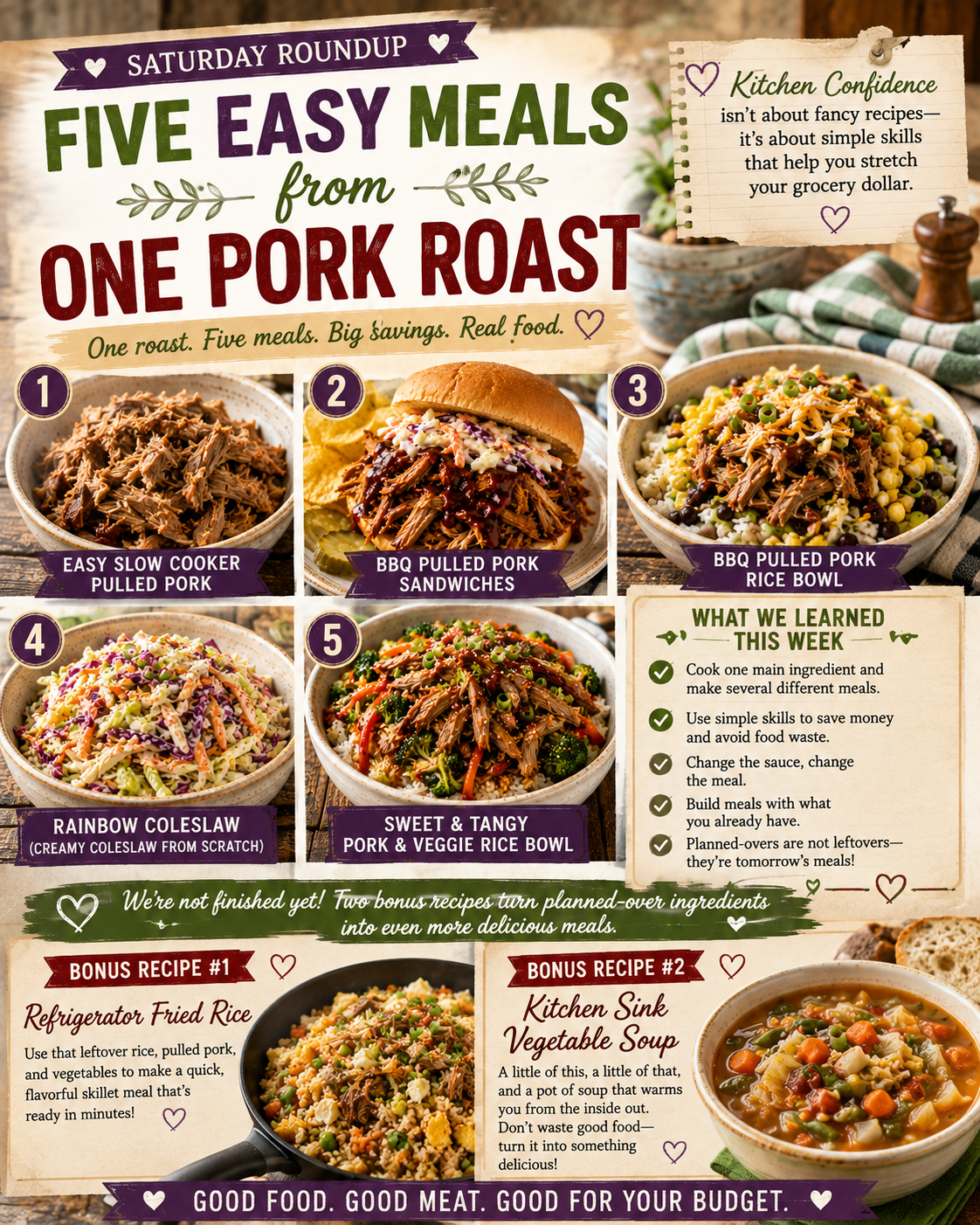
Five Easy Meals from One Pork Roast

Introduction

One of the best ways to stretch a grocery budget isn’t to buy the cheapest food you can find. It’s to make the food you buy work harder.

This week, we started with one affordable pork shoulder and turned it into several completely different meals. Along the way, we practiced some simple kitchen skills: shredding cooked meat, cooking rice, preparing fresh cabbage, making a simple sauce, and storing food in meal-sized portions.

The goal wasn’t to make you spend your week eating the same thing.

It was to show you how one good meal-prep decision can give you several different meals.

And that’s where kitchen confidence starts.


🐷 One Pork Roast, Five Meals

1. Easy Slow Cooker Pulled Pork

We started with the anchor recipe: Easy Slow Cooker Pulled Pork.

A few simple ingredients and a slow cooker did most of the work. The result was tender, flavorful pork that could be divided into portions for several meals.

The skill we practiced: Using a slow cooker to make an inexpensive cut of meat tender and versatile.


2. BBQ Pulled Pork Sandwiches

Next, we turned some of the precooked pork into BBQ Pulled Pork Sandwiches.

A toasted bun, barbecue sauce, and a scoop of Rainbow Coleslaw transformed the pork into a completely different meal.

The skill we practiced: Making a quick meal from precooked ingredients.

And remember—you don’t have to make the pulled pork yourself to enjoy this recipe. Refrigerated or frozen precooked shredded pork can be a perfectly good shortcut when that’s what works for you.


3. BBQ Pulled Pork Rice Bowl

Then came our first Build-A-Bowl.

Rice, pulled pork, corn, black beans, and barbecue sauce created an easy meal that could be customized with whatever toppings you happened to have available.

The skill we practiced: Making cooked rice work harder.

Once you learn how to cook a batch of rice, you’ve got the foundation for countless inexpensive meals.


4. Rainbow Coleslaw

Our colorful Rainbow Coleslaw (Creamy Coleslaw from Scratch) wasn’t just a side dish—it was another kitchen confidence lesson.

Green cabbage, red cabbage, carrots, and a simple homemade dressing turned an inexpensive head of cabbage into a fresh, crunchy side dish.

The skill we practiced: Choosing and preparing whole vegetables.

And that cabbage doesn’t have to stop at coleslaw. Keep those ideas in mind when you’re looking for ways to use the rest of the head.


5. Sweet & Tangy Pork & Veggie Rice Bowl

Our second Build-A-Bowl proved that you don’t need completely different ingredients to create a completely different dinner.

This time, the pulled pork and rice were paired with colorful vegetables and a sweet and tangy honey-garlic sauce.

The skill we practiced: Changing the flavor profile instead of starting from scratch.

That’s a powerful little trick when you’re trying to avoid meal-planning boredom.


🧺 What We Learned This Week

Kitchen confidence isn’t about learning complicated culinary techniques.

It’s about learning small skills that make everyday cooking easier.

This week we learned how to:

  • Shred cooked meat quickly and easily
  • Cook and reuse rice
  • Choose and shred fresh cabbage
  • Build meals from simple components
  • Change a meal’s flavor with a different sauce
  • Store food in meal-sized portions
  • Shop by unit price
  • Make better use of planned-over ingredients

Every one of those skills can save money.

And every one of them gets easier with practice.


💰 The Real Savings

Here’s the bigger lesson from this week’s pork roast:

Cooking once doesn’t mean eating the same meal five times.

The pork became sandwiches.

The pork became rice bowls.

The rice became the base for two different meals.

The cabbage became coleslaw.

The vegetables became part of a new flavor combination.

That’s how you stretch a grocery dollar without making your meals feel repetitive.


♻️ Waste Not, Want Not

We’re not quite finished with this week’s ingredients.

Today we’re going to take another look at what’s hanging around in the refrigerator and turn some of those planned-over ingredients into two more meals.

Because sometimes the most satisfying recipe of the week is the one that uses up the last bits of everything.


🌾 This Week’s Kitchen Confidence

You don’t need a completely new grocery list for every meal.

Start with what you already have.

Change the seasoning.

Change the sauce.

Change the way you serve it.

And suddenly, yesterday’s dinner doesn’t look—or taste—like yesterday’s dinner anymore.

That’s a skill worth learning.


📋 Looking Ahead

Next week we’ll keep building on the idea that simple, practical cooking can save both time and money.

And if you’ve been following along all month, you’re probably starting to see the pattern:

Cook smart.
Use what you have.
Plan for tomorrow.
Waste as little as possible.

That’s how we stretch every grocery dollar. 🌿

We’re not quite finished with this week’s ingredients.

Today we’re going to take another look at what’s hanging around in the refrigerator and turn some of those planned-over ingredients into two more meals.

Because sometimes the most satisfying recipe of the week is the one that uses up the last bits of everything.

Bonus Recipe #1: Refrigerator Fried Rice

Before you clean out the refrigerator, take a second look at what’s left from this week’s meals.

A little cooked rice, some leftover vegetables, and a bit of pulled pork can become a completely different dinner with a hot skillet and a few simple ingredients. Refrigerator Fried Rice is exactly the kind of meal that proves you don’t need a recipe-perfect refrigerator to make something delicious.

It’s also a great way to practice one of the most valuable kitchen skills we’ve talked about all week:

Learning to look at what you have instead of what you think you need.

Use the recipe as a starting point, then make substitutions based on what’s actually in your refrigerator. That’s not cheating—that’s cooking. 🥢


Bonus Recipe #2: Kitchen Sink Vegetable Soup

And finally, it’s time to clean out the vegetable drawer.

A little of this, a little of that, some broth, and a few pantry staples can become a hearty pot of Kitchen Sink Vegetable Soup.

This one is especially close to home because it brings us right back to the Saturday soup tradition you learned from your mom: don’t throw out perfectly good food just because there’s only a little bit left.

Those odds and ends can still make something delicious. Sometimes you just have to give them a chance. 💚

Easy Slow Cooker Pulled Pork
Some recipes feel almost magical, and this is one of them.
Check out this recipe
BBQ Pulled Pork Sandwiches
One of the best rewards for spending a few minutes preparing a slow cooker meal ishow easy dinner becomes the next day.
Check out this recipe
BBQ Pulled Pork Rice Bowl
Ricebowls are one of the easiest ways to stretch ingredients while creatingsomething that feels fresh and satisfying.
Check out this recipe
Rainbow Cabbage
Once you've made it yourself, you may never want to buy prepared coleslaw again.
Check out this recipe
Sweet & Tangy Pork & Veggie Rice Bowl
Oneof the easiest ways to make meal planning feel fresh is by changing theflavors—not the entire recipe.
Check out this recipe
Refrigerator Fried Rice
RefrigeratorFried Rice is all about taking the odds and ends in your refrigerator andturning them into a completely new meal.
Check out this recipe
Kitchen Sink Vegetable Soup
KitchenSink Vegetable Soup is the perfect way to use up the last bits of vegetablesand planned-over ingredients in your refrigerator.
Check out this recipe
Posted in Kitchen Tips

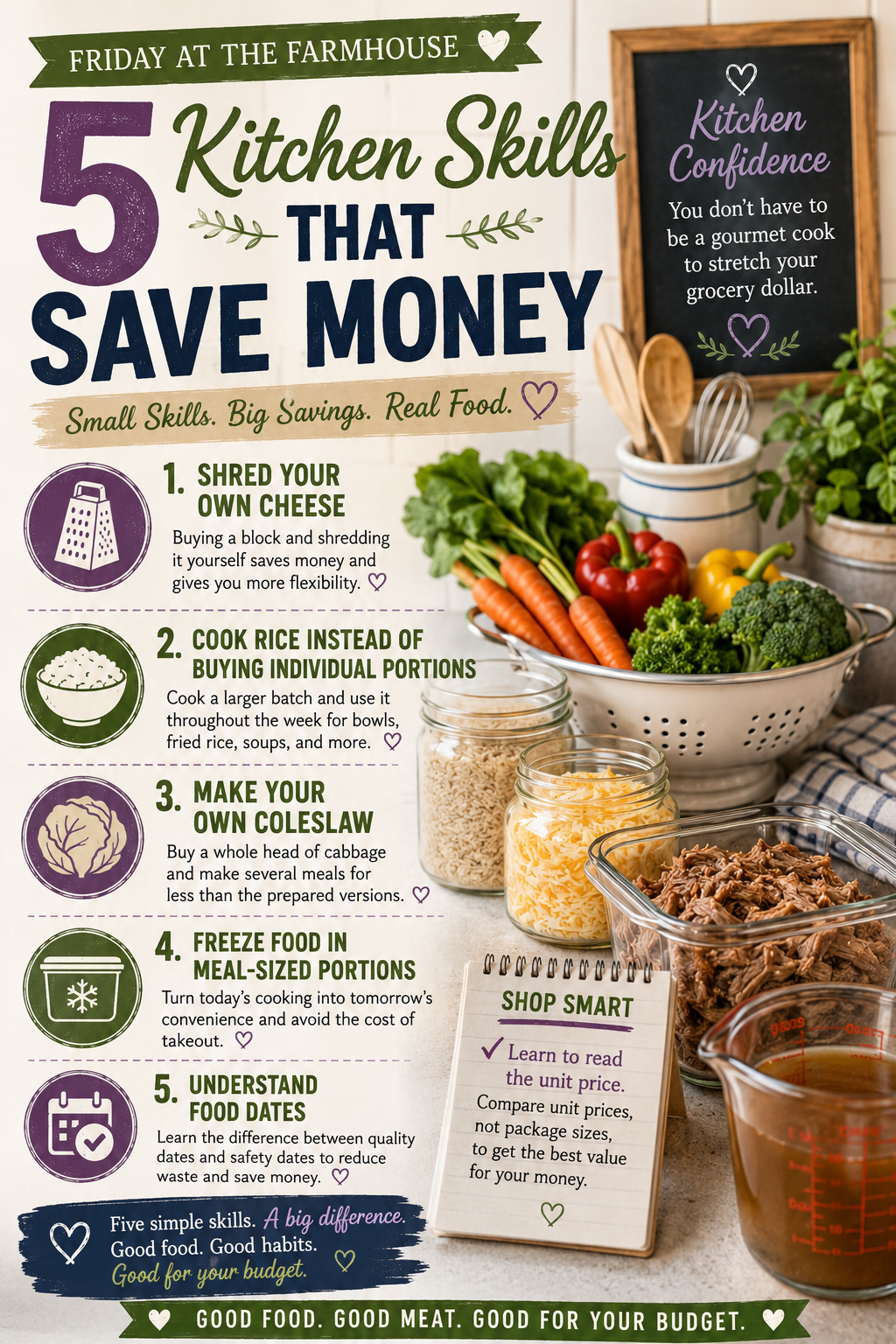
Five Kitchen Skills That Save Money

Introduction

You don’t have to be a gourmet cook to save money in the kitchen.

In fact, some of the best ways to stretch your grocery budget have very little to do with complicated recipes. They come down to learning a few basic skills that help you make better use of the food you already buy.

This week we’ve been building kitchen confidence one simple skill at a time. We’ve learned how to turn an inexpensive pork roast into several meals, how to make rice work harder for us, how to turn a whole cabbage into a colorful homemade slaw, and how changing a sauce can make the same ingredients taste completely different.

Today, let’s put those lessons together.

Here are five kitchen skills that can save you money every time you use them.


🧺 Kitchen Confidence

1. Shred Your Own Cheese

Pre-shredded cheese is convenient, but buying a block and shredding it yourself can often save money.

A block of cheese also gives you more flexibility. You can shred exactly what you need for a recipe, slice some for sandwiches, or cut a little into cubes for snacks.

And here’s another little trick: if you have a stand mixer with a shredding attachment or a food processor, you can shred a larger amount at once and store it for later.

Kitchen confidence takeaway: Convenience is wonderful, but learning to do a simple task yourself gives you another way to control your grocery budget.


2. Cook Rice Instead of Buying Individual Portions

Rice is one of the most economical staples you can keep in your pantry.

Cooking a larger batch takes only a little more effort than cooking a single serving. Once it’s cooled and stored properly, you can use it throughout the week for rice bowls, fried rice, casseroles, soups, and side dishes.

That’s exactly what we’ve been doing with our Build-A-Bowl recipes this week.

Kitchen confidence takeaway: Learn how to cook one inexpensive staple well, and you’ll have the foundation for dozens of meals.


3. Make Your Own Coleslaw

Our Rainbow Coleslaw is a perfect example of this one.

Instead of buying a bag of prepared slaw mix and a bottle of dressing, you can buy a whole head of cabbage, shred it yourself, and turn it into several different meals.

And cabbage isn’t limited to coleslaw. You can use it in soups, stir-fries, rice bowls, casseroles, tacos, and skillet meals.

Kitchen confidence takeaway: Learning how to prepare inexpensive whole vegetables gives you more options—and usually more food for your money.


4. Freeze Food in Meal-Sized Portions

One of the most expensive things you can throw away is food you already paid for.

When you make too much of something, don’t automatically put the whole container in the refrigerator and hope you’ll remember it later. Divide it into portions that make sense for your household.

For someone cooking for one or two, that might mean freezing one or two servings at a time.

That frozen portion can become tomorrow’s lunch—or rescue you from ordering takeout on a night when you don’t feel like cooking.

Kitchen confidence takeaway: Your freezer isn’t just for long-term storage. It’s a tool for turning today’s cooking into tomorrow’s convenience.


5. Understand Food Dates

“Best by,” “Best if Used By,” and “Use By” dates can be confusing, and throwing away perfectly good food because of a date printed on the package can unnecessarily increase your grocery bill.

The USDA notes that food product dating is generally about quality rather than safety, with some important exceptions and manufacturer-specific guidance. When in doubt about a perishable food, don’t rely on the date alone—consider how it has been stored and follow food-safety guidance.

This doesn’t mean you should ignore food safety. Perishable foods need to be refrigerated promptly, and foods that have been improperly stored or show signs of spoilage should be discarded.

Kitchen confidence takeaway: Understanding food labels helps you avoid unnecessary waste without taking unnecessary chances.

When it comes to food safety, always choose safety over saving a few dollars.


🌾 Smart Shopper Spotlight

Learn to Read the Unit Price

Here’s one of the simplest shopping skills you can learn:

Don’t compare packages. Compare unit prices.

A larger package isn’t automatically the better bargain, and a sale price isn’t necessarily the lowest price.

The unit price tells you what you’re actually paying per ounce, pound, quart, or other standard measurement.

This is especially helpful when comparing different package sizes of meat, cheese, pantry staples, and household products.

And remember: the cheapest price per pound isn’t a bargain if you won’t use the food.

Buying the amount your household can realistically use is part of saving money, too.


💰 Budget Swap of the Week

Buy the whole vegetable instead of the prepared version.

A bag of shredded cabbage is convenient.

A whole head of cabbage is versatile.

The same principle applies to:

  • Whole carrots instead of baby carrots
  • A block of cheese instead of pre-shredded cheese
  • Whole lettuce instead of individual salad kits
  • Regular rice instead of individual microwave portions
  • Whole chicken when the price makes sense instead of only buying prepared chicken

You don’t have to do everything from scratch.

Just learn which shortcuts are worth paying for—and which ones you can easily handle yourself.


♻️ Waste Not, Want Not

This week’s pork roast has been a perfect example.

One inexpensive cut of meat became:

Easy Slow Cooker Pulled Pork → BBQ Pulled Pork Sandwiches → BBQ Pulled Pork Rice Bowl → Sweet & Tangy Pork & Veggie Rice Bowl

And we’re not finished yet.

Tomorrow, we’ll turn some of those planned-over ingredients into Refrigerator Fried Rice.

That’s not simply leftovers.

That’s meal planning with a purpose.


📋 Next Week’s Prep

Before the next week begins, take a quick look through your refrigerator, freezer, and pantry.

Ask yourself:

  • What needs to be used first?
  • What vegetables are getting close to their limit?
  • Do I have cooked rice or other grains that need a plan?
  • What meat is already cooked or frozen?
  • What small amounts of ingredients could become part of another meal?

You don’t need a complicated meal plan.

Sometimes five minutes of looking around your kitchen is enough to save a trip to the grocery store—and a few dollars from your wallet.


🌿 The Takeaway

You don’t need to master twenty new cooking techniques to become a more confident cook.

Start with five.

Shred it yourself.
Cook the staple.
Prepare the whole vegetable.
Freeze the planned overs.
Learn to read the label.

Each skill seems small on its own.

Put them together, though, and they can change the way you shop, cook, and think about your grocery budget.

That’s what Kitchen Confidence is really about.

Not becoming a professional chef.

Just becoming a little more comfortable in your own kitchen, one meal at a time. 💚

Posted in Recipe Roundup

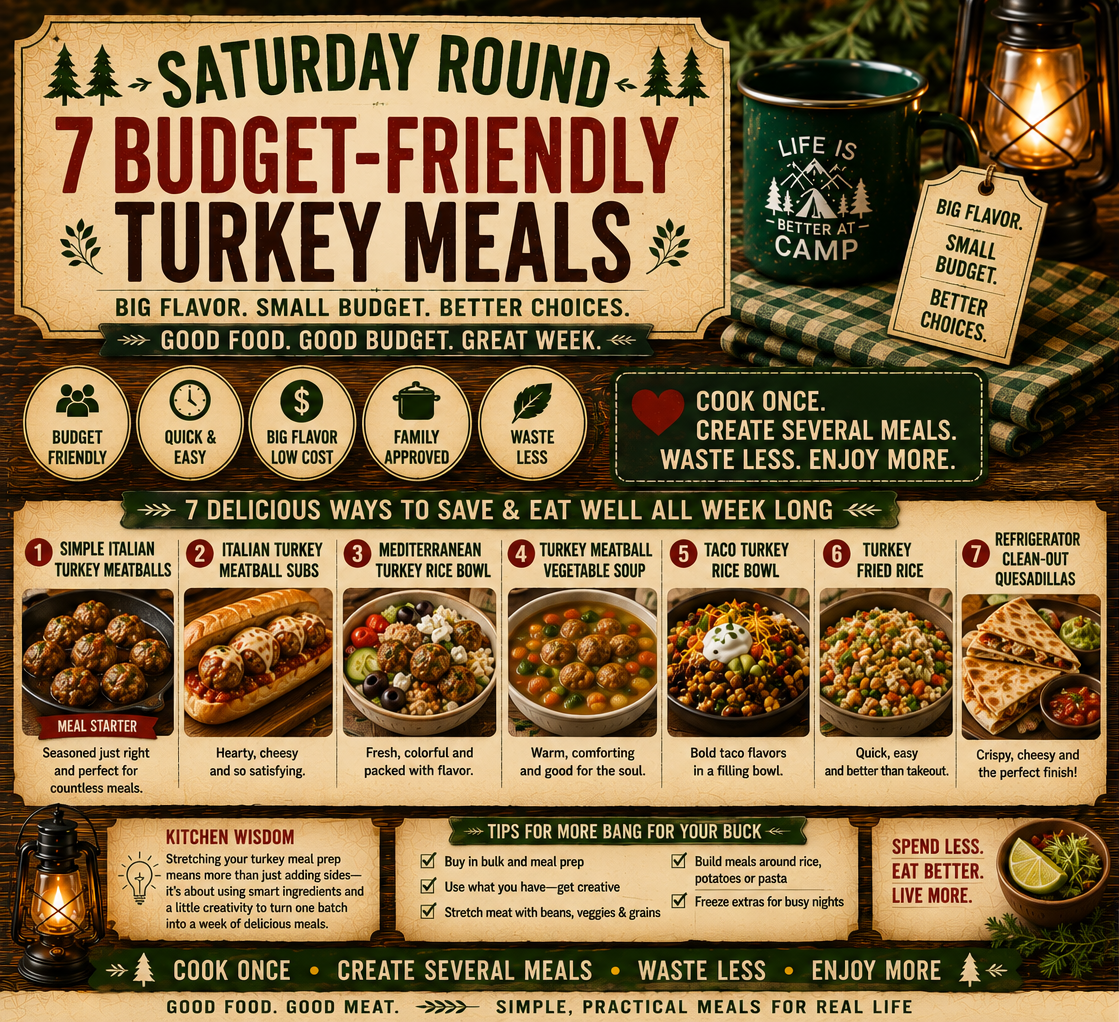
7 Budget-Friendly Turkey Meals

Looking for ways to make one package of ground turkey stretch into several delicious meals?

This week’s Stretch Every Grocery Dollar series showed how a simple batch of homemade Italian turkey meatballs can become a full week of satisfying dinners. Whether you’re cooking for one, feeding a small family, or simply trying to lower your grocery bill, these recipes prove that a little planning can go a long way.

From hearty soups and sandwiches to rice bowls and creative leftover meals, here are seven budget-friendly turkey recipes to inspire your next meal plan.


🍝 1. Simple Italian Turkey Meatballs

The meal prep foundation that starts the week and makes several later meals quick and easy.


🥪 2. Italian Turkey Meatball Subs

A toasted roll, marinara, melted mozzarella, and homemade turkey meatballs make an easy comfort-food favorite.


🥗 3. Mediterranean Turkey Rice Bowl

Fresh vegetables, brown rice, feta, and a creamy lemon herb yogurt sauce transform turkey meatballs into a fresh Mediterranean-inspired meal.


🥣 4. Turkey Meatball Vegetable Soup

A comforting soup filled with vegetables, pasta, and hearty turkey meatballs.


🌮 5. Taco Turkey Rice Bowl

Seasoned turkey meatballs, brown rice, black beans, corn, salsa, and fresh toppings come together in a colorful Build-A-Bowl dinner.


🍳 6. Turkey Fried Rice (Bonus Recipe)

A quick skillet meal that gives leftover turkey meatballs a delicious second life.


🧀 7. Refrigerator Clean-Out Quesadillas (Bonus Recipe)

One of the easiest ways to use leftover turkey, vegetables, cheese, and odds and ends from the refrigerator. Every quesadilla is a little different—and that’s exactly the point!


💡 Related Reading

Before you head to the grocery store, don’t miss:

Five Ways to Stretch Ground Turkey

You’ll find practical tips for meal prepping, freezing, using beans and vegetables to stretch your meat, and making every grocery dollar work a little harder.


Final Thoughts

Budget-friendly cooking isn’t about giving up the foods you love—it’s about making smart use of what you already have.

By starting with one simple batch of turkey meatballs and thinking creatively about leftovers, you can enjoy a full week of flavorful, satisfying meals while reducing food waste and saving money.

That’s exactly what the Stretch Every Grocery Dollar series is all about.

Simple Italian Turkey Meatballs
Thesetender Italian Turkey Meatballs are seasoned with classic herbs and Parmesancheese, then baked until juicy and lightly browned.
Check out this recipe
Italian Turkey Meatball Subs
Oneof the easiest ways to stretch your grocery budget is to transform leftoversinto something that feels completely new.
Check out this recipe
Mediterranean Turkey Rice Bowl
Thiscolorful Mediterranean Turkey Rice Bowl transforms a few of this week'shomemade turkey meatballs into a completely new meal.
Check out this recipe
Turkey Fried Rice
Oneof my favorite ways to stretch leftovers is to turn them into fried rice.
Check out this recipe
Turkey Meatball Vegetable Soup
Halfway through the week is the perfect time for a comforting bowl of homemade soup.
Check out this recipe
Taco Turkey Rice Bowl
Today's Taco Turkey Rice Bowl gives Sunday's Italian turkey meatballs a Southwestern makeover.
Check out this recipe
Refrigerator Clean-Out Quesadillas
Almost any leftover meat, vegetables, cheese, or rice can become a quesadilla.
Check out this recipe