Posted in Recipe Roundup

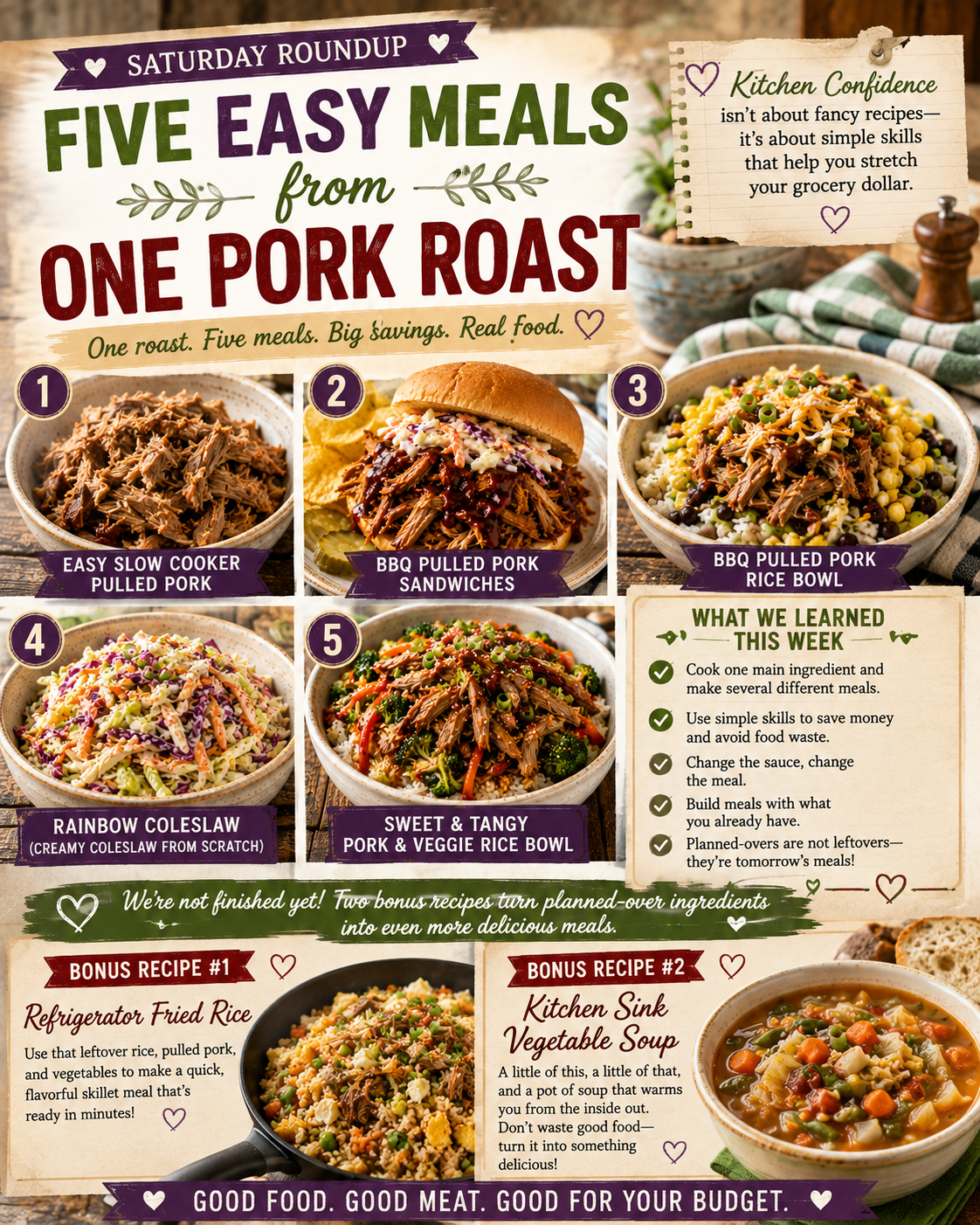
Five Easy Meals from One Pork Roast

Introduction

One of the best ways to stretch a grocery budget isn’t to buy the cheapest food you can find. It’s to make the food you buy work harder.

This week, we started with one affordable pork shoulder and turned it into several completely different meals. Along the way, we practiced some simple kitchen skills: shredding cooked meat, cooking rice, preparing fresh cabbage, making a simple sauce, and storing food in meal-sized portions.

The goal wasn’t to make you spend your week eating the same thing.

It was to show you how one good meal-prep decision can give you several different meals.

And that’s where kitchen confidence starts.


🐷 One Pork Roast, Five Meals

1. Easy Slow Cooker Pulled Pork

We started with the anchor recipe: Easy Slow Cooker Pulled Pork.

A few simple ingredients and a slow cooker did most of the work. The result was tender, flavorful pork that could be divided into portions for several meals.

The skill we practiced: Using a slow cooker to make an inexpensive cut of meat tender and versatile.


2. BBQ Pulled Pork Sandwiches

Next, we turned some of the precooked pork into BBQ Pulled Pork Sandwiches.

A toasted bun, barbecue sauce, and a scoop of Rainbow Coleslaw transformed the pork into a completely different meal.

The skill we practiced: Making a quick meal from precooked ingredients.

And remember—you don’t have to make the pulled pork yourself to enjoy this recipe. Refrigerated or frozen precooked shredded pork can be a perfectly good shortcut when that’s what works for you.


3. BBQ Pulled Pork Rice Bowl

Then came our first Build-A-Bowl.

Rice, pulled pork, corn, black beans, and barbecue sauce created an easy meal that could be customized with whatever toppings you happened to have available.

The skill we practiced: Making cooked rice work harder.

Once you learn how to cook a batch of rice, you’ve got the foundation for countless inexpensive meals.


4. Rainbow Coleslaw

Our colorful Rainbow Coleslaw (Creamy Coleslaw from Scratch) wasn’t just a side dish—it was another kitchen confidence lesson.

Green cabbage, red cabbage, carrots, and a simple homemade dressing turned an inexpensive head of cabbage into a fresh, crunchy side dish.

The skill we practiced: Choosing and preparing whole vegetables.

And that cabbage doesn’t have to stop at coleslaw. Keep those ideas in mind when you’re looking for ways to use the rest of the head.


5. Sweet & Tangy Pork & Veggie Rice Bowl

Our second Build-A-Bowl proved that you don’t need completely different ingredients to create a completely different dinner.

This time, the pulled pork and rice were paired with colorful vegetables and a sweet and tangy honey-garlic sauce.

The skill we practiced: Changing the flavor profile instead of starting from scratch.

That’s a powerful little trick when you’re trying to avoid meal-planning boredom.


🧺 What We Learned This Week

Kitchen confidence isn’t about learning complicated culinary techniques.

It’s about learning small skills that make everyday cooking easier.

This week we learned how to:

  • Shred cooked meat quickly and easily
  • Cook and reuse rice
  • Choose and shred fresh cabbage
  • Build meals from simple components
  • Change a meal’s flavor with a different sauce
  • Store food in meal-sized portions
  • Shop by unit price
  • Make better use of planned-over ingredients

Every one of those skills can save money.

And every one of them gets easier with practice.


💰 The Real Savings

Here’s the bigger lesson from this week’s pork roast:

Cooking once doesn’t mean eating the same meal five times.

The pork became sandwiches.

The pork became rice bowls.

The rice became the base for two different meals.

The cabbage became coleslaw.

The vegetables became part of a new flavor combination.

That’s how you stretch a grocery dollar without making your meals feel repetitive.


♻️ Waste Not, Want Not

We’re not quite finished with this week’s ingredients.

Today we’re going to take another look at what’s hanging around in the refrigerator and turn some of those planned-over ingredients into two more meals.

Because sometimes the most satisfying recipe of the week is the one that uses up the last bits of everything.


🌾 This Week’s Kitchen Confidence

You don’t need a completely new grocery list for every meal.

Start with what you already have.

Change the seasoning.

Change the sauce.

Change the way you serve it.

And suddenly, yesterday’s dinner doesn’t look—or taste—like yesterday’s dinner anymore.

That’s a skill worth learning.


📋 Looking Ahead

Next week we’ll keep building on the idea that simple, practical cooking can save both time and money.

And if you’ve been following along all month, you’re probably starting to see the pattern:

Cook smart.
Use what you have.
Plan for tomorrow.
Waste as little as possible.

That’s how we stretch every grocery dollar. 🌿

We’re not quite finished with this week’s ingredients.

Today we’re going to take another look at what’s hanging around in the refrigerator and turn some of those planned-over ingredients into two more meals.

Because sometimes the most satisfying recipe of the week is the one that uses up the last bits of everything.

Bonus Recipe #1: Refrigerator Fried Rice

Before you clean out the refrigerator, take a second look at what’s left from this week’s meals.

A little cooked rice, some leftover vegetables, and a bit of pulled pork can become a completely different dinner with a hot skillet and a few simple ingredients. Refrigerator Fried Rice is exactly the kind of meal that proves you don’t need a recipe-perfect refrigerator to make something delicious.

It’s also a great way to practice one of the most valuable kitchen skills we’ve talked about all week:

Learning to look at what you have instead of what you think you need.

Use the recipe as a starting point, then make substitutions based on what’s actually in your refrigerator. That’s not cheating—that’s cooking. 🥢


Bonus Recipe #2: Kitchen Sink Vegetable Soup

And finally, it’s time to clean out the vegetable drawer.

A little of this, a little of that, some broth, and a few pantry staples can become a hearty pot of Kitchen Sink Vegetable Soup.

This one is especially close to home because it brings us right back to the Saturday soup tradition you learned from your mom: don’t throw out perfectly good food just because there’s only a little bit left.

Those odds and ends can still make something delicious. Sometimes you just have to give them a chance. 💚

Easy Slow Cooker Pulled Pork
Some recipes feel almost magical, and this is one of them.
Check out this recipe
BBQ Pulled Pork Sandwiches
One of the best rewards for spending a few minutes preparing a slow cooker meal ishow easy dinner becomes the next day.
Check out this recipe
BBQ Pulled Pork Rice Bowl
Ricebowls are one of the easiest ways to stretch ingredients while creatingsomething that feels fresh and satisfying.
Check out this recipe
Rainbow Cabbage
Once you've made it yourself, you may never want to buy prepared coleslaw again.
Check out this recipe
Sweet & Tangy Pork & Veggie Rice Bowl
Oneof the easiest ways to make meal planning feel fresh is by changing theflavors—not the entire recipe.
Check out this recipe
Refrigerator Fried Rice
RefrigeratorFried Rice is all about taking the odds and ends in your refrigerator andturning them into a completely new meal.
Check out this recipe
Kitchen Sink Vegetable Soup
KitchenSink Vegetable Soup is the perfect way to use up the last bits of vegetablesand planned-over ingredients in your refrigerator.
Check out this recipe
Posted in Kitchen Tips

Five Kitchen Skills That Save Money

Introduction

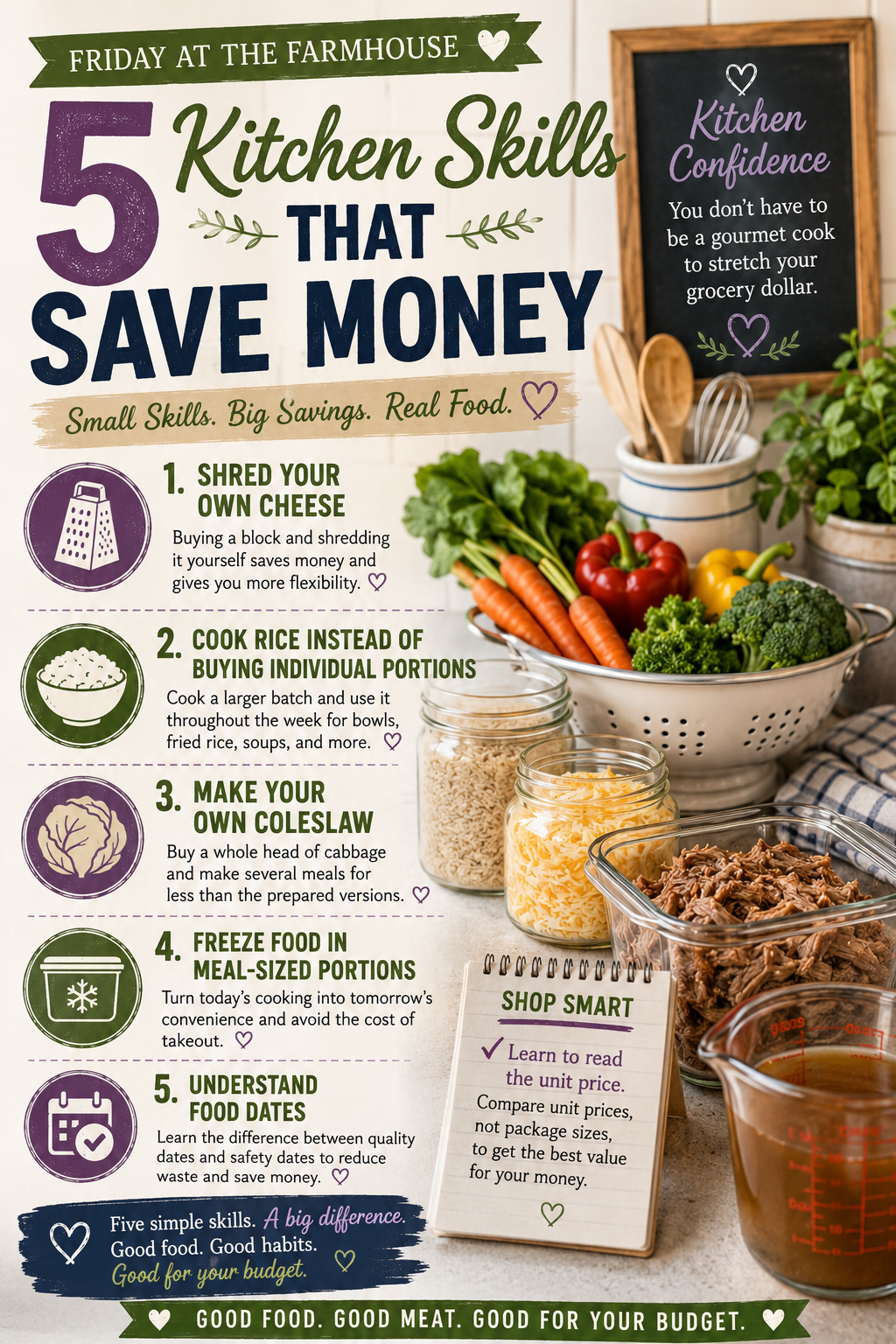
You don’t have to be a gourmet cook to save money in the kitchen.

In fact, some of the best ways to stretch your grocery budget have very little to do with complicated recipes. They come down to learning a few basic skills that help you make better use of the food you already buy.

This week we’ve been building kitchen confidence one simple skill at a time. We’ve learned how to turn an inexpensive pork roast into several meals, how to make rice work harder for us, how to turn a whole cabbage into a colorful homemade slaw, and how changing a sauce can make the same ingredients taste completely different.

Today, let’s put those lessons together.

Here are five kitchen skills that can save you money every time you use them.


🧺 Kitchen Confidence

1. Shred Your Own Cheese

Pre-shredded cheese is convenient, but buying a block and shredding it yourself can often save money.

A block of cheese also gives you more flexibility. You can shred exactly what you need for a recipe, slice some for sandwiches, or cut a little into cubes for snacks.

And here’s another little trick: if you have a stand mixer with a shredding attachment or a food processor, you can shred a larger amount at once and store it for later.

Kitchen confidence takeaway: Convenience is wonderful, but learning to do a simple task yourself gives you another way to control your grocery budget.


2. Cook Rice Instead of Buying Individual Portions

Rice is one of the most economical staples you can keep in your pantry.

Cooking a larger batch takes only a little more effort than cooking a single serving. Once it’s cooled and stored properly, you can use it throughout the week for rice bowls, fried rice, casseroles, soups, and side dishes.

That’s exactly what we’ve been doing with our Build-A-Bowl recipes this week.

Kitchen confidence takeaway: Learn how to cook one inexpensive staple well, and you’ll have the foundation for dozens of meals.


3. Make Your Own Coleslaw

Our Rainbow Coleslaw is a perfect example of this one.

Instead of buying a bag of prepared slaw mix and a bottle of dressing, you can buy a whole head of cabbage, shred it yourself, and turn it into several different meals.

And cabbage isn’t limited to coleslaw. You can use it in soups, stir-fries, rice bowls, casseroles, tacos, and skillet meals.

Kitchen confidence takeaway: Learning how to prepare inexpensive whole vegetables gives you more options—and usually more food for your money.


4. Freeze Food in Meal-Sized Portions

One of the most expensive things you can throw away is food you already paid for.

When you make too much of something, don’t automatically put the whole container in the refrigerator and hope you’ll remember it later. Divide it into portions that make sense for your household.

For someone cooking for one or two, that might mean freezing one or two servings at a time.

That frozen portion can become tomorrow’s lunch—or rescue you from ordering takeout on a night when you don’t feel like cooking.

Kitchen confidence takeaway: Your freezer isn’t just for long-term storage. It’s a tool for turning today’s cooking into tomorrow’s convenience.


5. Understand Food Dates

“Best by,” “Best if Used By,” and “Use By” dates can be confusing, and throwing away perfectly good food because of a date printed on the package can unnecessarily increase your grocery bill.

The USDA notes that food product dating is generally about quality rather than safety, with some important exceptions and manufacturer-specific guidance. When in doubt about a perishable food, don’t rely on the date alone—consider how it has been stored and follow food-safety guidance.

This doesn’t mean you should ignore food safety. Perishable foods need to be refrigerated promptly, and foods that have been improperly stored or show signs of spoilage should be discarded.

Kitchen confidence takeaway: Understanding food labels helps you avoid unnecessary waste without taking unnecessary chances.

When it comes to food safety, always choose safety over saving a few dollars.


🌾 Smart Shopper Spotlight

Learn to Read the Unit Price

Here’s one of the simplest shopping skills you can learn:

Don’t compare packages. Compare unit prices.

A larger package isn’t automatically the better bargain, and a sale price isn’t necessarily the lowest price.

The unit price tells you what you’re actually paying per ounce, pound, quart, or other standard measurement.

This is especially helpful when comparing different package sizes of meat, cheese, pantry staples, and household products.

And remember: the cheapest price per pound isn’t a bargain if you won’t use the food.

Buying the amount your household can realistically use is part of saving money, too.


💰 Budget Swap of the Week

Buy the whole vegetable instead of the prepared version.

A bag of shredded cabbage is convenient.

A whole head of cabbage is versatile.

The same principle applies to:

  • Whole carrots instead of baby carrots
  • A block of cheese instead of pre-shredded cheese
  • Whole lettuce instead of individual salad kits
  • Regular rice instead of individual microwave portions
  • Whole chicken when the price makes sense instead of only buying prepared chicken

You don’t have to do everything from scratch.

Just learn which shortcuts are worth paying for—and which ones you can easily handle yourself.


♻️ Waste Not, Want Not

This week’s pork roast has been a perfect example.

One inexpensive cut of meat became:

Easy Slow Cooker Pulled Pork → BBQ Pulled Pork Sandwiches → BBQ Pulled Pork Rice Bowl → Sweet & Tangy Pork & Veggie Rice Bowl

And we’re not finished yet.

Tomorrow, we’ll turn some of those planned-over ingredients into Refrigerator Fried Rice.

That’s not simply leftovers.

That’s meal planning with a purpose.


📋 Next Week’s Prep

Before the next week begins, take a quick look through your refrigerator, freezer, and pantry.

Ask yourself:

  • What needs to be used first?
  • What vegetables are getting close to their limit?
  • Do I have cooked rice or other grains that need a plan?
  • What meat is already cooked or frozen?
  • What small amounts of ingredients could become part of another meal?

You don’t need a complicated meal plan.

Sometimes five minutes of looking around your kitchen is enough to save a trip to the grocery store—and a few dollars from your wallet.


🌿 The Takeaway

You don’t need to master twenty new cooking techniques to become a more confident cook.

Start with five.

Shred it yourself.
Cook the staple.
Prepare the whole vegetable.
Freeze the planned overs.
Learn to read the label.

Each skill seems small on its own.

Put them together, though, and they can change the way you shop, cook, and think about your grocery budget.

That’s what Kitchen Confidence is really about.

Not becoming a professional chef.

Just becoming a little more comfortable in your own kitchen, one meal at a time. 💚