
There comes a point when a freezer needs more than another package added to it.
It needs a little cleaning out.
That’s not a failure of freezer planning. It’s actually part of successful food preservation.
All week, we’ve been talking about putting food back: freezing green beans while they’re plentiful, saving cooked chicken for another meal, portioning vegetables for future dinners, and keeping an inventory so we know what we have.
Now it’s time to use some of it.
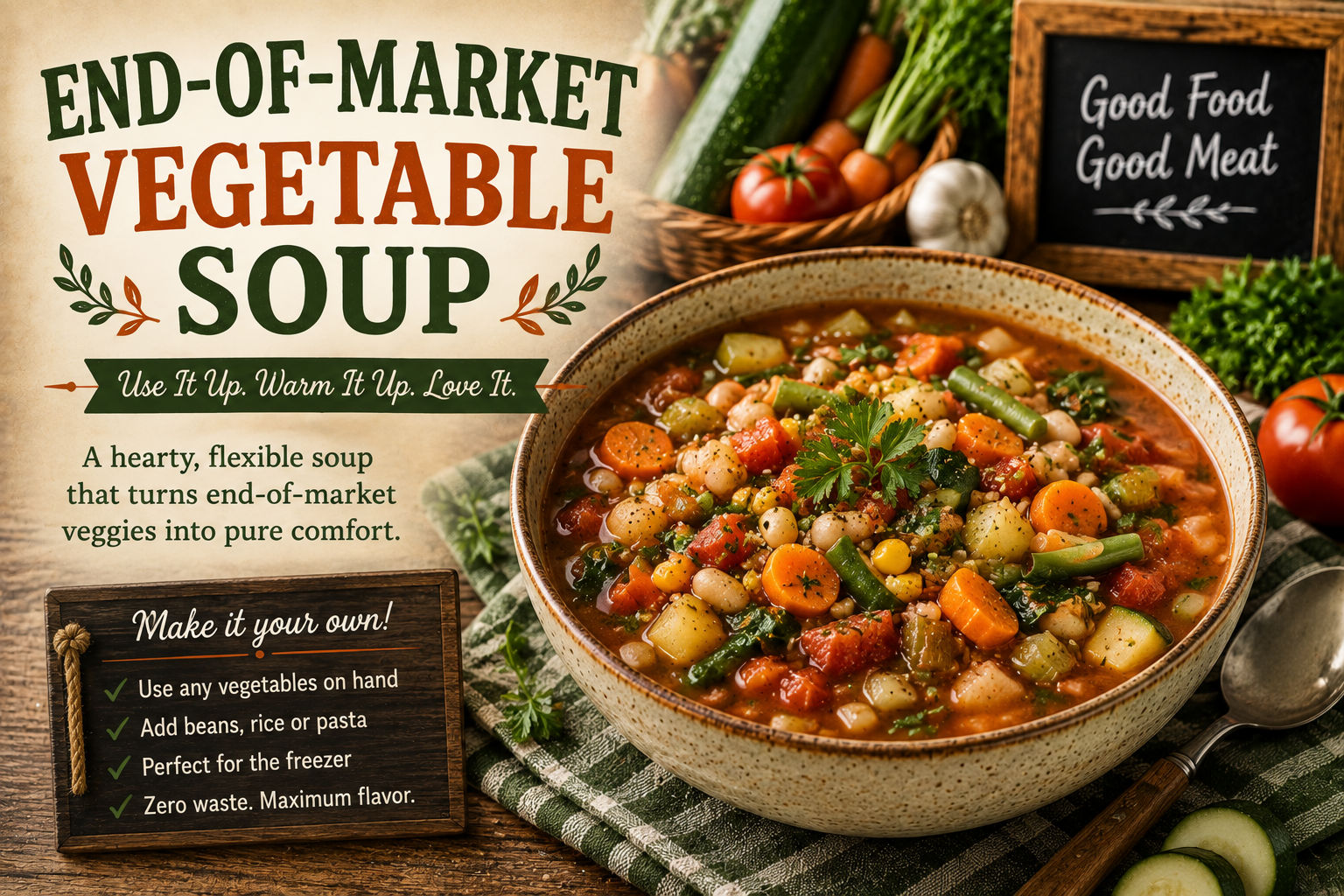
This Freezer Clean-Out Vegetable Soup is exactly the kind of meal I want waiting at the end of a week like this. It’s flexible, comforting, economical, and designed around the odds and ends already living in your freezer.
You don’t need exactly the vegetables listed below.
Look in the freezer. See what needs to be used. Make soup.
Why You’ll Love This Recipe
- A practical way to use assorted frozen vegetables.
- Perfect for small amounts of several different vegetables.
- A great home for leftover cooked chicken, turkey, or beef.
- Makes about 6 cups, or 4 smaller servings.
- Uses inexpensive pantry staples.
- Naturally adaptable to whatever you have available.
- Helps prevent preserved food from becoming forgotten food.
- Freezes well, making it possible to enjoy some now and save the rest.


Freezer Clean-Out Vegetable Soup
Ingredients
Method
- Heat the olive oil in a 4-quart saucepan or Dutch oven over medium heat.
- Add the onion, carrot, and celery.
- Cook for about 5 minutes, stirring occasionally, until the vegetables begin to soften.
- Add the garlic and cook for another 30 seconds.
- If you’re using garlic powder instead, add it with the other seasonings later.
- Add the broth and diced tomatoes.
- Stir in the thyme, parsley, black pepper, and salt.
- Bring the soup to a gentle boil.
- Reduce the heat and simmer for about 10 minutes, giving the fresh vegetables time to become tender.
- Now comes the fun part.
- Add your 2 cups of assorted frozen vegetables.
- This is where you get to look at what you actually have.
- Green beans?
- Absolutely.
- Corn?
- Throw it in.
- Peas?
- Perfect.
- Mixed vegetables?
- That’s practically what this recipe was waiting for.
- A few broccoli florets? Some frozen carrots? Peppers? Zucchini?
- All fair game.
- You don’t have to use exactly two cups, either. If you have a little more or a little less, adjust the amount of broth to keep the soup consistency you like.
- Stir in the cooked chicken.
- Simmer for another 8–10 minutes, or until the vegetables are tender and everything is heated through.
- If you’re using previously frozen cooked chicken, make sure it has been thawed safely and reheated thoroughly.
- If you have leftover cooked rice, pasta, or potatoes, this is a wonderful place to use them.
- Add about 1/2 cup during the last few minutes of cooking, just long enough to heat through.
- This is optional, but it can turn a simple vegetable soup into a more substantial meal.
- Taste the soup.
- Does it need more salt?
- A little more thyme?
- Another splash of broth?
- Adjust it to suit what you’ve put into the pot.
- Remember that your vegetables and broth may already contain salt, so it’s better to start conservatively and add more if needed.
- Ladle the hot soup into bowls and finish with fresh parsley if you have it.
- Serve with a piece of crusty bread, crackers, or a simple sandwich if you’d like.
- Or just enjoy a bowl of soup.
- Sometimes that’s enough.
Notes
What Counts as a “Freezer Clean-Out” Vegetable?
Almost anything that’s appropriate for soup. Here’s a handy way to think about it.Great Choices
- Green beans
- Corn
- Peas
- Carrots
- Mixed vegetables
- Broccoli
- Cauliflower
- Diced peppers
- Spinach
- Zucchini
- Shelled lima beans
Vegetables That Cook Quickly
Tender vegetables such as peas, corn, and spinach generally don’t need as much cooking time. Add them toward the end.Vegetables That Need More Time
Carrots, green beans, broccoli, cauliflower, and similar vegetables may need a little longer to become tender. That’s why they’re added before the final few minutes of cooking. The beauty of a clean-out soup is that you can adjust the timing based on what’s actually in your pot.Change the Protein
Chicken is a natural fit, but it isn’t required.
Try:
- Cooked turkey
- Leftover roast beef
- Cooked pork
- Beans
- Lentils
Or leave the meat out completely.
If you have several small amounts of cooked meat in the freezer, this is a great opportunity to use them rather than letting them become permanent freezer residents.
Change the Flavor
The recipe above is intentionally mild.
But you can take the soup in different directions without completely changing the basic idea.
For a more Italian-style soup, add Italian seasoning and a little Parmesan when serving.
For a chicken-and-herb soup, use thyme, parsley, and a little rosemary.
For a tomato-rich vegetable soup, add another small can of tomatoes.
For a heartier meal, add cooked pasta, rice, barley, or potatoes.
The point isn’t to follow a rigid recipe.
It’s to have a reliable framework for using what you already have.
Stretch Every Grocery Dollar
This may be one of the most economical recipes you’ll make all month.
The broth and canned tomatoes form the foundation.
The vegetables can come from your freezer.
The chicken can be leftover or previously meal-prepped.
The rice, pasta, or potatoes can be leftovers.
You’re taking ingredients that might otherwise sit around separately and turning them into one satisfying meal.
That’s not just economical.
It’s smart cooking.
Waste Not, Want Not
This is probably the most important section of this particular recipe.
A freezer clean-out isn’t an excuse to throw away food simply because it has been frozen for a while.
Instead, it’s an opportunity to pay attention to what you have and use food while it’s still at its best quality.
That’s why labeling and inventory matter.
If you’ve been dating your freezer packages and rotating older food forward, you already have a head start.
And if you discover something you no longer remember putting away?
That’s a pretty good sign that it’s time for a freezer reset.
Cooking for One or Two
This recipe makes about 6 cups, which gives you approximately 4 servings of 1½ cups each.
For one person, that’s several easy meals.
For two people, it’s dinner with leftovers.
If you’d rather make a smaller batch, simply cut the ingredients approximately in half.
This is also one of those recipes where a little variation isn’t going to hurt anything.
Don’t have exactly 2 cups of vegetables?
Use what you have.
Have extra chicken?
Add it.
Have only one kind of vegetable?
That’s fine, too.
Soup is forgiving.
Meal Prep Note
Soup is one of my favorite foods to prepare ahead.
Once cooled appropriately, portion the soup into containers sized for the meals you expect to eat.
Keep what you’ll use soon in the refrigerator and freeze the rest if desired.
For the best quality, leave appropriate space in freezer containers for expansion and label them with the contents and date.
The National Center for Home Food Preservation’s guidance on packaging and labeling frozen foods offers useful recommendations for choosing containers, allowing for expansion, and labeling frozen foods.
Storage & Freezing
Refrigerate leftover soup promptly in shallow containers so it cools more quickly.
For best quality, refrigerated leftovers should generally be eaten within 3–4 days.
If you want to freeze the soup, portion it into freezer-safe containers, leaving appropriate headspace for expansion. Label each container with the name and date.
The USDA’s Food Safety and Inspection Service guidance on leftovers and food safety provides current recommendations for cooling, storing, reheating, and using leftovers safely.
When reheating soup, heat it thoroughly before serving.
A Little Freezer Math
Here’s something I hope you notice about this recipe.
Earlier this week, we froze green beans.
We talked about cooked chicken as a freezer ingredient.
We discussed portioning food according to future meals.
We started an inventory.
And now we’re using those things.
That’s the cycle.
Buy or harvest.
Prepare.
Preserve.
Organize.
Use.
Then do it again.
That’s a much healthier freezer habit than simply adding more and more food.
Preserving Food Is Only Half the Job
A freezer full of carefully preserved food can feel like an accomplishment.
And it is.
But there’s another step.
Eat it.
If you never use the green beans, they weren’t really helping you.
If the cooked chicken sits untouched for a year, it wasn’t much of a meal plan.
If your freezer is so full that you can’t see what you have, the abundance has become a problem instead of a solution.
Successful preservation isn’t measured by how full the freezer is.
It’s measured by how often that food makes your life easier.
Today’s Harvest, Tomorrow’s Dinner
This soup is a fitting way to finish our week because it doesn’t require perfection.
It doesn’t care whether you froze your vegetables in matching containers.
It doesn’t care whether you have exactly the right combination of vegetables.
It doesn’t even care whether you planned this meal last Tuesday.
It simply asks:
What’s in the freezer that needs to become dinner?
Pull out a few vegetables.
Add some chicken.
Open a can of tomatoes.
Pour in some broth.
Give everything a little time together in the pot.
And there you are.
Dinner.
That’s the whole philosophy behind “Today’s Harvest is Tomorrow’s Dinner.”
Put a little back when food is plentiful.
Know what you have.
Use what you saved.
And when the freezer needs a little breathing room, make soup.
Preservation isn’t successful because we saved the food.
It’s successful because we eventually enjoyed it.