
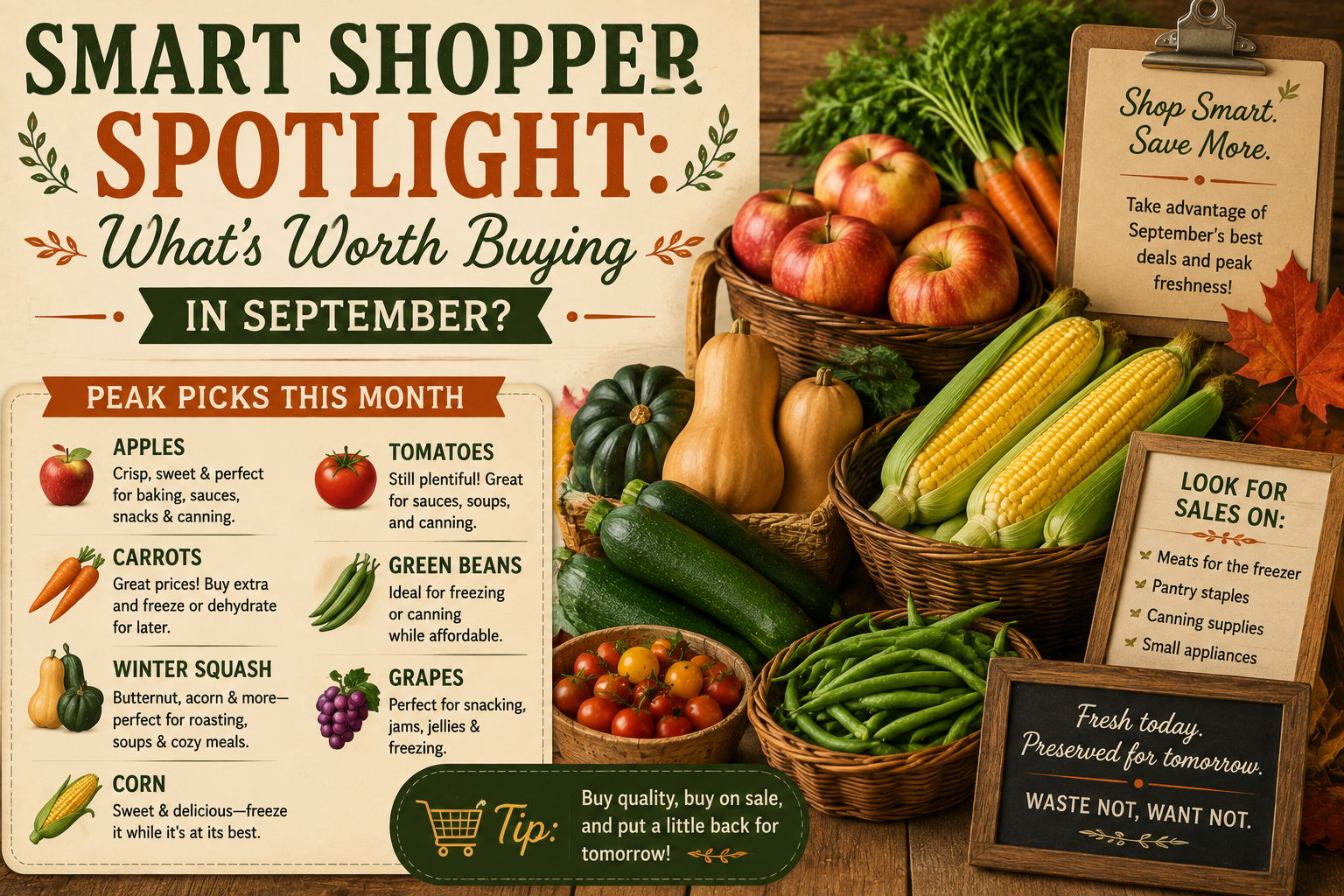
September is an interesting month at the grocery store.
Summer isn’t quite finished, but fall is beginning to make an appearance. Farmers markets are still bringing in the last big crops of summer, while apples and winter squash are starting to take their place.
For a budget-conscious shopper, that’s good news.
When produce is plentiful, you have more opportunities to find a good price—and when you find a genuinely good price on something your household will use, that’s when it’s worth thinking about buying a little extra.
Not everything has to go home with you.
The trick is knowing what is likely to be plentiful, checking the price, and having a plan for what you’ll do with it.
That’s the heart of smart seasonal shopping.
🍎 Apples
September is prime apple season in many parts of the country, and the variety can be wonderful.
This is a good time to compare prices between grocery stores, farmers markets, orchards, and roadside stands.
Don’t automatically assume the farmers market is cheaper—or that the grocery store is cheaper.
Compare.
If apples are a good price, they’re one of those fruits that can earn their keep in several ways.
Eat them fresh.
Bake with them.
Add them to oatmeal.
Make applesauce.
Or simply buy enough for the week instead of purchasing fruit that will sit forgotten in the refrigerator.
And remember that an apple doesn’t have to be perfectly shaped to be useful.
🎃 Winter Squash and Sweet Potatoes
The arrival of autumn means vegetables such as butternut, acorn, and other winter squash begin appearing more frequently.
Sweet potatoes are another useful fall staple.
These vegetables are particularly handy because they’re versatile and can become part of several different meals.
Roast them.
Add them to rice bowls.
Turn them into soup.
Mash them.
Stuff them.
Or roast a larger batch and use the leftovers throughout the week.
That’s the kind of ingredient I like to see in a grocery cart:
One purchase. Multiple meals.
🍅 Late Tomatoes
September can still bring plenty of tomatoes, depending on where you live.
If you find a good price on ripe tomatoes, have a plan before you buy a large quantity.
Tomatoes are wonderful for eating fresh, but they don’t have an unlimited refrigerator life.
Use them for sandwiches, salads, pasta, salsa, soups, or skillet meals.
And if you know you’re not going to use them quickly, consider freezing them for cooked dishes rather than watching them become a science experiment in the back of the refrigerator.
🫛 Green Beans
Green beans can still be plentiful as summer winds down.
They’re an especially useful vegetable for small households because you don’t need a giant quantity to make a meal.
Roast them.
Steam them.
Sauté them.
Add them to soup.
Or combine them with other vegetables in a skillet.
If the price is right, fresh green beans can also be a good candidate for freezing.
The important thing is to buy the amount you can realistically use or preserve.
A bargain isn’t a bargain if half of it ends up in the trash.
🌶️ Peppers
Peppers are another vegetable worth watching in September.
Bell peppers can be used in everything from breakfast eggs to rice bowls, soups, pasta dishes, fajitas, and casseroles.
And peppers are particularly useful for putting a little back.
If you find them at a good price, you can clean and cut them into meal-sized portions and freeze them for cooked dishes.
No fancy equipment required.
That’s a pretty good return on a few minutes of prep.
🌽 Sweet Corn
Depending on your region, September may be the tail end of the fresh corn season.
If the corn looks good and the price is right, enjoy it while it’s available.
But this is also a good time to ask yourself whether buying a large quantity makes sense.
If you’re not feeding a crowd, a dozen ears of corn may be more enthusiasm than your refrigerator can handle.
Buy what you’ll eat—or have a preservation plan before you put it in the cart.
That’s the difference between buying in season and simply buying too much.
🛒 The Smart Shopper Question
Before buying a large quantity of anything, ask yourself three questions:
1. Is it actually a good price?
Don’t assume.
Know roughly what you normally pay, and compare the unit price when possible.
A large package isn’t automatically cheaper.
A farmers market isn’t automatically cheaper.
A sale sign isn’t automatically a bargain.
The number on the shelf is what matters.
2. Will I actually use it?
This may be the most important question.
If you don’t normally eat five pounds of zucchini, a five-pound bargain isn’t necessarily a bargain.
Buy more of the foods your household already uses.
3. What will I do with the extra?
Have a plan before you buy.
Will you:
- Eat it this week?
- Freeze it?
- Dehydrate it?
- Can it using a tested recipe?
- Cook it into another meal?
- Share some with family or a neighbor?
If the answer is simply “I’ll figure something out,” that’s usually a good reason to buy less.
🧺 Buying by the Case vs. Buying by the Pound
Bulk buying can save money—but only when the math and the quantity both work in your favor.
Buying a case of produce may give you a lower per-pound price, but that doesn’t automatically make it the better choice for a household of one or two.
Consider the usable cost, not just the sticker price.
If a case costs $20 and contains 20 pounds, that’s $1 per pound.
Sounds great.
But if you only use 10 pounds before the rest spoils, you’ve effectively paid $2 per usable pound—and you’ve spent money on food you didn’t get to eat.
On the other hand, if you have a plan to freeze, dehydrate, can safely, cook, or share the extra, that case might be an excellent purchase.
Bulk buying works best when you already have a plan for the bulk.
🌾 A Little Extra Can Go a Long Way
This is really what our September theme, Harvest & Putting Things Back, is about.
You don’t need to buy a pantry full of food.
You don’t need to spend hundreds of dollars preserving the harvest.
And you certainly don’t need to buy something simply because it is on sale.
Instead, watch for the foods you already use.
When they’re plentiful and the price is genuinely good, buy a little extra.
Then decide what “putting it back” looks like for you.
Maybe it’s a bag of frozen peppers.
Maybe it’s dehydrated carrots and celery.
Maybe it’s a few jars of properly canned food made using a tested recipe.
Maybe it’s simply an extra container of soup in the freezer.
The method can change.
The principle doesn’t.
♻️ Waste Not, Want Not: Freeze Those Herbs
Fresh herbs have a frustrating habit of going from “I have plenty!” to “What on earth happened to these?” in what feels like about three days.
If you have fresh herbs that you aren’t going to use, freeze them rather than throwing them away.
For herbs you’re planning to use in cooked dishes, a simple method is to chop them, place them in an ice-cube tray, cover them with a little water or olive oil, and freeze.
Once frozen, transfer the portions to a labeled freezer bag or container.
They won’t have the same texture as fresh herbs after freezing, so they’re best used in soups, sauces, skillet meals, and other cooked dishes.
It’s a tiny preservation project—but that’s exactly the point.
Putting a little back doesn’t have to be a big production.
🫙 Pantry Builder: Start One Shelf
This week, take a look at one pantry shelf.
Not the whole pantry.
Just one shelf.
Ask yourself:
What do I use regularly that would make life easier if I already had some waiting for me?
Maybe that’s rice.
Maybe it’s canned tomatoes.
Maybe it’s dried beans.
Maybe it’s broth.
Maybe it’s properly preserved meat or vegetables.
Choose one thing.
Add it.
Then move on with your life.
Next week, you can add something else.
That’s how a practical pantry grows—quietly, steadily, and without turning grocery shopping into a military operation.
🌾 Shop the Season. Buy What You’ll Use. Put a Little Back.
September gives us a wonderful opportunity to practice a very old-fashioned idea in a modern way.
Pay attention to what’s plentiful.
Watch the prices.
Buy what you can use.
Preserve what makes sense.
And don’t confuse more with better.
The smartest pantry isn’t necessarily the fullest one.
It’s the one that contains food you actually eat, ingredients you know how to use, and a few things waiting patiently for the days when you need them.
That’s putting a little back.
And that’s a pretty good way to head into autumn. 🌾
Discover more from Simple, Practical Meals for Real Life
Subscribe to get the latest posts sent to your email.
