
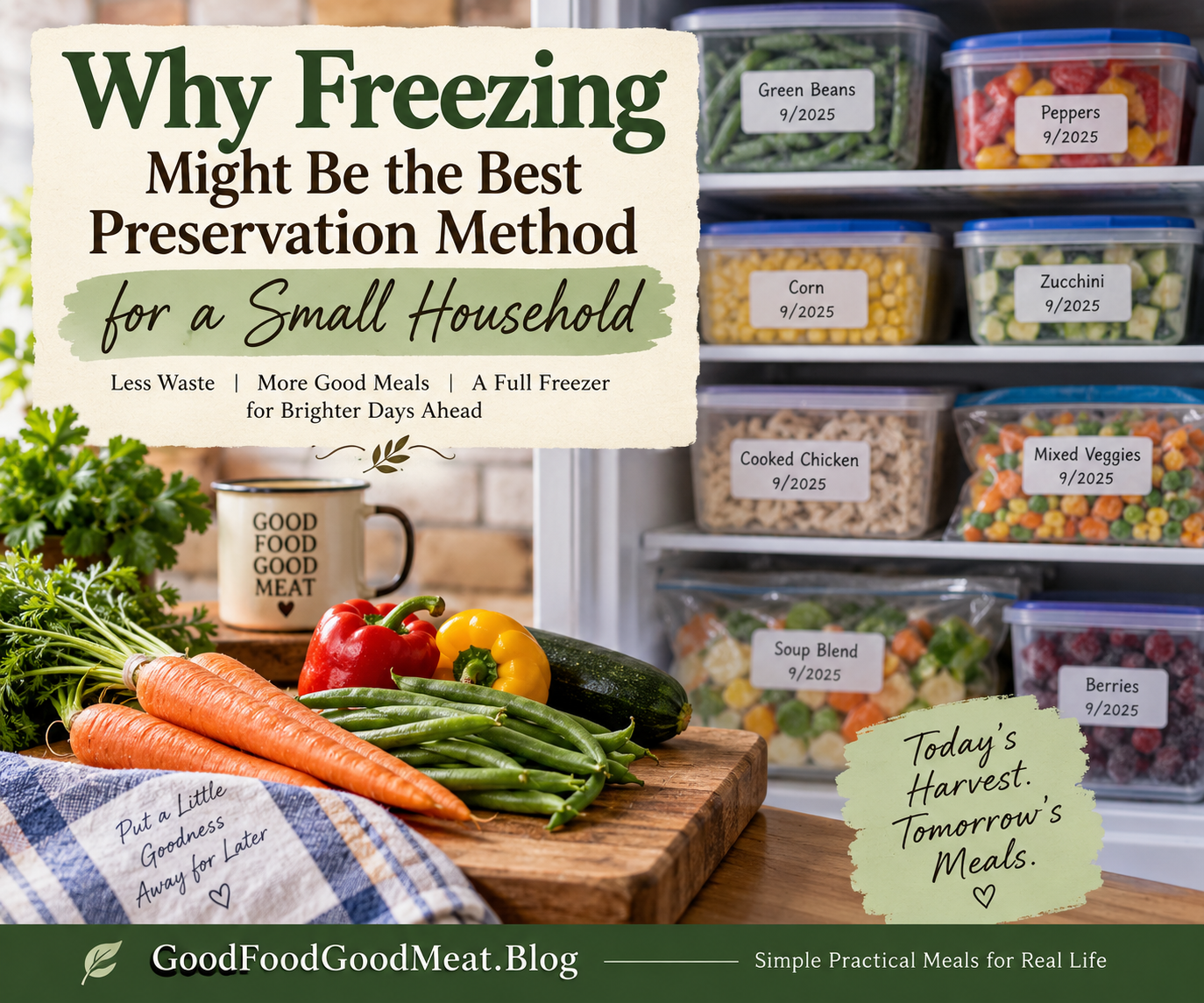
When you think about preserving the harvest, your mind might immediately go to canning.
And there’s a good reason for that. Canning is a wonderful way to put food on the shelf and enjoy it months later. But it isn’t the only way to preserve food—and for a small household, it may not always be the most practical.
Sometimes, the best preservation method is simply the one that fits the way you actually cook.
For a household of one or two people, freezing can be one of the easiest ways to put good food back for later without creating a whole pantry full of jars or preparing more food than you can reasonably use.
Why Freezing Makes Sense for a Small Household
There is something wonderfully simple about freezing.
You can buy a little extra when produce is plentiful, prepare it for the freezer, portion it for the meals you actually make, and then pull out exactly what you need later.
You aren’t necessarily preserving an entire bushel of green beans or making twelve jars of something at once.
You’re putting future meals away.
And that’s an important distinction.
For a small household, preservation doesn’t have to mean doing everything in bulk. It can mean quietly building a supply of ingredients that makes future meals easier, less expensive, and less wasteful.
You Don’t Have to Preserve Everything
One of the biggest advantages of freezing is flexibility.
Maybe the grocery store has a great price on green beans this week. Maybe your garden suddenly produces more zucchini than you can eat. Maybe you find a good deal on peppers, corn, berries, or chicken.
You don’t have to preserve every bit of it.
Put some aside for this week’s meals and freeze the rest.
That lets you take advantage of seasonal abundance without turning preservation into an all-day project.
And if you’re cooking for one or two, that flexibility can be especially valuable. A few extra portions can make a meaningful difference without requiring a huge investment of time or freezer space.
Think Ingredients, Not Just Finished Meals
I love a good freezer meal, but there’s another approach that can be even more useful:
Freeze ingredients that can become several different meals.
For example, a package of frozen green beans might eventually become:
- A chicken and green bean skillet
- Vegetable soup
- A casserole
- A rice bowl
- A simple side dish
Frozen cooked chicken can become soup, wraps, casseroles, salads, or skillet meals.
Frozen vegetables can be combined with rice, pasta, potatoes, meat, or whatever else happens to be waiting in the refrigerator.
That gives you options.
Instead of opening the freezer and thinking, “Well, I guess we’re having whatever meal I froze six weeks ago,” you’re looking at ingredients that can fit into whatever you’re in the mood to cook.
Freezing Can Help With Food Waste
Small households have a particular challenge when buying fresh produce.
The package may be designed for four or six people, even though your dinner table only has one or two chairs.
You buy the vegetables because they’re a good price, use some, and then discover the rest of the package hiding in the refrigerator several days later.
Freezing can interrupt that cycle.
If you know you aren’t going to use something soon, you can prepare it appropriately for freezing and put it away before it becomes refrigerator waste.
That doesn’t mean every food freezes well. Some foods change texture considerably when frozen, and others are better preserved by another method.
The point is to choose the method that works for the food and for the way you intend to use it.
The Freezer Can Become Part of Your Pantry
I’ve always liked the idea of a well-stocked pantry.
But for many of us, the pantry isn’t just a cupboard.
It’s the refrigerator, the freezer, and the shelves where we keep the ingredients that help us make dinner without starting from scratch every single time.
A useful freezer might contain:
- Meal-sized portions of vegetables
- Cooked or prepared meats
- Homemade broth or soup
- Fruit for baking or smoothies
- Portion-sized leftovers
- Ingredients purchased while they’re plentiful or on sale
None of those things has to be a complete meal.
They’re building blocks.
And when those building blocks are organized and labeled, they can make a surprisingly big difference on a busy day.
Small Portions Are a Big Advantage
This is where freezing really shines for smaller households.
Instead of freezing one enormous container, divide food into portions that make sense for the way you eat.
A couple of cups of vegetables may be perfect for one dinner and a lunch.
A small container of cooked chicken might be enough for two bowls.
A handful of frozen peppers could be just what you need for a skillet.
The goal isn’t to fill the freezer as quickly as possible.
The goal is to make it easier to find and use what you’ve already saved.
Don’t Forget to Label It
Future-you deserves to know what’s in that container.
A mystery package of frozen vegetables may seem obvious today. Three months from now, it might look suspiciously like every other package in the freezer.
Label containers and freezer bags with the food and the date.
If the food needs special preparation or has a particular intended use, adding a brief note can be helpful, too.
A freezer inventory can take that one step further—and we’ll get into that later this week.
Freezing Isn’t the Answer to Everything
Of course, freezing isn’t the best preservation method for every food.
Some foods are better suited to canning, drying, fermenting, or simply storing fresh.
And freezing doesn’t eliminate the need to handle food safely. Foods should be cooled, packaged, frozen, thawed, and stored using safe practices.
For tested home-preservation methods and food-safety recommendations, use current guidance from the USDA Complete Guide to Home Canning and the National Center for Home Food Preservation.
The important thing is not to choose a preservation method because it sounds impressive.
Choose it because it makes sense.
Preservation Should Make Life Easier
That’s really the heart of this whole idea.
Preserving food shouldn’t become another source of clutter, expense, or obligation.
It should help future-you.
Maybe that means freezing a few portions of green beans while they’re inexpensive.
Maybe it’s saving leftover cooked chicken instead of letting it languish in the refrigerator.
Maybe it’s freezing a few servings of soup for a rainy day.
Maybe it’s simply buying an extra package of vegetables and putting half in the freezer for next month.
Those small decisions add up.
And eventually, you open the freezer and discover that you’ve quietly built yourself a collection of ingredients that can become dinner.
That’s preservation with a purpose.
You’re not just saving food.
You’re putting a little dinner away for later.
Discover more from Simple, Practical Meals for Real Life
Subscribe to get the latest posts sent to your email.
