Posted in Soups & Stews

Kitchen Sink Vegetable Soup

Introduction

There are soups you make because you planned them, and then there are soups that seem to make themselves.

Kitchen Sink Vegetable Soup belongs in the second category.

It’s the soup you make when the refrigerator has a little of this and a little of that: a carrot or two, some leftover corn, a handful of green beans, part of an onion, perhaps some cabbage or spinach that needs to be used. Add a few pantry staples and some broth, and suddenly those odds and ends become a hearty, nourishing meal.

This kind of cooking has been around forever. In my family, Saturday was often soup day, and whatever vegetables were still hanging around after the week’s meals had a good chance of finding their way into the soup pot.

It’s a lesson worth keeping: you don’t need a refrigerator full of perfect ingredients to make a good meal.


❤️ Why You’ll Love This Recipe

  • A delicious way to use vegetables that need a home
  • Budget-friendly
  • Flexible and forgiving
  • Easy to adapt to what you have
  • Makes several meals from small amounts of ingredients
  • Freezer-friendly
  • Perfect for a chilly campground evening or a simple lunch at home
simplegoodfood's avatarsimplegoodfood

Kitchen Sink Vegetable Soup

KitchenSink Vegetable Soup is the perfect way to use up the last bits of vegetablesand planned-over ingredients in your refrigerator.
Prep Time 15 minutes
Cook Time 30 minutes
Total Time 45 minutes
Servings: 6
Course: Dinner, Lunch, Soup
Cuisine: American
Calories: 225

Ingredients
  

  • 1 tablespoon olive oil
  • 1 medium onion diced
  • 2 cloves garlic minced
  • 2 medium carrots sliced
  • 2 celery stalks sliced
  • 1 medium potato peeled and diced
  • 1 cup green beans cut into bite-sized pieces
  • 1 cup corn
  • 1 cup diced tomatoes
  • 1 cup shredded cabbage
  • ½ cup peas
  • 6 cups low-sodium vegetable or chicken broth
  • 1 teaspoon Italian seasoning
  • ½ teaspoon dried parsley
  • ½ teaspoon salt or to taste
  • ¼ teaspoon black pepper
Optional additions:
  • 1 cup cooked pulled pork chopped
  • ½ cup cooked rice
  • ½ cup cooked pasta
  • 1 cup cooked beans
  • A handful of fresh spinach or kale

Method
 

  1. Heat the olive oil in a large soup pot or Dutch oven over medium heat.
  2. Add the onion, carrots, and celery. Cook for 4–5 minutes, stirring occasionally, until the vegetables begin to soften.
  3. Add the garlic and cook for about 30 seconds.
  4. Add the potatoes, green beans, corn, tomatoes, cabbage, peas, broth, Italian seasoning, parsley, salt, and pepper.
  5. Bring the soup to a gentle boil.
  6. Reduce the heat, cover, and simmer for about 20–25 minutes, or until the potatoes and carrots are tender.
  7. If you’re adding cooked pulled pork, rice, pasta, or beans, stir them in during the last 5–10 minutes, just long enough to heat everything through.
  8. Add spinach or other tender greens during the final 2–3 minutes of cooking.
  9. Taste and adjust the seasonings.
  10. Ladle into bowls and serve warm.

Notes

🧺 Kitchen Confidence
This Week’s Skill: Learning to Cook Without Measuring Everything
Soup is one of the best places to practice cooking by instinct.
Once you’ve made a few pots of vegetable soup, you’ll realize you don’t need exactly one cup of carrots or precisely half a cup of peas. You can adjust the amounts according to what you have.
The important thing is understanding the basics:
Start with aromatics. Add vegetables according to how long they need to cook. Add cooked ingredients near the end. Taste before serving.
That’s it.
And if your soup is a little thicker than you expected, add more broth. If it’s too thin, let it simmer uncovered for a few minutes.
There is a lot of room for confidence in a soup pot.

💰 Stretch Every Grocery Dollar

Soup is one of the easiest ways to turn inexpensive ingredients into several satisfying meals.

You can also stretch it further with inexpensive pantry staples like potatoes, rice, pasta, beans, or barley.

And don’t overlook frozen vegetables. They can be less expensive than fresh, require no preparation, and are an excellent way to keep a variety of vegetables available without worrying about using them immediately.


♻️ Waste Not, Want Not

This is the recipe where everything gets a chance.

That half an onion?

In the pot.

The last carrot?

Slice it up.

A little corn from the rice bowls?

Absolutely.

Some cabbage from the Rainbow Coleslaw?

Perfect.

A handful of spinach?

Toss it in near the end.

A small amount of pulled pork?

Now you’ve got a heartier soup.

The only rule is to use ingredients that are still fresh and safe to eat. “Kitchen sink” doesn’t mean “anything that has been hiding in the refrigerator too long.” 😉


🍽️ Cooking for One or Two

Six servings might sound like a lot for a small household, but soup is one of those meals that makes batch cooking worthwhile.

Enjoy a bowl for lunch or dinner, refrigerate a couple of portions for the next few days, and freeze the rest in individual containers.

That turns one pot of soup into several future meals without having to cook again.


🥣 Meal Prep Note

If you’re making this soup specifically to use up refrigerator odds and ends, gather everything together before you start cooking.

Give each vegetable a quick inspection, wash what you’re using, and chop everything into similar-sized pieces.

Then you can decide what goes into the pot first based on cooking time.

It’s a great way to practice the same mise en place concept used by professional cooks—only we’re doing it in a very relaxed, real-life kitchen.


Storage & Freezing

Refrigerator: Store cooled soup in airtight containers for up to 4 days.

Freezer: Freeze in individual or meal-sized containers for up to 3 months.

If you plan to freeze the soup, consider leaving out pasta and adding freshly cooked pasta when you reheat it. Pasta can become soft after freezing and thawing.

Reheating: Reheat gently on the stovetop or in the microwave until steaming hot.


🌾 Saturday Soup Tradition

There’s something comforting about ending the week with a pot of soup.

You start with ingredients that might otherwise have been forgotten, add a little patience, and end up with something warm and nourishing.

That’s more than saving money.

It’s a way of looking at food differently.

Instead of asking:

“What can I make with this recipe?”

you start asking:

“What can I make with what I have?”

And that’s a pretty valuable kitchen skill.

Posted in Rice Bowls

Refrigerator Fried Rice

Introduction

This is the kind of recipe that doesn’t really need a recipe.

Have some cooked rice? A little pulled pork? A few vegetables that need to be used? Maybe an egg or two? You’re already halfway there.

Refrigerator Fried Rice is all about taking the odds and ends in your refrigerator and turning them into a completely new meal. The ingredients don’t have to match perfectly, and you certainly don’t need to make a special trip to the grocery store. In fact, the whole point is to use what you already have.

It’s one of those meals every cook should have in their back pocket—and it’s a perfect example of Waste Not, Want Not cooking.


❤️ Why You’ll Love This Recipe

  • A great way to use planned-over ingredients
  • Ready in about 20 minutes
  • Budget-friendly
  • Flexible and easy to customize
  • Perfect for small households
  • Works with pork, chicken, turkey, shrimp, or no meat at all
  • An excellent campground or RV meal

🥣 Build Your Bowl

This isn’t technically a Build-A-Bowl recipe, but it follows the same basic idea: start with a foundation and build from what you have.

  • 🍚 Base: Cooked, chilled rice
  • 🥩 Protein: Precooked pulled pork
  • 🥕 Vegetables: Whatever cooked or raw vegetables need to be used
  • 🥣 Sauce: Low-sodium soy sauce
  • 🥬 Fresh Finish: Sliced green onions
  • ✨ Optional Toppings: Fried egg, sesame seeds, cilantro, sriracha, or a drizzle of sesame oil

💡 Make It Your Own: Don’t have pulled pork? Use cooked chicken, turkey, shrimp, ham, or leave the meat out completely. Carrots, peas, corn, broccoli, cabbage, peppers, mushrooms, and green beans are all fair game.

simplegoodfood's avatarsimplegoodfood

Refrigerator Fried Rice

RefrigeratorFried Rice is all about taking the odds and ends in your refrigerator andturning them into a completely new meal.
Prep Time 10 minutes
Cook Time 10 minutes
Total Time 20 minutes
Servings: 4
Course: Dinner, Lunch
Cuisine: American
Calories: 400

Ingredients
  

  • 3 cups cooked chilled rice
  • cups precooked pulled pork chopped into small pieces
  • 2 large eggs
  • 1 cup mixed vegetables chopped small
  • ½ cup corn or peas
  • 2 green onions sliced
  • 2 tablespoons low-sodium soy sauce
  • 1 tablespoon sesame oil divided
  • 1 tablespoon cooking oil
  • 1 clove garlic minced
  • ½ teaspoon grated fresh ginger optional
  • Black pepper to taste
Optional:
  • 1 teaspoon rice vinegar
  • Sriracha or other hot sauce
  • Sesame seeds
  • Additional green onions

Method
 

  1. Prepare your ingredients first. Fried rice cooks quickly, so have everything chopped and ready before you turn on the skillet.
  2. Heat a large skillet or electric skillet over medium-high heat. Add the cooking oil.
  3. Add the eggs and scramble gently until just cooked. Transfer them to a plate.
  4. Add the remaining ½ tablespoon sesame oil to the skillet.
  5. Add the garlic, ginger, and vegetables. Stir-fry for 2–3 minutes, until the vegetables are heated through and beginning to soften.
  6. Add the chopped pulled pork and cook for another 2 minutes.
  7. Add the cold cooked rice. Stir and toss everything together, breaking up any clumps of rice.
  8. Pour the soy sauce around the edge of the hot skillet and stir it into the rice mixture.
  9. Return the cooked eggs to the skillet and stir everything together.
  10. Add the green onions and a splash of rice vinegar, if desired.
  11. Taste and adjust the soy sauce or seasonings as needed.
  12. Serve hot.

Notes

🧺 Kitchen Confidence
This Week’s Skill: Learning to Cook Without a Recipe
This might be the most important kitchen skill of the entire week.
A recipe is a guide, not a set of handcuffs.
Once you understand the basic technique, you can look into your refrigerator and make substitutions based on what you actually have. The vegetables don’t have to be the same ones listed here. The protein doesn’t have to be pork. You don’t even need meat.
The trick is to cut everything into similar-sized pieces and add ingredients according to how long they need to cook.
That’s cooking.

💰 Stretch Every Grocery Dollar

Fried rice is one of the best ways to make inexpensive rice stretch into a complete meal.

It’s also a great reason to cook extra rice when you’re already making it. One batch can become a side dish one night and the foundation for fried rice a few days later.


♻️ Waste Not, Want Not

This is where the refrigerator really gets to shine.

That last handful of peas? Toss them in.

Two lonely carrots? Absolutely.

A little corn from Tuesday’s rice bowl? Into the skillet it goes.

Some cabbage left from your Rainbow Coleslaw? Chop it up and use it.

And that little container of pulled pork that isn’t quite enough for another full meal? Perfect.

This is exactly what Waste Not, Want Not is supposed to look like.


🍽️ Cooking for One or Two

You can easily make a smaller batch by cutting the ingredients in half.

Or make the full recipe and portion it into individual containers for quick lunches. Fried rice reheats well, making it an especially useful meal for small households.


🥣 Meal Prep Note

If you’re cooking rice for another meal this week, make extra.

Cool the extra rice promptly and refrigerate it so it’s ready for fried rice later. Having cooked rice waiting in the refrigerator turns this from a recipe into a 20-minute clean-out-the-fridge meal.


Storage & Freezing

Refrigerator: Store cooked fried rice in an airtight container and use within 3–4 days.

Freezer: Portion cooled fried rice into freezer-safe containers and freeze for up to 3 months.

Reheating: Reheat thoroughly in a skillet or microwave. Add a splash of water if the rice seems dry.

Food safety: Cool and refrigerate cooked rice and other leftovers promptly rather than leaving them at room temperature for an extended period.


🌾 A Little Kitchen Wisdom

Don’t wait until your refrigerator is completely empty to make fried rice.

The sweet spot is when you have a little bit of several things.That’s when the magic happens.

Posted in Recipe Roundup

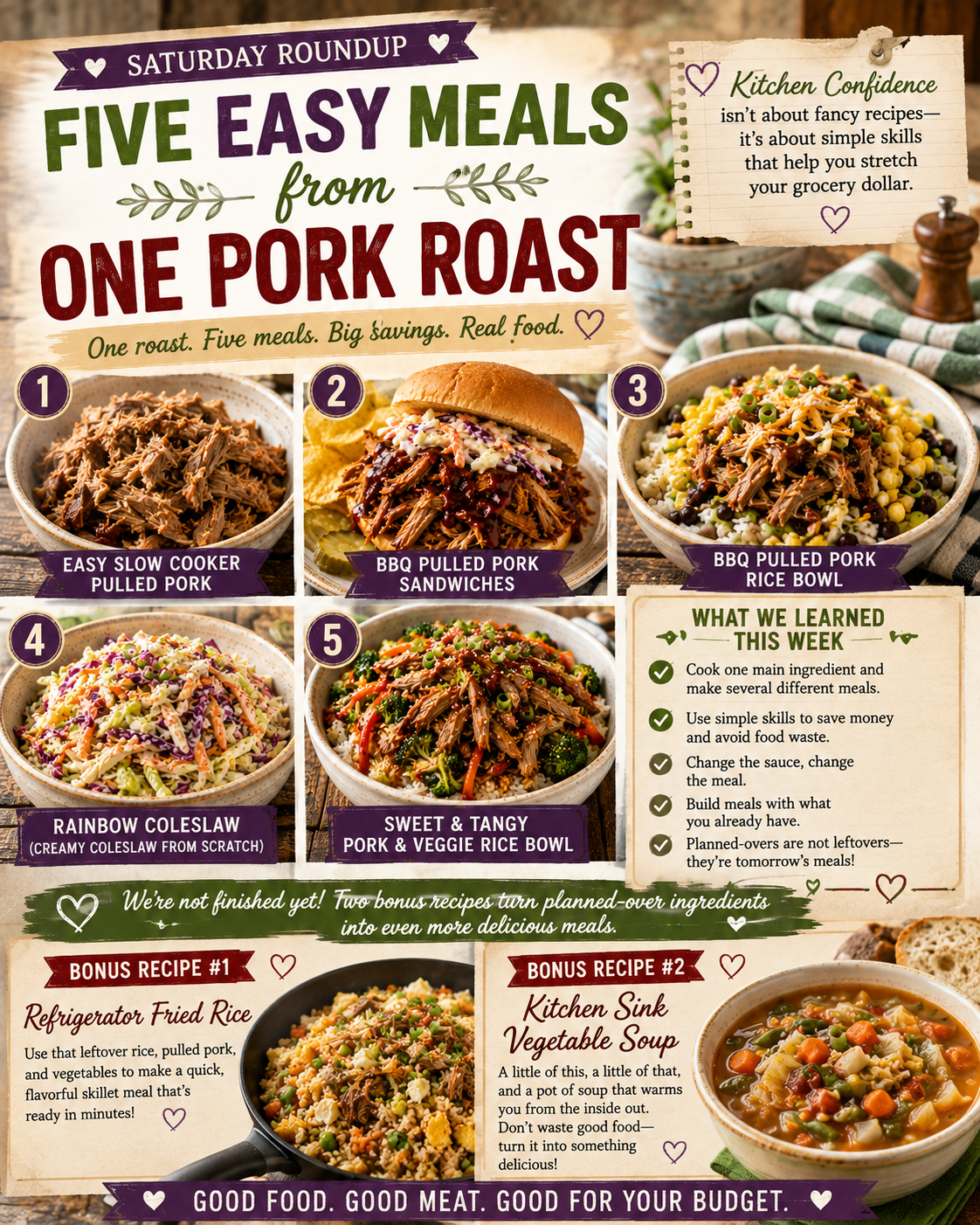
Five Easy Meals from One Pork Roast

Introduction

One of the best ways to stretch a grocery budget isn’t to buy the cheapest food you can find. It’s to make the food you buy work harder.

This week, we started with one affordable pork shoulder and turned it into several completely different meals. Along the way, we practiced some simple kitchen skills: shredding cooked meat, cooking rice, preparing fresh cabbage, making a simple sauce, and storing food in meal-sized portions.

The goal wasn’t to make you spend your week eating the same thing.

It was to show you how one good meal-prep decision can give you several different meals.

And that’s where kitchen confidence starts.


🐷 One Pork Roast, Five Meals

1. Easy Slow Cooker Pulled Pork

We started with the anchor recipe: Easy Slow Cooker Pulled Pork.

A few simple ingredients and a slow cooker did most of the work. The result was tender, flavorful pork that could be divided into portions for several meals.

The skill we practiced: Using a slow cooker to make an inexpensive cut of meat tender and versatile.


2. BBQ Pulled Pork Sandwiches

Next, we turned some of the precooked pork into BBQ Pulled Pork Sandwiches.

A toasted bun, barbecue sauce, and a scoop of Rainbow Coleslaw transformed the pork into a completely different meal.

The skill we practiced: Making a quick meal from precooked ingredients.

And remember—you don’t have to make the pulled pork yourself to enjoy this recipe. Refrigerated or frozen precooked shredded pork can be a perfectly good shortcut when that’s what works for you.


3. BBQ Pulled Pork Rice Bowl

Then came our first Build-A-Bowl.

Rice, pulled pork, corn, black beans, and barbecue sauce created an easy meal that could be customized with whatever toppings you happened to have available.

The skill we practiced: Making cooked rice work harder.

Once you learn how to cook a batch of rice, you’ve got the foundation for countless inexpensive meals.


4. Rainbow Coleslaw

Our colorful Rainbow Coleslaw (Creamy Coleslaw from Scratch) wasn’t just a side dish—it was another kitchen confidence lesson.

Green cabbage, red cabbage, carrots, and a simple homemade dressing turned an inexpensive head of cabbage into a fresh, crunchy side dish.

The skill we practiced: Choosing and preparing whole vegetables.

And that cabbage doesn’t have to stop at coleslaw. Keep those ideas in mind when you’re looking for ways to use the rest of the head.


5. Sweet & Tangy Pork & Veggie Rice Bowl

Our second Build-A-Bowl proved that you don’t need completely different ingredients to create a completely different dinner.

This time, the pulled pork and rice were paired with colorful vegetables and a sweet and tangy honey-garlic sauce.

The skill we practiced: Changing the flavor profile instead of starting from scratch.

That’s a powerful little trick when you’re trying to avoid meal-planning boredom.


🧺 What We Learned This Week

Kitchen confidence isn’t about learning complicated culinary techniques.

It’s about learning small skills that make everyday cooking easier.

This week we learned how to:

  • Shred cooked meat quickly and easily
  • Cook and reuse rice
  • Choose and shred fresh cabbage
  • Build meals from simple components
  • Change a meal’s flavor with a different sauce
  • Store food in meal-sized portions
  • Shop by unit price
  • Make better use of planned-over ingredients

Every one of those skills can save money.

And every one of them gets easier with practice.


💰 The Real Savings

Here’s the bigger lesson from this week’s pork roast:

Cooking once doesn’t mean eating the same meal five times.

The pork became sandwiches.

The pork became rice bowls.

The rice became the base for two different meals.

The cabbage became coleslaw.

The vegetables became part of a new flavor combination.

That’s how you stretch a grocery dollar without making your meals feel repetitive.


♻️ Waste Not, Want Not

We’re not quite finished with this week’s ingredients.

Today we’re going to take another look at what’s hanging around in the refrigerator and turn some of those planned-over ingredients into two more meals.

Because sometimes the most satisfying recipe of the week is the one that uses up the last bits of everything.


🌾 This Week’s Kitchen Confidence

You don’t need a completely new grocery list for every meal.

Start with what you already have.

Change the seasoning.

Change the sauce.

Change the way you serve it.

And suddenly, yesterday’s dinner doesn’t look—or taste—like yesterday’s dinner anymore.

That’s a skill worth learning.


📋 Looking Ahead

Next week we’ll keep building on the idea that simple, practical cooking can save both time and money.

And if you’ve been following along all month, you’re probably starting to see the pattern:

Cook smart.
Use what you have.
Plan for tomorrow.
Waste as little as possible.

That’s how we stretch every grocery dollar. 🌿

We’re not quite finished with this week’s ingredients.

Today we’re going to take another look at what’s hanging around in the refrigerator and turn some of those planned-over ingredients into two more meals.

Because sometimes the most satisfying recipe of the week is the one that uses up the last bits of everything.

Bonus Recipe #1: Refrigerator Fried Rice

Before you clean out the refrigerator, take a second look at what’s left from this week’s meals.

A little cooked rice, some leftover vegetables, and a bit of pulled pork can become a completely different dinner with a hot skillet and a few simple ingredients. Refrigerator Fried Rice is exactly the kind of meal that proves you don’t need a recipe-perfect refrigerator to make something delicious.

It’s also a great way to practice one of the most valuable kitchen skills we’ve talked about all week:

Learning to look at what you have instead of what you think you need.

Use the recipe as a starting point, then make substitutions based on what’s actually in your refrigerator. That’s not cheating—that’s cooking. 🥢


Bonus Recipe #2: Kitchen Sink Vegetable Soup

And finally, it’s time to clean out the vegetable drawer.

A little of this, a little of that, some broth, and a few pantry staples can become a hearty pot of Kitchen Sink Vegetable Soup.

This one is especially close to home because it brings us right back to the Saturday soup tradition you learned from your mom: don’t throw out perfectly good food just because there’s only a little bit left.

Those odds and ends can still make something delicious. Sometimes you just have to give them a chance. 💚

Easy Slow Cooker Pulled Pork
Some recipes feel almost magical, and this is one of them.
Check out this recipe
BBQ Pulled Pork Sandwiches
One of the best rewards for spending a few minutes preparing a slow cooker meal ishow easy dinner becomes the next day.
Check out this recipe
BBQ Pulled Pork Rice Bowl
Ricebowls are one of the easiest ways to stretch ingredients while creatingsomething that feels fresh and satisfying.
Check out this recipe
Rainbow Cabbage
Once you've made it yourself, you may never want to buy prepared coleslaw again.
Check out this recipe
Sweet & Tangy Pork & Veggie Rice Bowl
Oneof the easiest ways to make meal planning feel fresh is by changing theflavors—not the entire recipe.
Check out this recipe
Refrigerator Fried Rice
RefrigeratorFried Rice is all about taking the odds and ends in your refrigerator andturning them into a completely new meal.
Check out this recipe
Kitchen Sink Vegetable Soup
KitchenSink Vegetable Soup is the perfect way to use up the last bits of vegetablesand planned-over ingredients in your refrigerator.
Check out this recipe