Posted in Kitchen Tips

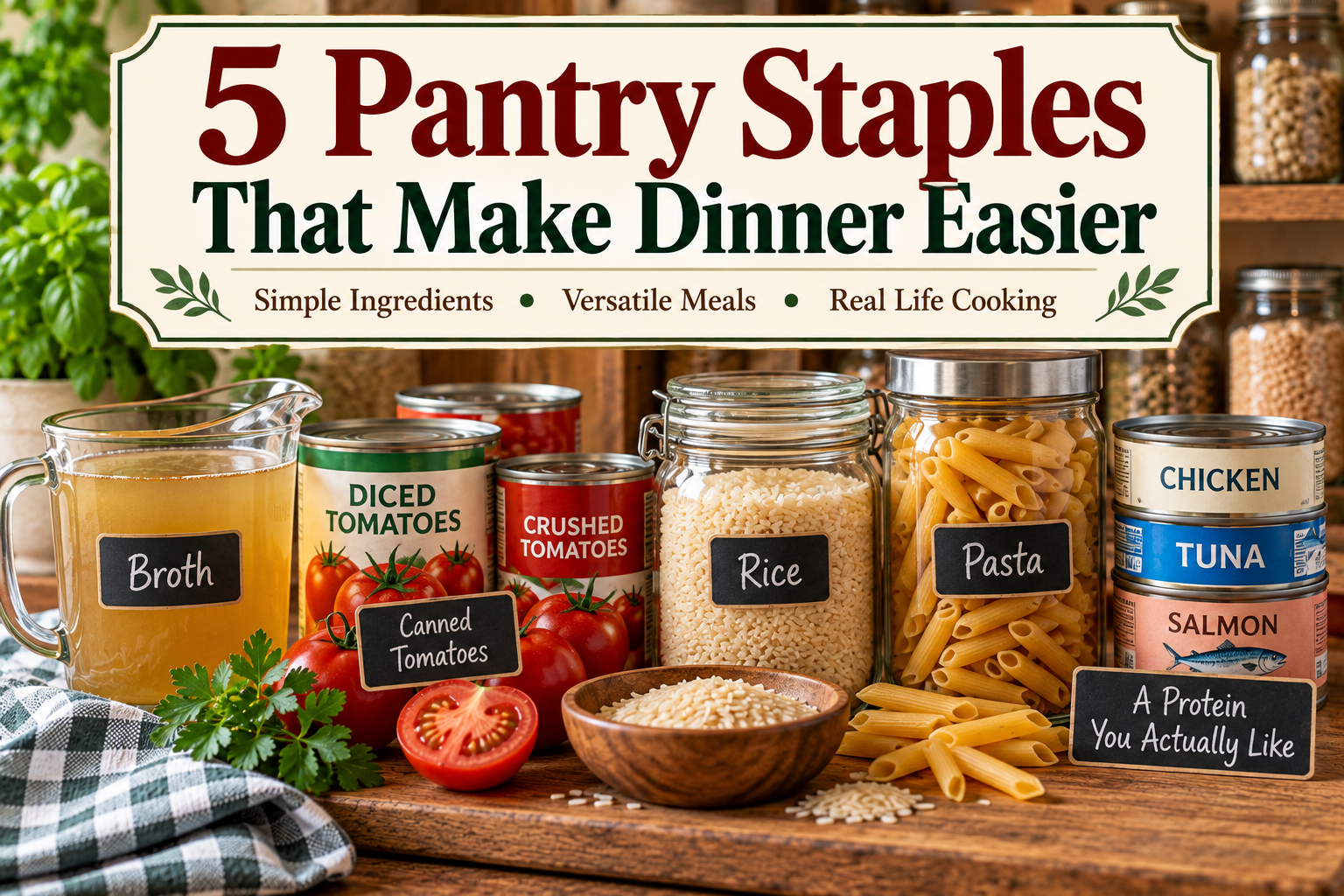
5 Pantry Staples That Make Dinner Easier

A good pantry doesn’t need to be packed to the ceiling.

In fact, when you’re cooking for one or two people, I think there’s a lot to be said for keeping it fairly simple.

The goal isn’t to own every pantry staple ever invented.

It’s to have a handful of ingredients that can step in when you need them and help turn what you already have into dinner.

After a week of Pantry to Table, I’ve been thinking about the ingredients that do the most work in my own kitchen.

Here are five pantry staples that earn their shelf space.

1. Broth

Broth may not sound exciting, but it’s one of those ingredients that can quietly rescue a meal.

A carton or can of broth can become:

  • Soup
  • The cooking liquid for rice or barley
  • The base for a sauce
  • A way to loosen a skillet meal
  • A starting point for gravy
  • Part of a casserole
  • The liquid for rehydrating dehydrated vegetables

And that’s exactly why broth belongs near the top of my pantry list.

Remember Thursday’s Chicken & Vegetable Soup Mix?

Broth is what turns that jar of dehydrated ingredients into lunch or dinner.

Small-household tip

If you don’t use large amounts of broth at once, look for packaging that fits your cooking habits.

Shelf-stable broth also means you don’t have to use valuable refrigerator space until you’ve opened it.

2. Canned Tomatoes

Canned tomatoes are another hardworking pantry ingredient.

Depending on the type you keep, they can become:

  • Pasta sauce
  • Soup
  • Chili
  • Skillet meals
  • Casseroles
  • Rice dishes
  • Bean dishes

A can of tomatoes can add moisture, flavor, and substance without requiring fresh produce.

That’s especially helpful when refrigerator space is limited.

And you don’t necessarily need every variety.

If diced tomatoes are what you use most often, buy diced tomatoes.

If tomato sauce is more useful in your kitchen, stock that instead.

Think about what you actually cook.

The best pantry staple is the one that repeatedly finds its way into your meals.

3. Rice

Rice is one of those pantry staples that can look pretty unremarkable sitting in a container.

Then dinner needs a little help.

Suddenly it’s useful.

Rice can be:

  • A side dish
  • The base for a bowl
  • Combined with chicken
  • Combined with beans
  • Added to soup
  • Used in casseroles
  • Turned into fried rice

It’s also an excellent way to stretch a small amount of protein.

A little chicken and a cup of cooked rice can become a meal.

The same is true of tuna, beans, or leftover vegetables.

Small-household tip

You don’t have to commit to a giant bag if you don’t have the storage space or don’t use rice often.

Choose the size and variety that fits your kitchen.

4. Pasta

Pasta has a similar advantage.

It stores easily, cooks quickly, and can become an entirely different meal depending on what you add.

Tuna and pasta.

Chicken and pasta.

Tomatoes and pasta.

Beans and pasta.

Vegetables and pasta.

Broth and pasta can even become soup.

Wednesday’s Pantry Tuna & Tomato Pasta is a perfect example.

There wasn’t anything particularly unusual in that recipe.

Pasta.

Tuna.

Tomatoes.

Broth.

Seasonings.

Yet those ordinary pantry ingredients became dinner.

That’s exactly the kind of workhorse ingredient we’re looking for.

5. A Protein You Actually Like

I’m deliberately making the fifth item a category rather than naming one particular food.

Your pantry needs a dependable protein.

For some people that’s canned chicken.

For others it’s tuna.

Maybe it’s canned salmon.

Maybe mackerel.

Maybe beans.

Maybe peanut butter.

There isn’t one right answer.

The important thing is having something shelf-stable that you can reach for when fresh meat isn’t available or when you simply don’t want to cook a larger piece of meat.

And this is where the whole Pantry to Table philosophy comes together.

Don’t stock a protein because someone told you it belongs in a pantry.

Stock the one you’ll actually turn into dinner.

What These Five Ingredients Can Do Together

Here’s where things get interesting.

Take just those five categories:

Broth + tomatoes + rice + pasta + protein

You already have the foundation for quite a few meals.

Chicken + rice + broth

Chicken and rice soup

Tuna + pasta + tomatoes

Pantry Tuna & Tomato Pasta

Beans + tomatoes + rice

Bean and tomato rice bowl

Chicken + pasta + broth

Chicken noodle soup

Beans + pasta + tomatoes

A simple pasta and bean skillet

You can add vegetables, seasonings, cheese, sauces, or whatever else you happen to have.

But the foundation is already there.

What About Vegetables?

I’m leaving vegetables off this particular list deliberately.

Not because they’re unimportant.

They’re incredibly important to a practical pantry.

But vegetables are a category where the best choice depends heavily on your storage space and household size.

Some households can keep several bags of frozen vegetables.

Some have room for fresh produce.

Others rely more heavily on canned or dehydrated vegetables.

And for a household of one, even a regular can may sometimes be more than you want to eat at once.

That’s a topic worth giving its own attention as we continue through October.

The Five-Staple Test

Here’s a little test you can use the next time you’re looking at your pantry.

Pick an ingredient.

Then ask:

How many meals can I make with this?

If the answer is one, it may be a recipe ingredient.

If the answer is five or ten, you’ve probably found a pantry workhorse.

That doesn’t mean every versatile ingredient belongs in your kitchen.

It simply gives you a way to think about pantry space.

Pantry Space Is Valuable

Especially in a small kitchen, every shelf has a job.

That’s why I don’t want a pantry full of things that sounded like a good idea when I bought them.

I want ingredients that make cooking easier.

Ingredients that work together.

Ingredients that help me use leftovers.

Ingredients that don’t require me to buy six more things before I can make dinner.

And ingredients that I actually enjoy eating.

Build From What You Use

If you’re looking at your pantry and thinking it needs an overhaul, don’t start with a giant shopping list.

Start with your meals.

What do you cook most often?

What ingredients disappear quickly?

What do you repeatedly find yourself wishing you had?

And what sits untouched for months?

Those answers are far more useful than a generic list of pantry essentials.

Your pantry should reflect your kitchen.

Not somebody else’s.

One Week of Pantry to Table

That’s really what this first week has been about.

We started with a simple chicken meal starter.

Then we talked about building a pantry around the way a small household actually cooks.

We looked at shelf-stable proteins.

We turned tuna, tomatoes, and pasta into dinner.

And we made a homemade chicken and vegetable soup mix from dehydrated ingredients.

Now we’ve narrowed it down to five basic pantry workhorses:

Broth.
Tomatoes.
Rice.
Pasta.
A protein you actually like.

That’s not a complete pantry.

It doesn’t need to be.

It’s a starting point.

Because a useful pantry isn’t built in one shopping trip.

It’s built meal by meal.
And the best pantry is the one that makes tonight’s dinner easier.


Posted in Kitchen Tips

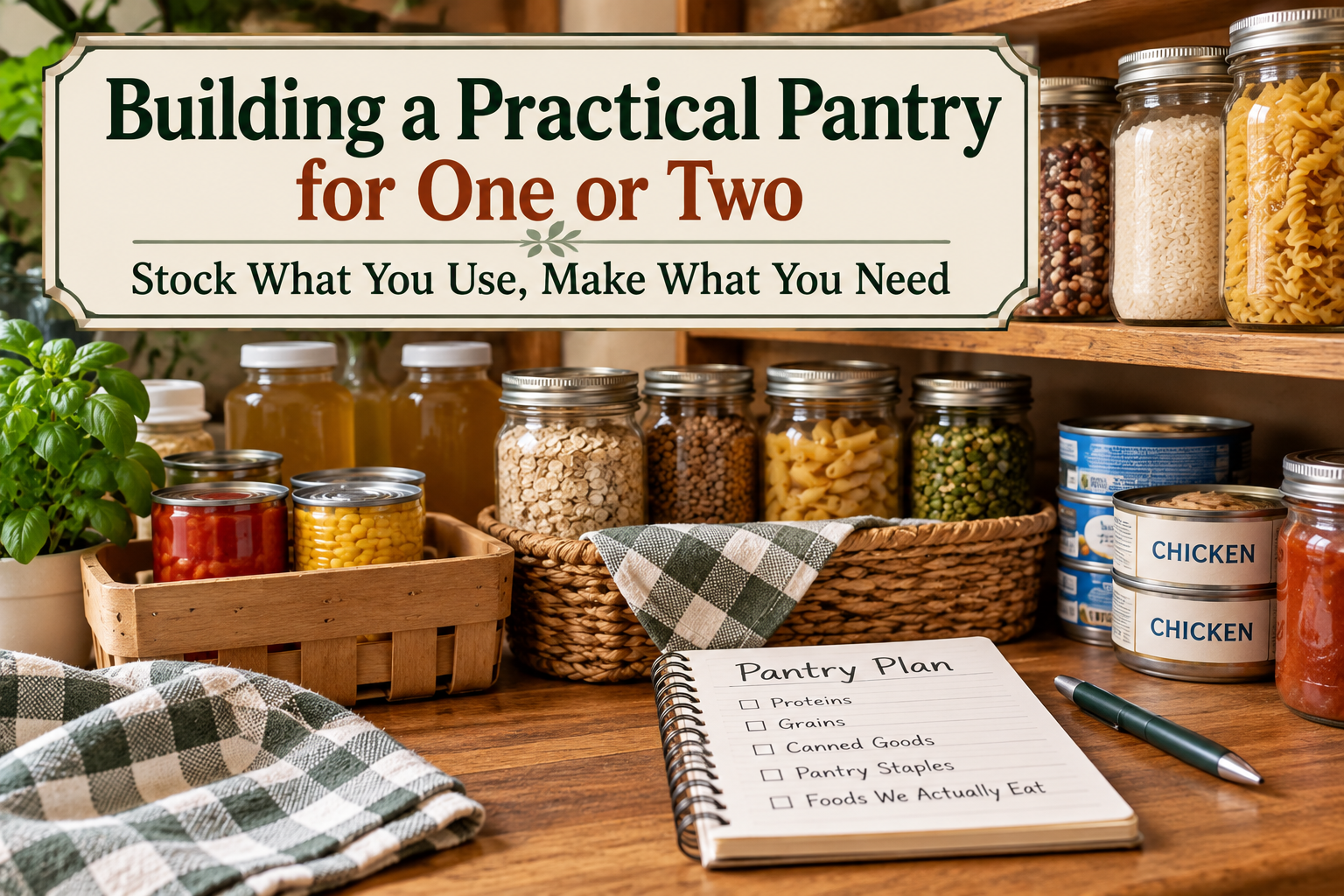
Building a Practical Pantry for One or Two: Stock What You Use, Make What You Need

A lot of pantry advice seems to have been written for somebody with a family of four, a giant kitchen, and enough cupboard space to store every variety of bean ever produced.

That’s not necessarily practical when you’re cooking for one or two.

A useful small-household pantry doesn’t have to be enormous. It needs to contain foods you genuinely use, in amounts that make sense for your cooking habits.

That’s the thinking behind Pantry to Table.

The goal isn’t to fill shelves simply because they’re there. It’s to create a pantry that helps make everyday meals easier, keeps the grocery budget under control, and gives you something useful to work with when another trip to the store isn’t appealing.

Sometimes that means making a few convenience foods yourself.

Begin With the Meals You Already Make

Before buying a collection of “pantry essentials,” look at the meals that already appear on your table.

If soup is a regular part of your menu, you may want broth, canned tomatoes, vegetables, beans, rice or pasta, and a protein you enjoy.

For skillet meals, rice, pasta, canned vegetables, chicken, tomato sauce, broth, and familiar seasonings may be more useful.

For simple breakfasts, oats, pancake ingredients, shelf-stable milk or dry milk, peanut butter, and fruit may be enough.

You don’t need every possible pantry staple.

You need the ingredients that help you cook the food you actually want to eat.

Give Every Pantry Ingredient More Than One Job

Here’s a useful test before bringing a new ingredient home: can you think of at least three meals you could make with it?

Canned chicken is a good example. It can become chicken and rice, soup, chicken salad, a casserole, a wrap, or a skillet meal.

Rice has the same kind of versatility. It can be served as a side, turned into a bowl, combined with chicken, used for fried rice, added to soup, or incorporated into a casserole.

On the other hand, an ingredient that requires several additional purchases just to make the one recipe you bought it for may not be a pantry staple at all. It may simply be a recipe-specific ingredient.

There’s nothing wrong with that. The important thing is knowing which is which.

Homemade Convenience Isn’t Automatically a Bargain

Making something yourself sounds economical, but it isn’t always.

The University of Maine Cooperative Extension’s Saving Money With Homemade Convenience Mixes takes a refreshingly practical approach to the question. It explains that homemade mixes can make sense when you already have the ingredients and will use them, while commercially prepared convenience foods can sometimes be the better choice when making them yourself requires considerable time, extra storage, or ingredients you rarely use.

That’s an important distinction for Pantry to Table.

The objective isn’t to make everything from scratch simply because we can.

The objective is to make choices that work for our own kitchens.

Small-Batch Homemade Mixes Make Particular Sense

There is one area where I think small households can really benefit from homemade convenience foods: mixes.

Pancake mix. Biscuit mix. Cornbread. Muffins. Quick breads. Seasonings. Soup mixes.

The University of Maine Cooperative Extension’s Saving Money With Homemade Convenience Mixes publication contains 15 master mixes and recipes showing how those mixes can be used for pancakes, biscuits, muffins, breads, casseroles, dressings, seasonings, and more.

It’s particularly useful because it doesn’t simply hand you recipes. It also addresses the practical question of whether making a mix yourself is actually worthwhile.

For a household of one or two, that question matters.

Portion the Mix for the Way You Cook

There’s no reason to make a five-pound container of pancake mix if you make pancakes once or twice a month.

Instead, consider preparing several smaller batches.

The University of Alaska Fairbanks Cooperative Extension’s Make Your Own Mix guide specifically discusses storing homemade mixes in amounts suited to your usual needs and labeling them with the information needed for preparation.

That’s an especially good fit for a small household.

Rather than measuring several dry ingredients every time you want pancakes, you can prepare individual batches ahead of time and simply add the wet ingredients when you’re ready to cook.

Those Little Mason Jars Can Earn Their Keep

Small jars are ideal for this kind of project.

A jar can contain one batch of dry mix, with a label giving you the information you’ll need later:

Pancake Mix
Makes 2 servings
Add 1 egg + milk/water
Cook on griddle
Made: October 2026

The jar becomes both storage container and recipe reminder.

There’s no need to measure flour, baking powder, sugar, and salt each time.

Just open the jar, add the required wet ingredients, and cook.

But Don’t Assume Every Mix Is Shelf-Stable

This is important.

Some homemade mixes contain fats such as oil, butter, margarine, or shortening, so they may require refrigeration or freezing.

The University of Maine Cooperative Extension’s All-Purpose Convenience Mix contains oil and calls for refrigeration. Oregon State University Extension’s Master Mix also contains oil and recommends refrigeration and using the mix within one month.

So “homemade mix” does not automatically mean “store it in the pantry.”

Use the storage instructions provided for the particular recipe.

That’s another reason dry, single-use mixes can be attractive for a small pantry.

Convenience Mixes Can Be Seasonings, Too

Homemade mixes don’t have to involve baking.

You can prepare small jars of taco seasoning, chili seasoning, Italian-style seasoning, salt-free seasoning, or other blends you regularly use.

The University of Maine Cooperative Extension’s Homemade Convenience Mixes recipes include several seasoning recipes, including taco, chili, salt-free, and other blends.

For a small household, a little jar of a seasoning you use regularly can be more practical than buying a large specialty container that may sit around for months.

And making your own gives you control over the ingredients and flavor.

Keep Good Extension Resources Close

Another goal for Pantry to Table is to point readers toward reliable information rather than presenting every idea as though it originated here.

Several Cooperative Extension programs have excellent material on homemade mixes.

The University of Maine Cooperative Extension’s Saving Money With Homemade Convenience Mixes is probably the best comprehensive starting point. It contains 15 master mixes along with recipes that use them for pancakes, biscuits, muffins, breads, casseroles, seasonings, dressings, and more.

The University of Alaska Fairbanks Cooperative Extension’s Make Your Own Mix covers master mixes, baking mixes, seasoning mixes, beverage mixes, and other homemade convenience ideas. Its emphasis on making quantities appropriate for your normal needs is especially relevant for one- and two-person households.

The Oregon State University Extension’s Master Mix provides a master mix for biscuits, pancakes, and other recipes. It’s also a useful reminder that storage requirements vary from recipe to recipe.

And UC Agriculture and Natural Resources’ Do-It-Yourself Mixes offers jar mixes and other homemade convenience ideas for turning pantry ingredients into ready-to-use combinations.

These are resources worth keeping bookmarked, especially if we’re going to experiment with homemade mixes ourselves.

Dehydrating Gives a Small Pantry Another Option

Homemade pantry building doesn’t stop with flour, oats, and seasoning.

Dehydrated vegetables can be especially useful when you’re cooking for one or two because you can store relatively small amounts and use only what a particular meal requires.

The University of Minnesota Extension’s information on drying food explains that dried foods are convenient, lightweight, easy to prepare, and can save storage space compared with canned or frozen foods.

That’s one of the reasons I like dehydrating for a small household.

You don’t necessarily have to open an entire can when you need a couple of tablespoons.

You can use exactly what the recipe calls for.

Remember That “Shelf-Stable” Doesn’t Mean “Keep Forever”

A pantry isn’t a place where food disappears until somebody eventually rediscovers it.

Rotate what you have.

Use older items first.

Keep dates where you can see them.

And label homemade mixes.

The University of Alaska Fairbanks guidance specifically recommends labeling homemade mixes with information about what they contain, how much to use, and the directions needed to prepare them.

A piece of masking tape and a marker can prevent that inevitable moment months later when you stare at an unidentified jar and wonder:

“What on earth did I put in this?”

Ask me how I know. 😉

Your Pantry Should Look Like Your Kitchen

There isn’t one perfect pantry.

If you don’t eat beans, you don’t need six varieties of beans.

If canned salmon isn’t something you enjoy, it doesn’t become useful merely because somebody calls it a pantry essential.

If canned chicken is something you use regularly, keep it.

If you make pancakes once a month, a small homemade pancake mix may be worthwhile.

If you rarely bake, there is no reason to devote precious shelf space to baking mixes.

Your pantry should support your cooking—not dictate it.

That’s the real distinction between simply accumulating pantry food and building a pantry that serves you.

Start With a Few Categories

If you’re beginning—or rebuilding—a pantry, don’t feel as though you need to do it all at once.

Begin by considering five basic areas.

Protein: chicken, tuna, salmon, beans, peanut butter, or the proteins you actually use.

Vegetables: the canned, frozen, or dehydrated vegetables that regularly appear in your meals.

Grains and starches: rice, pasta, oats, potatoes, barley, or whichever staples you actually cook.

Flavor builders: broth, tomatoes, sauces, oils, vinegars, herbs, and seasonings.

Convenience helpers: homemade mixes, shelf-stable ingredients, or prepared foods that genuinely make cooking easier.

Then pay attention to what you use.

Over time, your own shopping habits will reveal what belongs in your pantry.

The Point Isn’t to Prepare for 100 Meals

A practical pantry isn’t about preparing for some imaginary future in which you’ll suddenly need to cook for a hundred people.

It’s about making an ordinary Tuesday night easier.

It’s looking at the shelves and realizing:

“I’ve got chicken. I’ve got rice. I’ve got vegetables. I’ve got broth. I can make dinner.”

That’s exactly what Sunday’s Chicken Meal Starter demonstrated.

And that’s where Pantry to Table is headed throughout October: simple ingredients, small batches, useful shortcuts, less waste, and food that actually gets eaten.

Because the best pantry isn’t necessarily the one with the most food.

It’s the one that helps you make dinner.


Pantry Resources Worth Saving

These are the resources I’ll be returning to throughout the series:

I’ll be referring back to these resources as we continue Pantry to Table.