
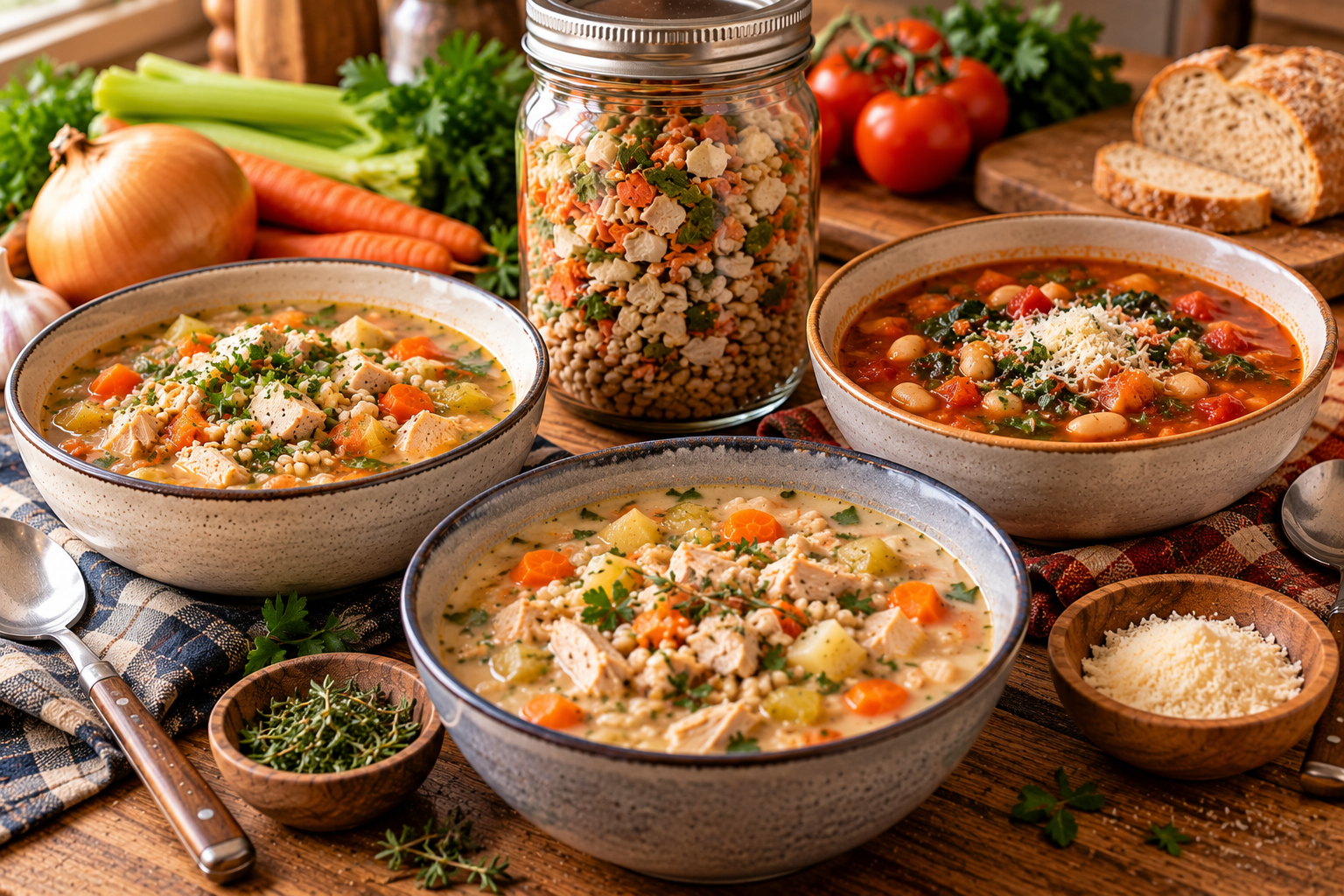
Yesterday, we turned a jar of homemade soup starter into Turkey & Barley Comfort Soup.
Today, we’re going to do something even more useful.
We’re going to take that same soup starter and turn it into three completely different meals.
Because that’s the secret to a practical pantry:
You don’t need a pantry full of recipes. You need ingredients that can work in more than one recipe.
A good soup starter gives you the vegetables, grain, and basic seasonings.
What you add to it determines what kind of soup ends up in the bowl.
And for a household of one or two, that kind of flexibility can make a big difference.
Start With the Same Soup Starter
Our Homemade Soup Starter Mix contains dehydrated:
- Carrots
- Celery
- Onion
- Potatoes
Along with:
- Pearl barley
- Parsley
- Thyme
- Garlic
- Onion powder
- Black pepper
- Salt
The basic cooking method stays the same.
Add one portion of the starter to about 4 cups of broth, bring it to a simmer, and cook until the barley and vegetables are tender.
Then comes the fun part.
Change the protein. Change the vegetables. Change the seasoning. Change the finish.
And you’ve changed the soup.
1. Turkey & Barley Comfort Soup
Let’s start with the version we made yesterday.
It’s the classic combination:
Turkey + barley + root vegetables + herbs
Add
- 1 to 1½ cups cooked turkey
- Chicken or turkey broth
- Fresh parsley
- A squeeze of lemon
Optional
Add a handful of frozen peas during the last few minutes.
Why It Works
Turkey and barley are a natural match.
The barley makes the soup hearty, while the turkey adds protein without requiring a large amount of meat.
The lemon at the end gives the whole bowl a little lift.
This is the version to make when you’re craving a traditional, cozy bowl of soup.
2. Chicken, Vegetable & Lemon Soup
Now let’s change the personality of the same starter.
Instead of turkey, use chicken and brighten everything up.
Add
- 1 to 1½ cups cooked chicken
- Chicken broth
- ½ cup frozen peas
- A handful of fresh spinach
- 1–2 teaspoons lemon juice
- Fresh parsley
Optional
If you have leftover cooked carrots, green beans, or corn, add them too.
The Difference
The basic starter hasn’t changed.
But the addition of chicken, green vegetables, and lemon makes this version feel much lighter and brighter.
And this is a perfect example of why you don’t have to follow a recipe rigidly.
Maybe you don’t have turkey.
That’s fine.
Use chicken.
Maybe you have leftover vegetables that need a home.
Add them.
The soup adapts.
3. White Bean & Tomato Barley Soup
Now let’s take the same starter in an entirely different direction.
Skip the meat and add beans and tomatoes.
Add
- 1 can (15 ounces) white beans, drained and rinsed
- 1 cup diced tomatoes, canned or leftover
- Vegetable or chicken broth
- ½ teaspoon Italian seasoning
- 1 tablespoon grated Parmesan, optional
- Fresh parsley, optional
How to Make It
Start the soup starter in the broth as usual.
When the vegetables and barley are nearly tender, add the beans and tomatoes.
Simmer until everything is hot and the flavors have come together.
Taste before adding additional salt because canned beans and tomatoes can vary considerably in sodium.
Finish with Parmesan and parsley if desired.
The Difference
Suddenly we’re no longer talking about turkey soup.
We’re talking about a hearty bean-and-tomato soup with Italian-inspired flavors.
Same starter.
Completely different supper.
The Formula Behind the Three Soups
Here’s what changed:
| Soup | Protein | Flavor Direction | Finish |
| Turkey & Barley | Turkey | Classic herb | Lemon + parsley |
| Chicken & Vegetable | Chicken | Bright & fresh | Lemon + greens |
| White Bean & Tomato | White beans | Tomato & Italian | Parmesan + parsley |
The starter stayed essentially the same.
That’s the point.
You aren’t building three different pantry systems.
You’re building one useful base that can become several meals.
Kitchen Confidence: Think in Swaps
Once you understand the formula, you can start making substitutions without worrying that you’re somehow “ruining” the recipe.
Protein swaps
Turkey → Chicken → Beans → Lentils → Pork
Vegetable swaps
Peas → Green beans → Corn → Spinach → Cabbage
Grain swaps
Barley → Rice → Small pasta
Flavor swaps
Thyme & parsley → Italian herbs → Cumin & oregano
The combinations are practically endless.
But you don’t need endless combinations.
You only need enough variety to keep your pantry meals interesting.
What If You Don’t Have the Exact Ingredient?
This is where pantry cooking gets easier.
No fresh parsley?
Use dried.
No turkey?
Use chicken.
No chicken?
Use beans.
No peas?
Use frozen green beans.
No fresh spinach?
Skip it.
No lemon?
Try a tiny splash of vinegar in a savory soup.
No barley?
Use rice or small pasta, keeping in mind that the cooking method and timing may change.
The important thing is understanding what an ingredient contributes.
Once you know that, substitutions become much easier.
Stretch Every Grocery Dollar
This is one of the reasons I like homemade pantry mixes so much.
You’re not buying a different boxed soup mix for every flavor you want.
Instead, you keep a flexible base on hand and use the ingredients you already have to change it.
A can of white beans can become soup.
Leftover chicken can become soup.
A small amount of frozen vegetables can become soup.
That half can of tomatoes left from another recipe can become soup.
You’re getting more meals from the same groceries.
And that’s a much more useful kind of pantry stocking than simply buying more food.
Waste Not, Want Not
Soup is one of the easiest places to use small quantities of leftovers.
That doesn’t mean dumping everything into the pot.
Flavor matters.
But if you have a little cooked vegetable, a small amount of leftover meat, or part of a can of beans or tomatoes, soup is worth considering.
The trick is to ask:
Will this ingredient work with the flavor direction I’m creating?
If yes, use it.
If no, save it for something else.
“Use everything” shouldn’t mean “throw everything together.”
Cooking for One or Two
This concept is especially useful for small households.
You don’t have to make three different soups.
Make one starter mix.
Then change the additions.
For example:
Monday: Turkey soup
Wednesday: Chicken soup
Friday: Bean and tomato soup
You get variety without buying a completely different set of ingredients for each meal.
And if you live alone, you can make one or two servings at a time instead of cooking a large pot.
Meal Prep Note
If you want to make several versions during the same week, keep your starter mix dry and prepare only the amount of soup you need.
That way, you can make one flavor today and a different flavor later.
This is particularly helpful when you’re cooking for one.
There’s no reason the entire household has to eat the same soup three nights in a row simply because you made a large pot.
Storage & Freezing
Once prepared, store leftover soup in a covered container in the refrigerator and use within 3–4 days.
Individual portions can also be frozen.
If you know you’re going to freeze the soup, consider keeping delicate finishing ingredients such as fresh herbs, lemon juice, cheese, or yogurt until you’re ready to serve.
Add those after reheating for the freshest flavor.
The Bigger Lesson
This is what I really want you to take away from this week’s soup project:
A pantry doesn’t have to be a collection of finished meals.
It can be a collection of building blocks.
The soup starter gives you one building block.
Your freezer gives you another.
The canned goods on your shelf give you more.
Your refrigerator leftovers give you another.
And your knowledge of how those ingredients work together is what turns them into dinner.
That’s a much more flexible way to cook.
And once you start thinking this way, you’ll find yourself looking at your pantry a little differently.
Instead of seeing:
“I don’t have the ingredients for a recipe.”
You may start seeing:
“I have the ingredients to make something.”
And honestly, that’s a pretty useful cooking skill to have.
