There is something special about a September farm stand.
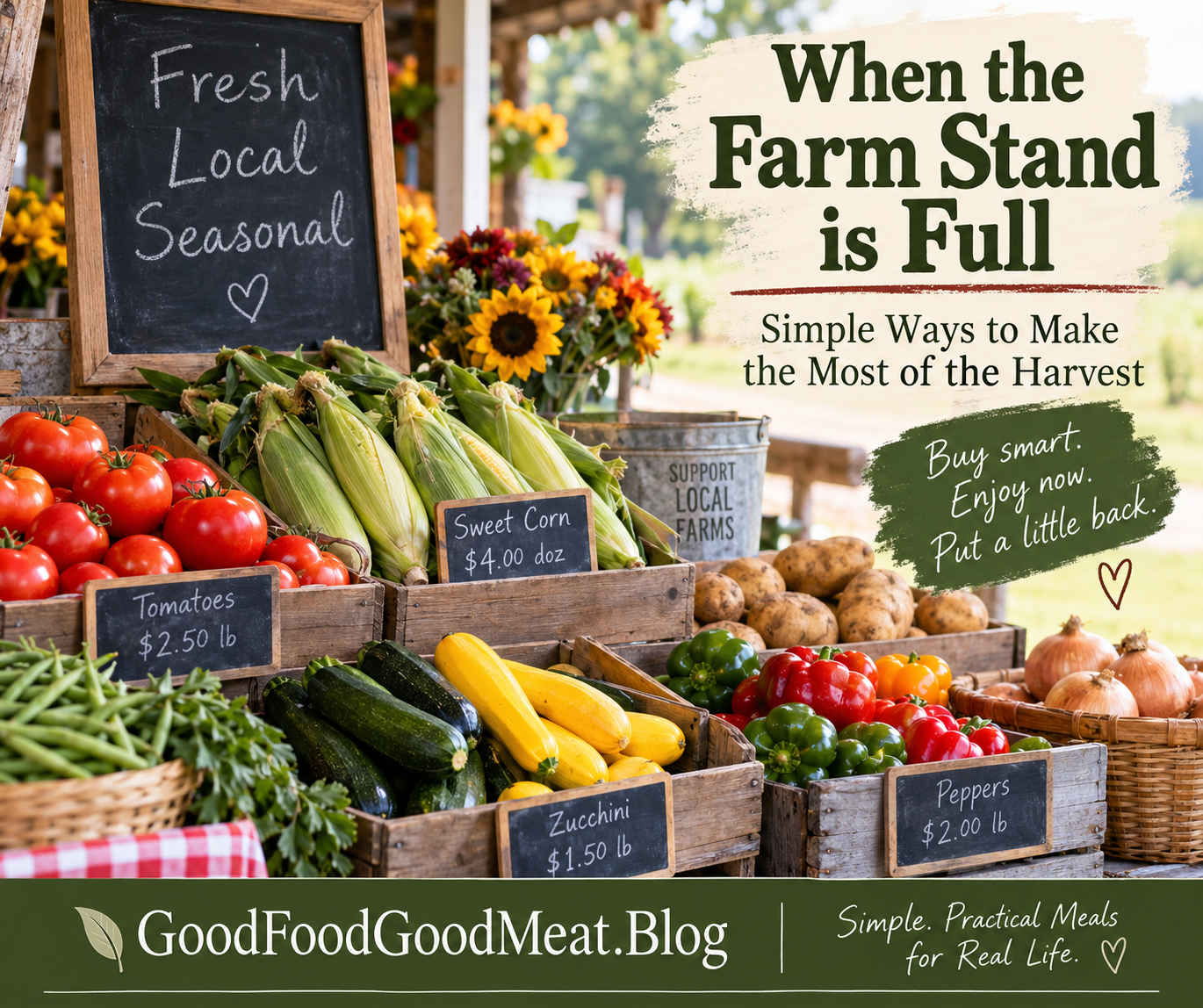
The tables seem to get fuller by the day. Corn is piled high. Tomatoes are still hanging on. Peppers, zucchini, onions, potatoes, carrots, and all sorts of late-summer vegetables are competing for your attention.
It is the kind of abundance that makes you want to bring home a little bit of everything.
And honestly? That isn’t always a bad idea.
September is one of the best times of year to take advantage of what’s plentiful and affordable right now. But the trick is knowing what to do with all that goodness once you get it home.
That’s where a little planning—and a little old-fashioned common sense—comes in.
Buy What’s Good Now
When something is plentiful, it often means two things: it’s at its peak, and there is a lot of it available.
That can be good news for your grocery budget.
Instead of buying vegetables simply because you have a recipe that calls for them, September is a good time to look at what’s actually abundant where you shop. If sweet corn is piled up at the farm stand, that’s your cue to enjoy some now and consider putting a little away for later.
If tomatoes are plentiful, make sauce, salsa, or a simple tomato dish.
If zucchini is practically giving itself away, buy what you can realistically use—and perhaps freeze some for a future meal.
The goal isn’t to bring home the entire farm stand.
It’s to recognize an opportunity.
Don’t Buy More Than You Can Manage
There is a fine line between taking advantage of abundance and creating your own kitchen emergency.
We’ve all done it.
You see beautiful produce at a great price and think, I’ll figure out what to do with it.
Then three days later, you’re staring at a refrigerator full of vegetables wondering when you’re going to find the time to deal with them.
So before you buy, ask yourself a few simple questions:
How much can I realistically use this week?
What can I cook right away?
Can I freeze, dehydrate, or otherwise preserve some of it?
Do I have the storage space?
Is the savings worth the work involved?
Those questions can turn an impulse purchase into a smart one.
Think Beyond This Week’s Dinner
One of the best things about buying produce at its peak is that you don’t necessarily have to eat all of it immediately.
Some foods can be preserved so that today’s abundance becomes part of a meal weeks or months from now.
That’s the idea behind putting a little back.
You don’t need a basement full of shelves lined with jars to preserve food. You don’t even have to preserve an enormous quantity.
A few bags of frozen sweet corn can become a quick side dish.
A container of frozen vegetables can become part of a soup or skillet meal.
Dried vegetables can become ingredients in a pantry meal.
And a small batch of something preserved today can make a future dinner just a little easier.
That’s a pretty good return on a little time spent in the kitchen.
September Is About Making the Most of What We Have
Around here, September isn’t about buying every gadget, filling every shelf, or spending an entire weekend preserving fifty pounds of vegetables.
It’s about being practical.
Buy what’s good.
Buy what’s affordable.
Enjoy some now.
Put a little back for later.
And use what you already have before buying something else.
That last part matters, too. Before heading to the market, take a quick look through your refrigerator, freezer, and pantry. You may already have half of what you need for a meal.
September’s harvest gives us a chance to be intentional about all of it.
We’re going to spend this month looking at different ways to take advantage of seasonal abundance—from freezing and dehydrating to simply planning meals around what’s available.
And we’re going to keep one important idea in mind:
Preserving food isn’t about preserving everything. It’s about preserving what makes sense for you.
So when the farm stand is full, take a good look.
Enjoy the abundance.
Buy what you’ll use.
And if there’s something especially good—and especially plentiful—maybe put a little back.
Because today’s harvest can make tomorrow’s dinner a whole lot easier.
September has arrived, and with it comes one of my favorite transitions of the year.
The gardens and farmers markets are still giving us plenty of summer vegetables, but autumn is beginning to show up around the edges. Apples are appearing. Winter squash is making an entrance. The days are getting a little shorter.
It’s the perfect time to start thinking about putting a little back.
And preserving food doesn’t have to mean spending an entire weekend in a hot kitchen surrounded by dozens of canning jars.
There are several ways to preserve seasonal food, and the best method depends on what you’re preserving, how much you have, how you’ll use it, and how much time you want to spend.
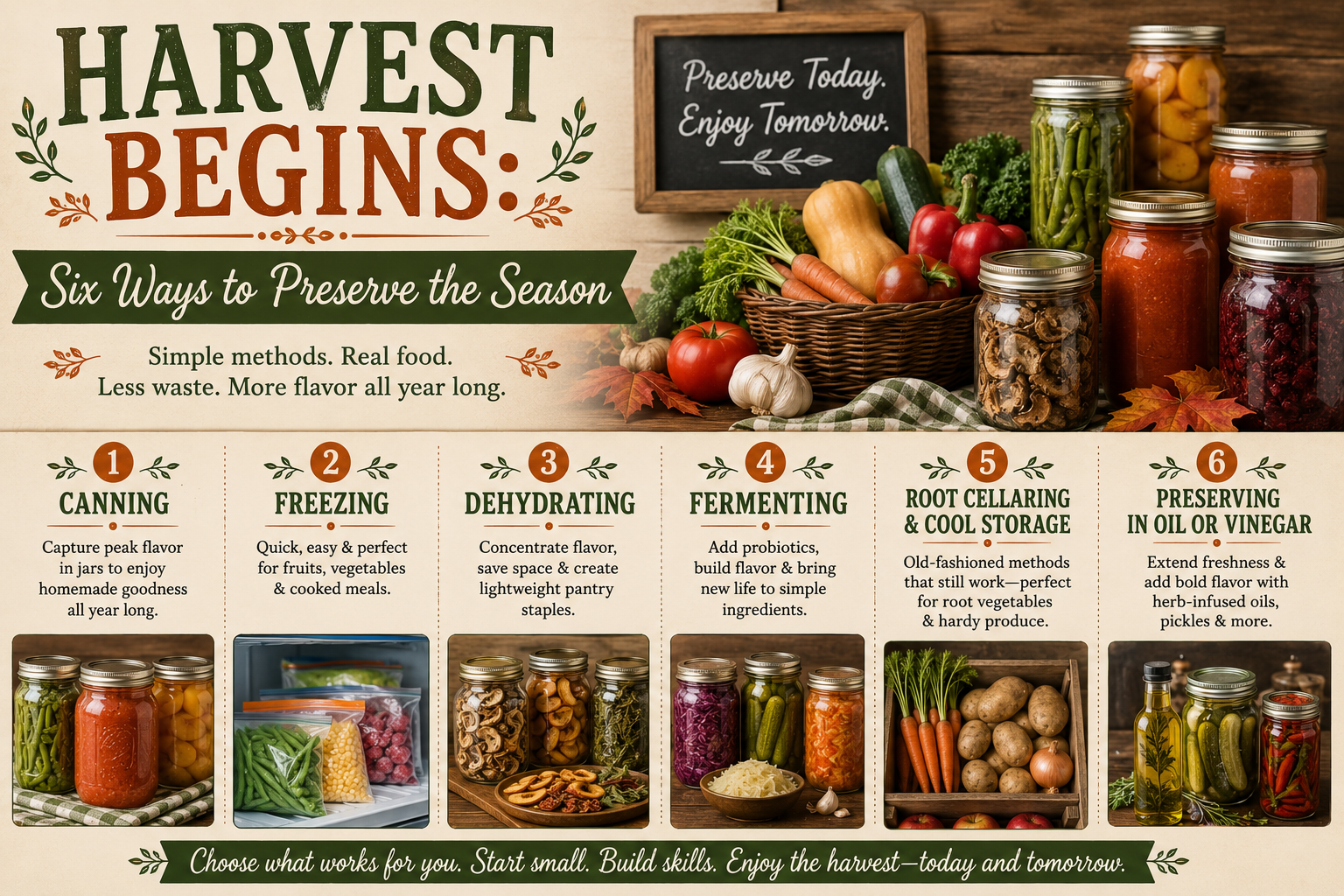
So let’s look at six practical ways to make today’s harvest last a little longer.
🫙 1. Pressure Canning
Pressure canning is the method used for preserving low-acid foods, including meat and many vegetables.
That’s why you’ll see pressure canning discussed when we talk about putting things like ground beef, chicken, or certain vegetables back for the pantry.
But pressure canning is not a method to improvise.
The food, jar size, processing time, pressure, and other details all matter. Always use a current, tested recipe and follow the instructions for your specific pressure canner.
This week, we introduced the idea with Pressure-Canning Ground Beef.
The goal wasn’t to turn everyone into a canner overnight.
It was to show how a good sale on ground beef could potentially become several future meals instead of just tonight’s dinner.
Best for: Low-acid foods and shelf-stable pantry storage when using tested recipes and proper equipment.
🧊 2. Freezing
Freezing is probably the easiest preservation method for most home cooks.
No special canner.
No pressure gauge.
No long processing session.
Just prepare the food appropriately, package it well, label it, and get it into the freezer.
Freezing works particularly well for:
Peppers
Herbs
Corn
Green beans
Cooked meats
Soups
Broths
Prepared meals
It’s also an excellent option for small households.
You don’t have to preserve a bushel of anything.
Freeze a pound.
Freeze four servings.
Freeze the extra peppers from this week’s grocery trip.
That’s still putting food back.
Best for: Small quantities, prepared meals, vegetables, meats, herbs, and ingredients you’ll use within a reasonable freezer-storage period.
🌬️ 3. Dehydrating
Dehydrating removes moisture from food, making it much lighter and extending its storage life when properly prepared and stored.
It’s especially useful for people who have limited freezer space.
Vegetables such as carrots, celery, corn, peas, onions, mushrooms, and zucchini can be dehydrated and later used in soups, stews, skillet meals, and other dishes.
It’s also a wonderful way to deal with those moments when you’ve bought more produce than you can possibly eat fresh.
Instead of asking:
“How am I going to eat all of this?”
you can ask:
“How can I turn some of this into an ingredient I’ll use later?”
Best for: Vegetables, fruits, herbs, and lightweight ingredients that can be rehydrated or used directly in cooking.
🍎 4. Making Jams, Jellies, and Fruit Spreads
Fruit preservation gives us another way to capture the season.
Apples, peaches, berries, and other fruits can become jams, jellies, sauces, and spreads.
This is one area where it’s particularly important to distinguish between a recipe intended for refrigerator or freezer storage and one intended for shelf-stable canning.
If you’re canning fruit products for pantry storage, use a tested recipe and follow it exactly.
But you don’t have to can a dozen jars.
A small batch of refrigerator jam can be just as useful for a household of one or two.
Best for: Seasonal fruit and creating something that can brighten breakfasts, desserts, sauces, or snacks later.
🥣 5. Cook It Into Something
Here’s a preservation method we don’t talk about often enough:
Cook it now.
Sometimes the best way to save seasonal food is to turn it into something you’ll actually want to eat.
Those extra vegetables can become:
Soup
Chili
Pasta sauce
Casserole filling
Vegetable skillet
Rice bowl components
A pot of soup can then be refrigerated for the next few days or frozen in meal-sized portions.
That’s exactly what we did with Garden Harvest Beef & Vegetable Soup this week.
Instead of trying to preserve every individual vegetable, we turned several of them into dinner.
And then we put a few servings in the freezer for another day.
Best for: Vegetables and ingredients that need to be used soon, especially when you want a ready-to-eat meal later.
🥕 6. Preserve the Ingredients, Not Just the Food
This might be my favorite approach for everyday cooking.
Instead of thinking about preserving a finished meal, think about preserving building blocks.
Cook extra chicken.
Freeze some ground beef.
Freeze chopped peppers and onions.
Dehydrate carrots and celery.
Cook a little extra rice and freeze it in portions.
Freeze fresh herbs before they spoil.
None of these things requires you to create a perfectly stocked pantry.
But each one gives future-you something to work with.
And that’s really the idea behind our new Pantry Builder feature.
🫙 One Thing at a Time
Every week this month, we’ll choose one practical thing to put back.
Not twenty things.
Not an entire year’s supply.
One thing.
Because a pantry doesn’t have to appear overnight.
You can build it gradually, based on the way you actually cook and the foods you actually eat.
🌾 Which Preservation Method Is Right for You?
There isn’t one answer.
If you have…
Consider…
A small amount of extra produce
Freezing
Plenty of vegetables and limited freezer space
Dehydrating
Extra cooked food
Freezing meal-sized portions
Low-acid foods such as meat
Pressure canning with a tested process
Seasonal fruit
Freezing, dehydrating, or tested canning recipes
Vegetables that need to be used quickly
Cook them into a meal
Fresh herbs about to spoil
Freezing
The important thing is to choose a method that fits your kitchen, your storage space, your schedule, and your cooking habits.
You don’t need to preserve everything.
You just need to preserve the things that make sense.
🛡️ A Word About Food Safety
This month we’ll be talking more about canning, freezing, and dehydrating.
Whenever we do, I’ll always recommend checking your plans against current guidance from the USDA and the National Center for Home Food Preservation.
Food preservation is one area where an old family recipe isn’t necessarily enough to establish that a particular method is safe.
Recipes and techniques have changed as we’ve learned more about food safety.
So keep Grandma’s recipe card.
Keep the memories.
But check the preservation method against current, tested guidance before putting food on the pantry shelf.
That’s not taking the fun out of preserving food.
It’s how we make sure the food we’re saving is actually something we can safely enjoy later.
♻️ And Don’t Forget the Waste
Preservation starts before the canning jar, freezer bag, or dehydrator.
It starts with not buying more than you can use.
Then it becomes:
Use what you can fresh.
Preserve what you can’t use immediately.
Cook what needs to be cooked.
Freeze the leftovers.
Dehydrate the extras.
Share what you won’t use.
And yes—sometimes the smartest preservation method is simply buying a smaller amount next time.
That’s the Waste Not, Want Not part of the equation.
🌾 Today’s Abundance, Tomorrow’s Comfort
There’s something deeply satisfying about opening the freezer in January and finding a container of summer vegetables.
Or reaching into the pantry for something you preserved months earlier.
Or pulling out a portion of soup when you’re tired and don’t feel like cooking.
You’re not just storing food.
You’re giving your future self a little help.
That’s what Harvest & Putting Things Back is really about.
Not fear.
Not excess.
Just stewardship.
Enjoy what’s plentiful today.
Save what makes sense.
And put a little back for tomorrow. 🌾❤️
Garden Harvest Beef & Vegetable Soup
There is something wonderfully practical about a pot of vegetable soup.
The gardens are still giving us tomatoes, peppers, green beans, zucchini, and corn. Apples are beginning to show up at roadside stands. Farmers markets are overflowing with the last big harvests of summer while the first signs of autumn are starting to appear.
When I was growing up, this was the time of year when people started thinking about putting a little something back.
Saturday mornings might mean a trip to the farmers market. A roadside stand might have a bushel of peaches or tomatoes for a good price. A neighbor might have more green beans or zucchini than their family could possibly eat.
And then came the family canning days.
There would be jars lined up on the counter, vegetables being prepared, pots simmering, and shelves slowly filling with food that had been gathered while it was plentiful.
It wasn’t about filling every shelf to overflowing.
It was about being practical.
Put a little back while it’s available.
That idea still makes sense today, even if our kitchens—and our lives—look very different.
Maybe you don’t have a garden.
Maybe your harvest comes from a farmers market, a roadside stand, a grocery-store sale, or a surprisingly good deal at Costco.
Maybe putting food back means freezing a few portions instead of canning dozens of jars. Maybe it means dehydrating vegetables, making a soup starter, or simply buying extra of something you know you’ll use later.
The method isn’t really the point.
The principle is.
When something is plentiful and affordable, we can make today’s abundance work a little harder for us tomorrow.
And that’s what September will be about here at Good Food Good Meat.
We’ll talk about preserving the season, stretching a grocery bargain, using what we already have, and building a practical pantry one small step at a time.
We’ll also keep things sensible. Safe food preservation matters, so when we’re talking about canning, we’ll point you toward tested recipes and guidance from the USDA and National Center for Home Food Preservation rather than asking you to guess at a method.
Because putting food back shouldn’t feel overwhelming.
It doesn’t have to mean buying a pressure canner and spending an entire weekend filling jars.
Sometimes it can be as simple as freezing those extra peppers before they go bad.
Or drying a few carrots.
Or making one extra batch of soup.
Or putting one useful jar on the pantry shelf.
🫙 One Thing at a Time
That’s why we’re adding a new September feature: Pantry Builder.
Each week, we’ll choose one practical thing to put back.
Not twenty things.
Just one.
By the end of the month, you may not have a perfectly stocked pantry—and that’s not the goal.
You’ll simply have a few more useful things waiting for you when you need them.
Because there’s something comforting about knowing that tomorrow’s dinner doesn’t always have to start with tomorrow’s grocery trip.
September is a reminder that abundance is temporary.
But with a little planning, some of today’s abundance can become tomorrow’s comfort.
So let’s enjoy the harvest while it’s here—and put a little back for later. 🌾
Today’s plenty can become tomorrow’s peace of mind.