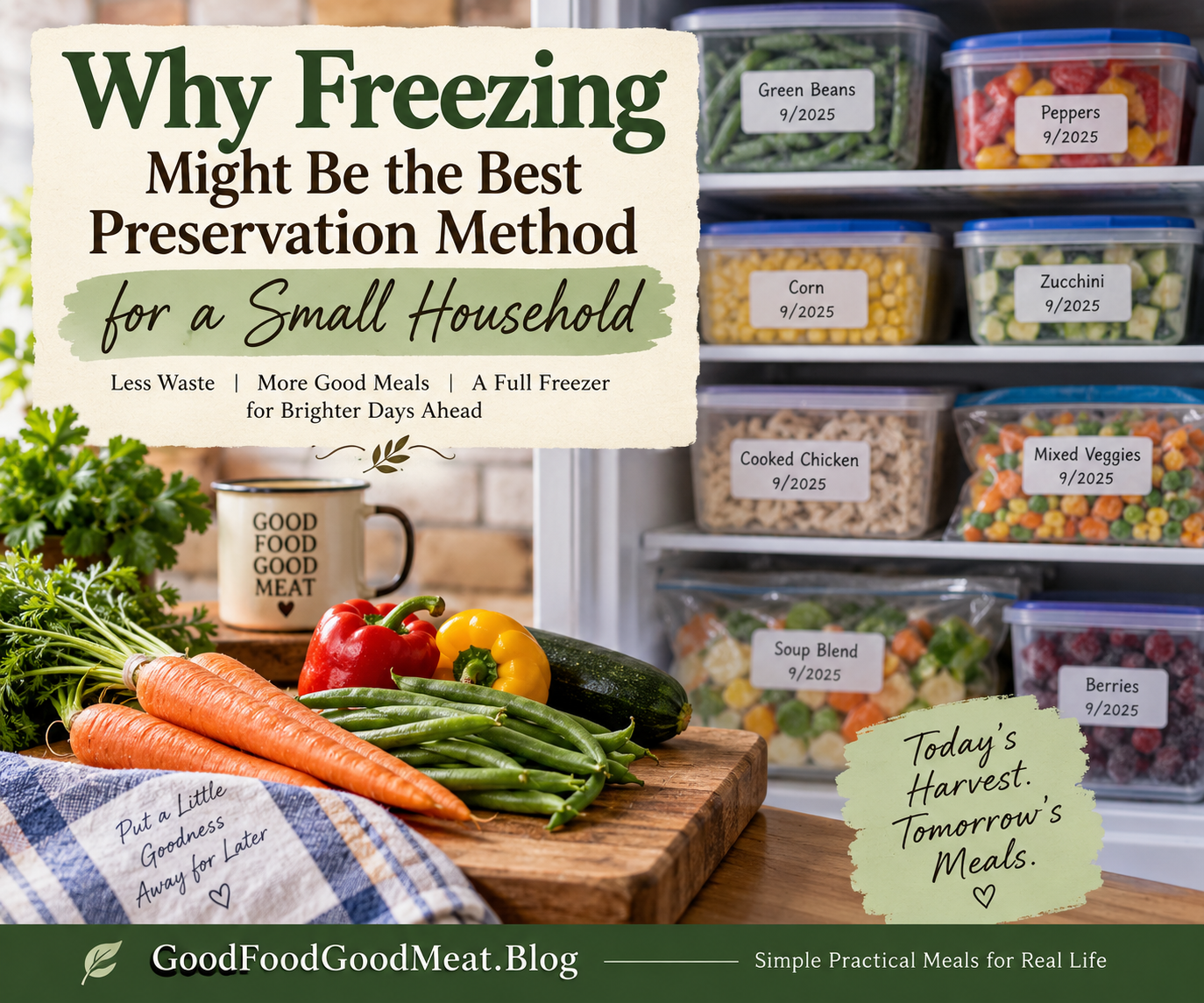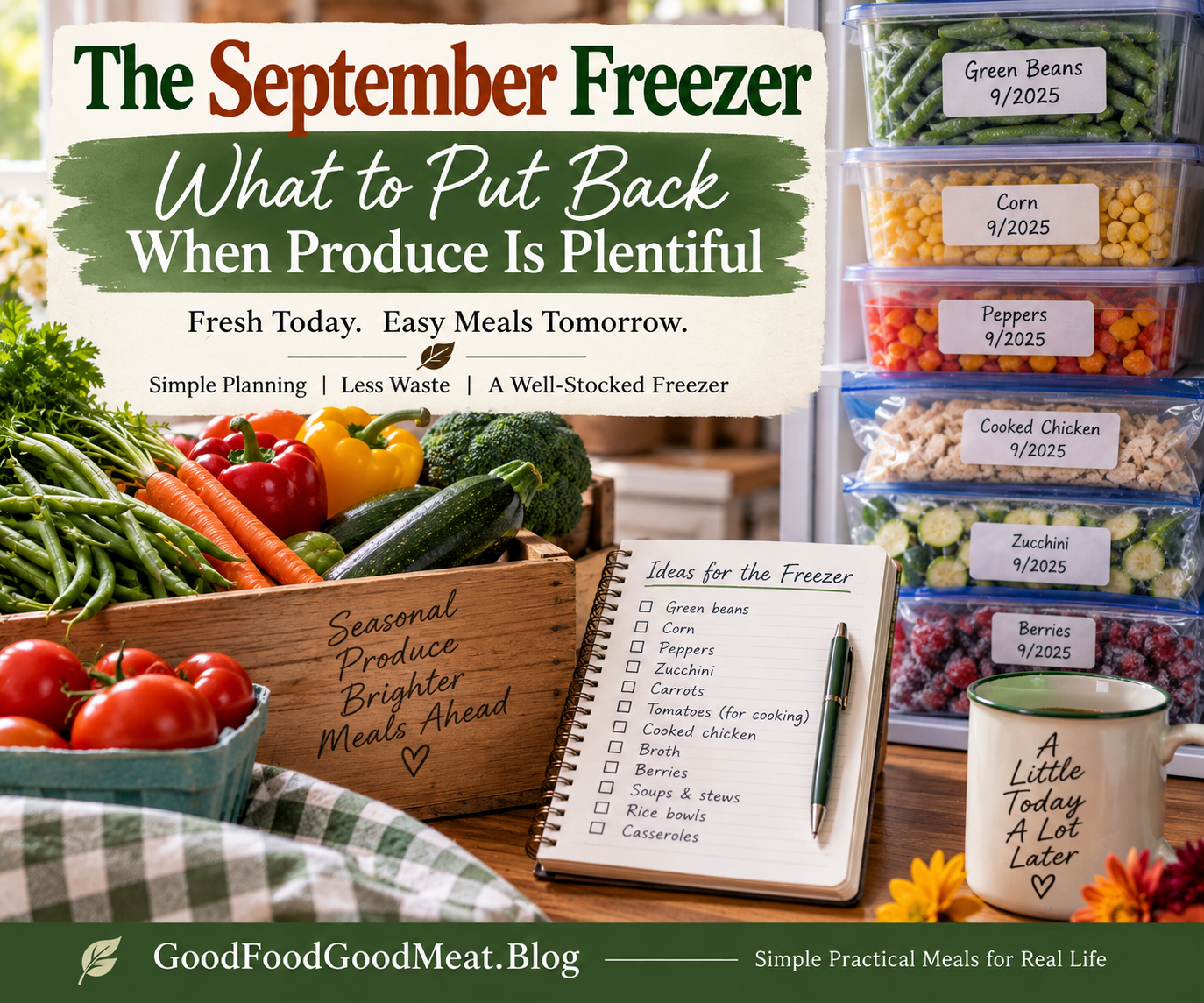
September has always felt a little like the pantry-building month to me.
The garden is still producing. Farmers’ markets are full. Grocery stores are featuring late-summer and early-fall produce. And after a summer of eating fresh, it’s a good time to start thinking about what you’d like to have available when those fresh choices aren’t quite so abundant.
But here’s the trick:
Don’t fill your freezer just for the sake of filling it.
Instead, think about the meals you actually cook.
A small household doesn’t need twenty pounds of frozen vegetables sitting in the freezer. What you need are useful ingredients in useful amounts—portioned and labeled so that three weeks from now you can pull something out and turn it into dinner.
That’s what I mean by putting a little back.
Start With the Meals You Already Make
Before you buy anything specifically for the freezer, take a look at your regular meals.
What vegetables do you use over and over?
What proteins are useful in several different recipes?
What ingredients would save you time if they were already prepared?
Those are the foods worth putting back.
For example, if you regularly make soups, casseroles, rice bowls, and skillet meals, a freezer stocked with portions of green beans, corn, carrots, peppers, cooked chicken, and other versatile ingredients can be far more useful than a freezer full of complete meals.
You’re building a collection of meal components.
And meal components give you choices.
What Vegetables Are Worth Freezing?
September is a particularly good month to look at vegetables that are plentiful right now.
Depending on what’s available where you live, consider:
- Green beans
- Corn
- Carrots
- Bell peppers
- Zucchini and summer squash
- Broccoli
- Cauliflower
- Spinach and other greens
- Onions
- Peas
Not every vegetable needs to be treated exactly the same way before freezing. Many vegetables benefit from blanching to slow enzyme activity and help preserve color, flavor, and texture. The National Center for Home Food Preservation’s blanching guidance provides the recommended method and timing for individual vegetables.
And remember that the vegetables you freeze don’t necessarily have to come straight from your garden.
A good sale at the grocery store or a generous farmers’ market haul can be an opportunity to put some away for later, too.
Think in Meal-Sized Portions
This is where I think freezing gets particularly useful for a small household.
Don’t automatically freeze everything in one large package.
Instead, ask:
How much would I use in one meal?
If a recipe usually calls for two cups of green beans, freeze some portions in roughly that amount.
If you use a half cup of diced peppers in a skillet, consider making some small packages specifically for that purpose.
If you usually make soup in a small batch, freeze the vegetables in amounts that make sense for your soup pot.
The goal isn’t mathematical perfection.
It’s convenience.
When you can grab one package instead of opening a large container, measuring out what you need, and finding somewhere to put the rest, you’ve made future dinner just a little easier.
Don’t Forget Fruit
The freezer isn’t only for dinner.
September can also be a good time to put fruit away for:
- Smoothies
- Oatmeal
- Baking
- Sauces
- Desserts
- Breakfasts
Berries are an obvious choice, but apples, peaches, and other seasonal fruits can also be useful depending on what’s available.
The important thing is to freeze them for the way you’ll eventually use them.
A soft thawed fruit isn’t necessarily a problem if you’re going to cook it into a sauce or bake it into something.
Some foods simply don’t retain their fresh texture particularly well after freezing, so thinking about the future use of the food before you freeze it can save disappointment later. The USDA’s guidance on Freezing and Food Safety explains that freezing can preserve food safely while quality after thawing varies from one food to another.
That’s another reason I like the idea of a freezer built around future meals.
Put Some Protein Back, Too
Produce may be the star of September, but proteins can be useful freezer building blocks.
You might put back:
- Cooked chicken
- Cooked turkey
- Ground meat in meal-sized portions
- Pork
- Leftover roast meat
- Homemade broth or stock
A package of cooked chicken can become soup one week, a rice bowl the next, and a casserole after that.
That’s considerably more useful to me than freezing a single giant casserole that we might or might not want to eat later.
If you’re freezing meat or poultry, package it appropriately for the freezer and label it clearly. For long-term frozen storage, the USDA recommends keeping the freezer at 0°F or below.
And Then There Are the Little Things
Some of the most useful freezer ingredients aren’t things you’d necessarily think of as “preserving.”
A few examples:
Chopped onions.
Perfect for soups, casseroles, rice dishes, and skillets.
Diced peppers.
Ready for eggs, rice bowls, soups, and skillet meals.
Cooked grains.
Portion them so they’re easy to add to a future meal.
Broth.
Freeze it in amounts that match your recipes.
Herbs.
Some are excellent frozen for cooking, even though they won’t necessarily have the same texture as fresh herbs.
Leftovers.
One serving of dinner is still worth saving if you know you’ll actually eat it.
This is where the freezer starts becoming less of a storage space and more of a meal-prep tool.
Buy With a Plan
Here’s a simple rule I like:
Don’t put something in the freezer unless you can name at least one future meal for it.
Better yet, name two or three.
Green beans?
Chicken and green bean skillet.
Soup.
Rice bowls.
Bell peppers?
Eggs.
Rice bowls.
Skillet meals.
Cooked chicken?
Soup.
Wraps.
Casseroles.
Rice bowls.
Now you’re not just buying produce.
You’re buying ingredients for future dinners.
Don’t Overfill the Freezer
There’s a temptation when you’re thinking about preserving food to say, “Well, if some is good, more must be better.”
Not necessarily.
A freezer that’s packed so tightly that you can’t see what’s inside isn’t particularly helpful.
Leave enough room to organize the food and get cold air where it needs to go. When you’re adding newly prepared foods, freezing them promptly and packaging them properly helps protect quality.
The National Center for Home Food Preservation’s guidance on containers for freezing explains that freezer packaging should protect food from moisture loss and freezer odors and should be durable, leakproof, and easy to label.
The USDA also recommends keeping a freezer at 0°F or below for long-term storage and using an appliance thermometer to verify the temperature.
A useful freezer is better than a stuffed freezer.
Build Your September Freezer Slowly
You don’t have to spend one Saturday filling every available inch.
In fact, I’d rather see you build your freezer gradually.
This week, perhaps it’s green beans.
Next week, you find a good price on chicken.
A few days later, you have leftover vegetables from dinner.
Another week, you freeze some fruit that’s beginning to get ahead of you.
Before long, you’ve built a little reserve.
And because you chose foods based on the meals you actually cook, that reserve is useful.
Put It Where Future-You Can Find It
This is where labeling becomes important.
Write down what you froze and the date.
If it’s something portioned specifically for a recipe, you might even add the approximate amount.
Green beans — 2 cups — September
Cooked chicken — 1½ cups — September
Diced peppers — ½ cup — September
That tiny bit of information can save you from pulling every container out of the freezer while muttering, “What on earth did I put in here?”
Not that I’ve ever done that. 😉
And later this week, we’ll take that one step further with a simple freezer inventory.
The Goal Isn’t a Full Freezer
The goal is a useful freezer.
One that contains ingredients you recognize.
One that doesn’t require archaeological excavation to find dinner.
One that helps you use seasonal abundance instead of watching it go to waste.
One that makes a Tuesday evening meal a little easier.
And most importantly, one where the food actually gets eaten.
Because putting food back isn’t about collecting food.
It’s about making sure today’s abundance can become tomorrow’s dinner.