A colorful one-skillet dinner that makes the most of September’s harvest.
When the farm stand is full of beautiful vegetables, this is exactly the kind of meal I want to make.
Tender pieces of chicken are cooked with sweet corn, zucchini, bell pepper, onion, and tomatoes for a simple skillet dinner that tastes like the best of late summer and early fall. A little garlic and Italian seasoning are all you need to bring everything together.
It’s colorful, filling, budget-friendly, and—best of all—there’s only one skillet to wash.
Why You’ll Love This Recipe
One skillet: Everything cooks together, making cleanup easy.
Harvest-friendly: Perfect for using whatever fresh vegetables look best this week.
High in protein: Chicken makes this a satisfying main dish.
Mildly seasoned: Plenty of flavor without making the dish overly spicy.
Flexible: Swap in whatever seasonal vegetables you already have.
Small-batch friendly: Makes four servings, so it works well for singles and couples with leftovers for another meal.
Budget-conscious: Seasonal vegetables help stretch a modest amount of chicken.
simplegoodfood
Harvest Chicken & Vegetable Skillet
Tender pieces of chicken are cooked with sweet corn, zucchini, bell pepper, onion, and tomatoes for a simple skillet dinner that tastes like the best of late summer and early fall.
1poundbonelessskinless chicken breasts, cut into bite-sized pieces
1tablespoonolive oildivided
1small onionchopped
1medium zucchinidiced
1red bell pepperchopped
1cupfresh or frozen sweet corn
1cupcherry tomatoeshalved
2clovesgarlicminced
1teaspoonItalian seasoning
½teaspoonsalt
¼teaspoonblack pepper
½cuplow-sodium chicken broth
2tablespoonschopped fresh parsley
¼cupgrated Parmesan cheeseoptional
Method
Prepare the chicken.
Pat the chicken dry and cut it into bite-sized pieces. Season lightly with the salt, pepper, and Italian seasoning.
Brown the chicken.
Heat 2 teaspoons of the olive oil in a large skillet over medium-high heat. Add the chicken in a single layer and cook for about 5–7 minutes, turning occasionally, until lightly browned and cooked through. Transfer the chicken to a plate.
Cook the vegetables.
Add the remaining teaspoon of olive oil to the skillet. Add the onion and bell pepper and cook for 2–3 minutes. Add the zucchini and corn and continue cooking for another 3–4 minutes, stirring occasionally.
Add the tomatoes and garlic.
Stir in the tomatoes and garlic. Cook for about 1 minute, just until the garlic becomes fragrant and the tomatoes begin to soften.
Bring it together.
Return the chicken and any accumulated juices to the skillet. Pour in the chicken broth and stir everything together.
Finish cooking.
Reduce the heat to medium and simmer for 2–3 minutes, stirring occasionally, until the vegetables are tender and the broth has reduced slightly.
Finish and serve.
Sprinkle with fresh parsley and, if desired, Parmesan cheese. Serve hot.
Notes
Make It Your Own
This skillet is intentionally flexible.Use yellow squash instead of zucchini, add a handful of spinach, substitute green beans for the bell pepper, or toss in leftover roasted vegetables. If tomatoes aren’t looking their best, a few spoonfuls of drained canned diced tomatoes work, too.You can also change the seasoning to match what you have on hand. A little dried basil or parsley works beautifully here.
Serving Suggestions
This is a complete meal on its own, but you can stretch it a little further by serving it over:
Brown rice
Quinoa
Barley
Whole-grain pasta
Cauliflower rice
For a lighter meal, serve it with a simple green salad or a piece of whole-grain bread.
A Little Leftover Magic
Don’t overlook the leftovers!
The chicken and vegetables can be refrigerated and reheated for another lunch or dinner. They can also become the starting point for a rice bowl, wrap, or quick quesadilla.
And if you’re following along with our September “Put a Little Back” theme, this is also a good reminder of why preserving seasonal produce can be worthwhile. Today’s harvest doesn’t have to stay today’s dinner.
Nutrition Estimate
Per serving, without optional Parmesan: approximately 330 calories and 37g protein.
Nutrition is an estimate and will vary depending on the specific ingredients and brands used.
Food Safety Note
Cook chicken to an internal temperature of 165°F as measured with a food thermometer. Refrigerate leftovers promptly and use within 3–4 days.
September can be one of the best months for grocery shopping.
The summer harvest is still rolling in, fall crops are beginning to appear, and farm stands and farmers markets can be overflowing with fresh produce. When there’s plenty of something available, that’s often a good time to buy it.
But “in season” isn’t just about buying whatever happens to look good.
For a smart shopper, it’s about finding the sweet spot between quality, price, quantity, and what you can actually use.
Why Seasonal Shopping Can Save Money
When a crop is abundant, there is generally more of it available. That can mean better prices, particularly when you’re buying directly from a farm stand or farmers market.
It also means you can often buy produce at its freshest.
That’s a win—but only if you actually use it.
A bargain isn’t a bargain if half of it ends up in the trash.
That’s why seasonal shopping works especially well when you pair it with a little meal planning and, when appropriate, preservation.
Buy what is plentiful. Plan how you’ll use it. Preserve what makes sense.
That’s the basic strategy.
What to Look for in September
What’s actually in season varies by where you live, so your local farm stand is always the best guide.
But September is commonly a great time to look for things like:
🌽 Sweet corn
🍅 Tomatoes
🫑 Peppers
🥒 Zucchini and summer squash
🥔 Potatoes
🧅 Onions
🥕 Carrots
🫘 Green beans
🍎 Apples
🍐 Pears
🎃 Early fall squash
You don’t need to buy all of them.
In fact, please don’t.
Choose the things that fit the meals you already enjoy.
Buy Extra When the Price Is Right
Here’s where seasonal shopping gets particularly interesting.
Suppose you normally buy four ears of corn for dinner. The farm stand has beautiful corn at a particularly good price, and you know your family—or in my case, your future self—will enjoy corn later in the year.
That’s when buying extra might make sense.
Enjoy some fresh.
Put some away.
Now you’re not just shopping for tonight’s dinner. You’re shopping for a future dinner, too.
The same thinking can apply to other produce that is suitable for safe preservation.
But there’s an important distinction:
Don’t preserve something simply because it’s cheap. Preserve it because you have a plan for using it.
The Three-Question Test
Before buying a large quantity of anything, ask yourself three questions:
1. Will I use it?
This is the most important question.
Think about the meals you actually eat—not the meals you imagine you might make someday.
If you love corn, buying extra corn makes sense.
If you’re not particularly fond of zucchini, a crate of zucchini isn’t suddenly going to become a good purchase because it’s inexpensive.
2. Do I have room for it?
Fresh produce takes up space.
So does frozen produce.
So do jars, dehydrated foods, and everything else you put away.
Check your refrigerator, freezer, pantry, and storage space before buying enough produce to stock a small grocery store.
3. Do I have time to deal with it?
This one is easy to overlook.
Buying ten pounds of tomatoes sounds like a wonderful idea until you realize that ten pounds of tomatoes now need your attention.
Preserving food takes time.
Freezing may require blanching and cooling. Dehydrating takes time. Canning requires preparation and careful attention to tested processing instructions.
Know what you’re getting yourself into before you bring it home.
Fresh Doesn’t Mean You Have to Eat It All Today
One of the great advantages of seasonal shopping is that some foods can have a life beyond the week you bought them.
That’s where putting a little back comes in.
You might freeze some sweet corn while it’s plentiful.
You might dehydrate vegetables for future meals.
You might preserve certain high-acid foods using a tested canning method.
Or you might simply buy enough fresh produce to get you through the next week without another grocery-store trip.
Preservation doesn’t have to mean filling every available shelf.
Sometimes putting a little back really does mean a little.
A Smart Shopper’s Harvest Basket
If I were heading to the farm stand this week, I’d think about my basket in three categories:
For tonight: Something that can become dinner right away.
For this week: Produce that can work its way into several meals.
For later: A small amount of something that’s worth preserving because it’s plentiful, affordable, and something I’ll actually use.
That approach keeps the shopping trip from becoming overwhelming.
It also helps prevent the classic “I bought too much because everything looked so good” problem.
And yes, September farm stands make that problem particularly easy to have. 😉
Don’t Forget to Check What You Already Have
Before you leave for the market, take a quick inventory at home.
What’s already in the refrigerator?
What’s in the freezer?
What needs to be used?
What pantry staples can turn a few fresh vegetables into a complete meal?
This is where seasonal shopping and the Waste Not, Want Not mindset work beautifully together.
You don’t have to start every meal from scratch.
Sometimes the smartest purchase is the one that completes something you already have.
Buy at the Peak. Use It Well.
Seasonal shopping isn’t about chasing the lowest possible price or buying the largest possible quantity.
It’s about recognizing when something is plentiful and making that abundance work for you.
Buy what you love.
Buy what you’ll use.
Buy enough to make the price worthwhile—but not so much that you’re creating work or waste.
And when something is especially good and plentiful?
Enjoy some now. Put a little back for later.
That’s smart shopping at harvest time.
A September Reminder
As we talk about freezing, dehydrating, and canning throughout this month, remember that safe food preservation depends on the food and the preservation method.
For canning in particular, use current, tested recipes and processing recommendations from a reliable source such as the USDA rather than relying on an old family recipe or guessing at processing times.
The goal isn’t simply to save food.
It’s to save it safely—so today’s harvest really can become tomorrow’s meal.
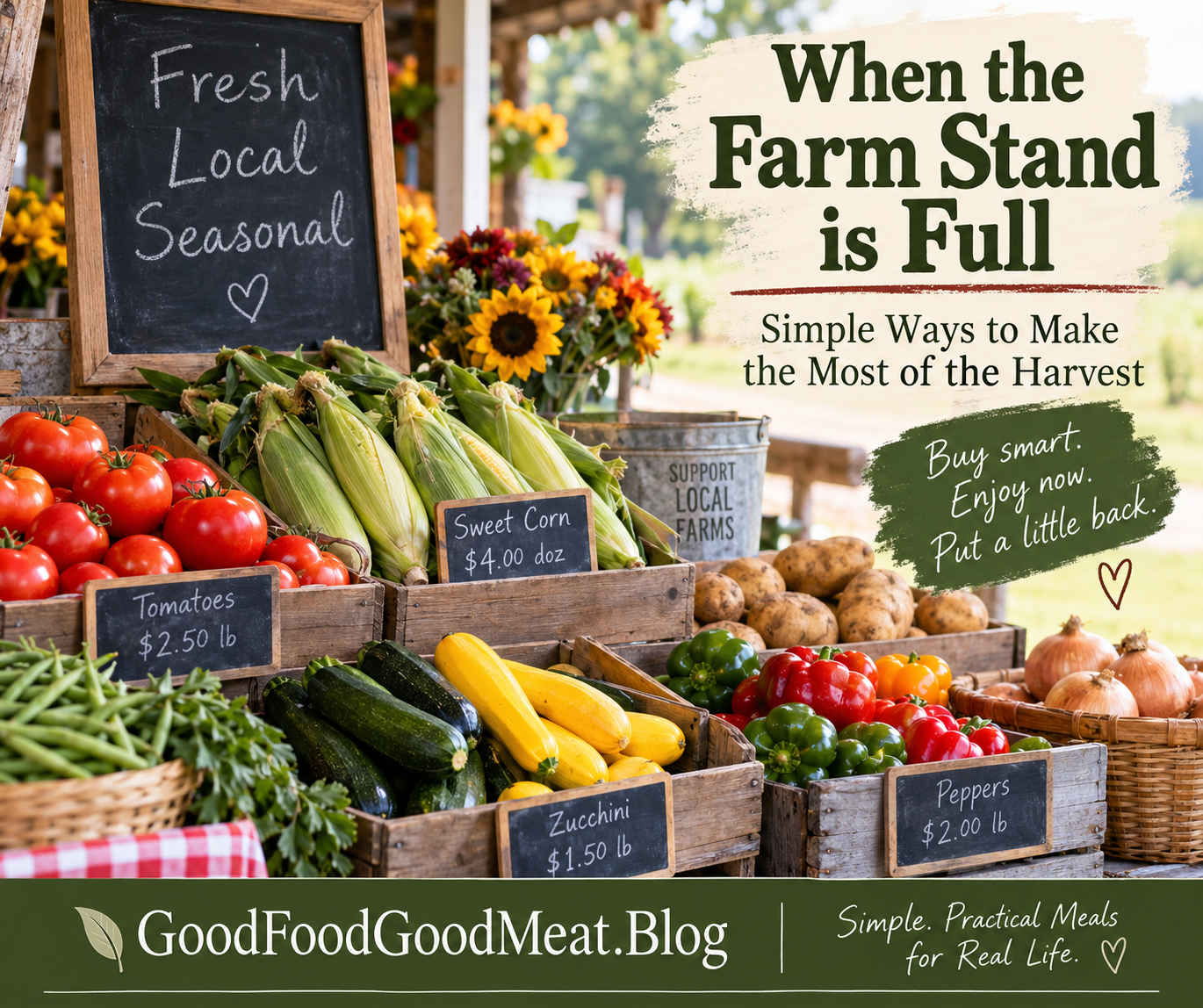
There is something special about a September farm stand.
The tables seem to get fuller by the day. Corn is piled high. Tomatoes are still hanging on. Peppers, zucchini, onions, potatoes, carrots, and all sorts of late-summer vegetables are competing for your attention.
It is the kind of abundance that makes you want to bring home a little bit of everything.
And honestly? That isn’t always a bad idea.
September is one of the best times of year to take advantage of what’s plentiful and affordable right now. But the trick is knowing what to do with all that goodness once you get it home.
That’s where a little planning—and a little old-fashioned common sense—comes in.
Buy What’s Good Now
When something is plentiful, it often means two things: it’s at its peak, and there is a lot of it available.
That can be good news for your grocery budget.
Instead of buying vegetables simply because you have a recipe that calls for them, September is a good time to look at what’s actually abundant where you shop. If sweet corn is piled up at the farm stand, that’s your cue to enjoy some now and consider putting a little away for later.
If tomatoes are plentiful, make sauce, salsa, or a simple tomato dish.
If zucchini is practically giving itself away, buy what you can realistically use—and perhaps freeze some for a future meal.
The goal isn’t to bring home the entire farm stand.
It’s to recognize an opportunity.
Don’t Buy More Than You Can Manage
There is a fine line between taking advantage of abundance and creating your own kitchen emergency.
We’ve all done it.
You see beautiful produce at a great price and think, I’ll figure out what to do with it.
Then three days later, you’re staring at a refrigerator full of vegetables wondering when you’re going to find the time to deal with them.
So before you buy, ask yourself a few simple questions:
How much can I realistically use this week?
What can I cook right away?
Can I freeze, dehydrate, or otherwise preserve some of it?
Do I have the storage space?
Is the savings worth the work involved?
Those questions can turn an impulse purchase into a smart one.
Think Beyond This Week’s Dinner
One of the best things about buying produce at its peak is that you don’t necessarily have to eat all of it immediately.
Some foods can be preserved so that today’s abundance becomes part of a meal weeks or months from now.
That’s the idea behind putting a little back.
You don’t need a basement full of shelves lined with jars to preserve food. You don’t even have to preserve an enormous quantity.
A few bags of frozen sweet corn can become a quick side dish.
A container of frozen vegetables can become part of a soup or skillet meal.
Dried vegetables can become ingredients in a pantry meal.
And a small batch of something preserved today can make a future dinner just a little easier.
That’s a pretty good return on a little time spent in the kitchen.
September Is About Making the Most of What We Have
Around here, September isn’t about buying every gadget, filling every shelf, or spending an entire weekend preserving fifty pounds of vegetables.
It’s about being practical.
Buy what’s good.
Buy what’s affordable.
Enjoy some now.
Put a little back for later.
And use what you already have before buying something else.
That last part matters, too. Before heading to the market, take a quick look through your refrigerator, freezer, and pantry. You may already have half of what you need for a meal.
September’s harvest gives us a chance to be intentional about all of it.
We’re going to spend this month looking at different ways to take advantage of seasonal abundance—from freezing and dehydrating to simply planning meals around what’s available.
And we’re going to keep one important idea in mind:
Preserving food isn’t about preserving everything. It’s about preserving what makes sense for you.
So when the farm stand is full, take a good look.
Enjoy the abundance.
Buy what you’ll use.
And if there’s something especially good—and especially plentiful—maybe put a little back.
Because today’s harvest can make tomorrow’s dinner a whole lot easier.
September has arrived, and with it comes one of my favorite transitions of the year.
The gardens and farmers markets are still giving us plenty of summer vegetables, but autumn is beginning to show up around the edges. Apples are appearing. Winter squash is making an entrance. The days are getting a little shorter.
It’s the perfect time to start thinking about putting a little back.
And preserving food doesn’t have to mean spending an entire weekend in a hot kitchen surrounded by dozens of canning jars.
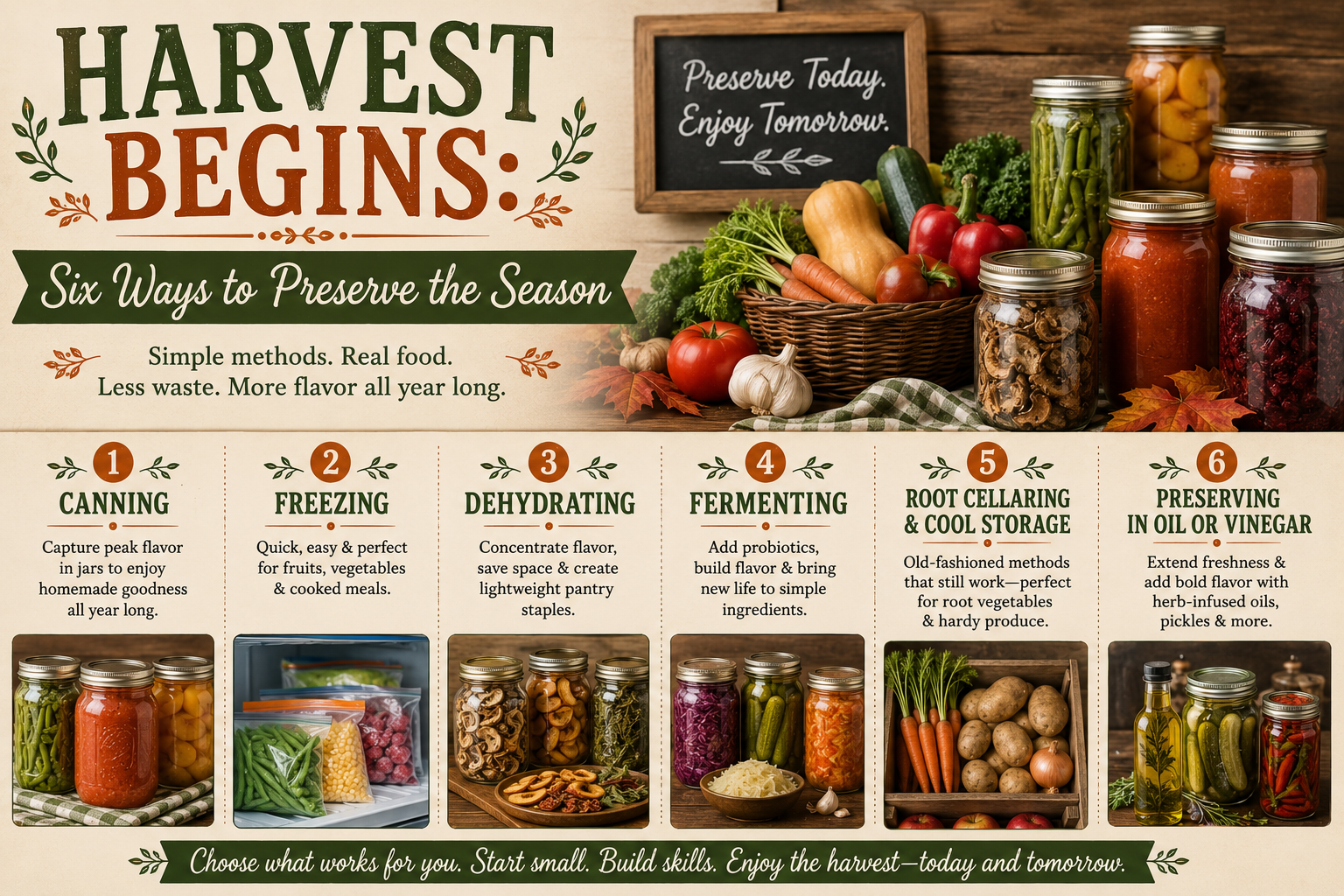
There are several ways to preserve seasonal food, and the best method depends on what you’re preserving, how much you have, how you’ll use it, and how much time you want to spend.
So let’s look at six practical ways to make today’s harvest last a little longer.
🫙 1. Pressure Canning
Pressure canning is the method used for preserving low-acid foods, including meat and many vegetables.
That’s why you’ll see pressure canning discussed when we talk about putting things like ground beef, chicken, or certain vegetables back for the pantry.
But pressure canning is not a method to improvise.
The food, jar size, processing time, pressure, and other details all matter. Always use a current, tested recipe and follow the instructions for your specific pressure canner.
This week, we introduced the idea with Pressure-Canning Ground Beef.
The goal wasn’t to turn everyone into a canner overnight.
It was to show how a good sale on ground beef could potentially become several future meals instead of just tonight’s dinner.
Best for: Low-acid foods and shelf-stable pantry storage when using tested recipes and proper equipment.
🧊 2. Freezing
Freezing is probably the easiest preservation method for most home cooks.
No special canner.
No pressure gauge.
No long processing session.
Just prepare the food appropriately, package it well, label it, and get it into the freezer.
Freezing works particularly well for:
Peppers
Herbs
Corn
Green beans
Cooked meats
Soups
Broths
Prepared meals
It’s also an excellent option for small households.
You don’t have to preserve a bushel of anything.
Freeze a pound.
Freeze four servings.
Freeze the extra peppers from this week’s grocery trip.
That’s still putting food back.
Best for: Small quantities, prepared meals, vegetables, meats, herbs, and ingredients you’ll use within a reasonable freezer-storage period.
🌬️ 3. Dehydrating
Dehydrating removes moisture from food, making it much lighter and extending its storage life when properly prepared and stored.
It’s especially useful for people who have limited freezer space.
Vegetables such as carrots, celery, corn, peas, onions, mushrooms, and zucchini can be dehydrated and later used in soups, stews, skillet meals, and other dishes.
It’s also a wonderful way to deal with those moments when you’ve bought more produce than you can possibly eat fresh.
Instead of asking:
“How am I going to eat all of this?”
you can ask:
“How can I turn some of this into an ingredient I’ll use later?”
Best for: Vegetables, fruits, herbs, and lightweight ingredients that can be rehydrated or used directly in cooking.
🍎 4. Making Jams, Jellies, and Fruit Spreads
Fruit preservation gives us another way to capture the season.
Apples, peaches, berries, and other fruits can become jams, jellies, sauces, and spreads.
This is one area where it’s particularly important to distinguish between a recipe intended for refrigerator or freezer storage and one intended for shelf-stable canning.
If you’re canning fruit products for pantry storage, use a tested recipe and follow it exactly.
But you don’t have to can a dozen jars.
A small batch of refrigerator jam can be just as useful for a household of one or two.
Best for: Seasonal fruit and creating something that can brighten breakfasts, desserts, sauces, or snacks later.
🥣 5. Cook It Into Something
Here’s a preservation method we don’t talk about often enough:
Cook it now.
Sometimes the best way to save seasonal food is to turn it into something you’ll actually want to eat.
Those extra vegetables can become:
Soup
Chili
Pasta sauce
Casserole filling
Vegetable skillet
Rice bowl components
A pot of soup can then be refrigerated for the next few days or frozen in meal-sized portions.
That’s exactly what we did with Garden Harvest Beef & Vegetable Soup this week.
Instead of trying to preserve every individual vegetable, we turned several of them into dinner.
And then we put a few servings in the freezer for another day.
Best for: Vegetables and ingredients that need to be used soon, especially when you want a ready-to-eat meal later.
🥕 6. Preserve the Ingredients, Not Just the Food
This might be my favorite approach for everyday cooking.
Instead of thinking about preserving a finished meal, think about preserving building blocks.
Cook extra chicken.
Freeze some ground beef.
Freeze chopped peppers and onions.
Dehydrate carrots and celery.
Cook a little extra rice and freeze it in portions.
Freeze fresh herbs before they spoil.
None of these things requires you to create a perfectly stocked pantry.
But each one gives future-you something to work with.
And that’s really the idea behind our new Pantry Builder feature.
🫙 One Thing at a Time
Every week this month, we’ll choose one practical thing to put back.
Not twenty things.
Not an entire year’s supply.
One thing.
Because a pantry doesn’t have to appear overnight.
You can build it gradually, based on the way you actually cook and the foods you actually eat.
🌾 Which Preservation Method Is Right for You?
There isn’t one answer.
If you have…
Consider…
A small amount of extra produce
Freezing
Plenty of vegetables and limited freezer space
Dehydrating
Extra cooked food
Freezing meal-sized portions
Low-acid foods such as meat
Pressure canning with a tested process
Seasonal fruit
Freezing, dehydrating, or tested canning recipes
Vegetables that need to be used quickly
Cook them into a meal
Fresh herbs about to spoil
Freezing
The important thing is to choose a method that fits your kitchen, your storage space, your schedule, and your cooking habits.
You don’t need to preserve everything.
You just need to preserve the things that make sense.
🛡️ A Word About Food Safety
This month we’ll be talking more about canning, freezing, and dehydrating.
Whenever we do, I’ll always recommend checking your plans against current guidance from the USDA and the National Center for Home Food Preservation.
Food preservation is one area where an old family recipe isn’t necessarily enough to establish that a particular method is safe.
Recipes and techniques have changed as we’ve learned more about food safety.
So keep Grandma’s recipe card.
Keep the memories.
But check the preservation method against current, tested guidance before putting food on the pantry shelf.
That’s not taking the fun out of preserving food.
It’s how we make sure the food we’re saving is actually something we can safely enjoy later.
♻️ And Don’t Forget the Waste
Preservation starts before the canning jar, freezer bag, or dehydrator.
It starts with not buying more than you can use.
Then it becomes:
Use what you can fresh.
Preserve what you can’t use immediately.
Cook what needs to be cooked.
Freeze the leftovers.
Dehydrate the extras.
Share what you won’t use.
And yes—sometimes the smartest preservation method is simply buying a smaller amount next time.
That’s the Waste Not, Want Not part of the equation.
🌾 Today’s Abundance, Tomorrow’s Comfort
There’s something deeply satisfying about opening the freezer in January and finding a container of summer vegetables.
Or reaching into the pantry for something you preserved months earlier.
Or pulling out a portion of soup when you’re tired and don’t feel like cooking.
You’re not just storing food.
You’re giving your future self a little help.
That’s what Harvest & Putting Things Back is really about.
Not fear.
Not excess.
Just stewardship.
Enjoy what’s plentiful today.
Save what makes sense.
And put a little back for tomorrow. 🌾❤️
Garden Harvest Beef & Vegetable Soup
There is something wonderfully practical about a pot of vegetable soup.
Saturday is a good day to look around the refrigerator and ask one very important question:
What needs to be used?
Maybe there’s a little roasted squash left from Thursday’s Autumn Harvest Rice Bowl. Maybe you’ve got some carrots, zucchini, corn, peppers, or onions hanging around from earlier in the week.
And maybe there’s some cooked rice waiting in the refrigerator.
That’s dinner.
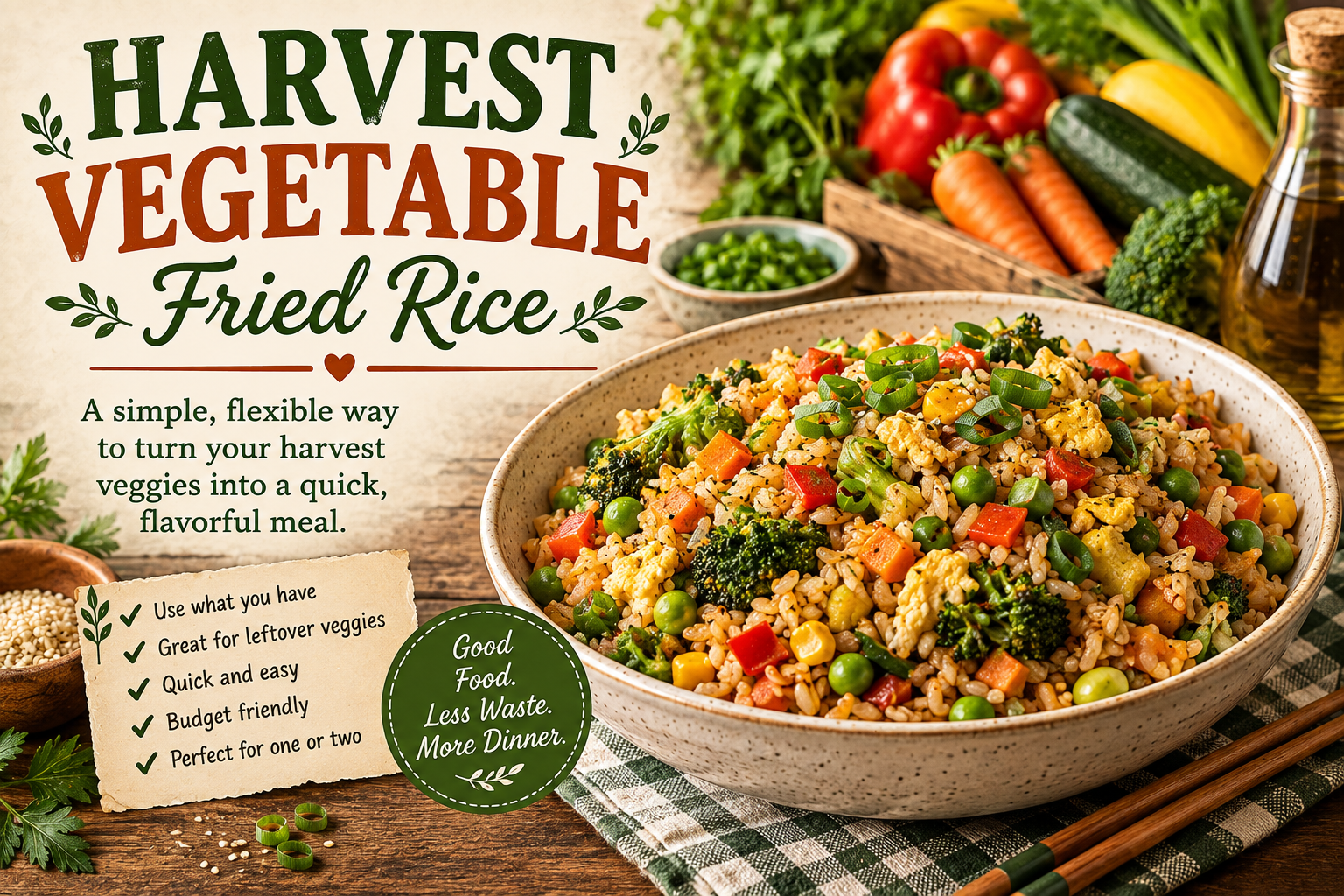
This Harvest Vegetable Fried Rice is designed for exactly those moments. It doesn’t require a specific collection of vegetables. It simply gives all those little leftovers somewhere to go.
The result is a quick, colorful skillet meal that’s inexpensive, filling, and a whole lot better than throwing good food away.
It’s Waste Not, Want Not in a bowl—or, in this case, a skillet. 🍚🌾
simplegoodfood
Harvest Vegetable Fried Rice
Give leftover vegetables and cooked rice a delicious second life with this easy one-skillet fried rice.
2cupsmixed leftover vegetableschopped into bite-sized pieces
2large eggs
1/2small oniondiced
1tablespoonolive oil
1tablespoonlow-sodium soy sauce
1teaspoonsesame oil
1/2teaspoongarlic powder
1/4teaspoonblack pepper
2green onionssliced
1tablespoonchopped fresh parsleyoptional
Good vegetables to use:
Roasted carrots
Corn
Zucchini
Peppers
Green beans
Peas
Mushrooms
Roasted squash or sweet potatoes
Cooked broccoli
Method
Prepare the rice.
Break up any clumps in the cold cooked rice with your fingers or a fork. Cold rice works particularly well because it is less likely to become mushy in the skillet.
Cook the eggs.
Heat a large skillet or electric skillet over medium heat. Add about half of the olive oil. Beat the eggs lightly, add them to the skillet, and gently scramble until just cooked. Transfer them to a plate.
Sauté the onion.
Add the remaining olive oil to the skillet. Add the diced onion and cook for 2–3 minutes, until softened.
Add the vegetables.
Stir in the leftover vegetables and cook for 2–4 minutes, depending on how firm they are. Since most of the vegetables are already cooked, you’re simply heating and lightly browning them.
Add the rice.
Add the cold rice to the skillet. Stir and toss everything together. Cook for about 4–5 minutes, allowing the rice to heat through and pick up a little color.
Season.
Stir in the soy sauce, sesame oil, garlic powder, and black pepper.
Return the eggs.
Add the cooked eggs back to the skillet and gently stir them into the rice and vegetables.
Finish.
Sprinkle with sliced green onions and fresh parsley, if using. Taste and add a little more soy sauce if needed.
Notes
🌾 The Beauty of LeftoversThis recipe doesn’t have a “correct” vegetable list.That’s intentional.If you have a cup of leftover roasted vegetables and half a cup of something else, use them.If your vegetables are already seasoned, that’s fine.If they’re a little soft, that’s okay, too. Fried rice is an excellent place for vegetables that aren’t quite at their fresh-from-the-garden best anymore.The goal is to use them while they’re still good, not wait until they’re perfect.
🥢 Make It Your Own
Want more protein?
Add:
Leftover cooked chicken
Cooked ground beef
Cooked pork
Shrimp
Want more vegetables?
Add frozen peas, corn, or carrots straight from the freezer.
Want to keep it meatless?
The eggs provide protein and make this a satisfying meatless meal.
For a little extra flavor, add fresh ginger or a small amount of minced garlic if you have it.
🏕️ Campground Kitchen Tip
This is an especially good recipe for an electric skillet because you have plenty of surface area for the rice to brown without having to juggle several pans.
It’s also a great campground meal because it turns leftovers into something that feels completely different.
Nobody needs to know that Thursday’s roasted vegetables are making a return appearance. 😉
🧊 Meal Prep Tip
If you’re intentionally making fried rice for leftovers, cool the finished rice promptly and refrigerate it in a shallow container.
When reheating, heat the portion thoroughly until steaming hot.
And remember that cooked rice should be handled just like other perishable cooked foods—don’t leave it sitting at room temperature for hours.
You know that feeling when you come home from the farmers market with a little bit of everything?
A few tomatoes.
Some carrots.
An onion.
Maybe green beans, zucchini, corn, or peppers.
Everything looked so good at the market that you couldn’t resist—and now you have to figure out what to do with it all.
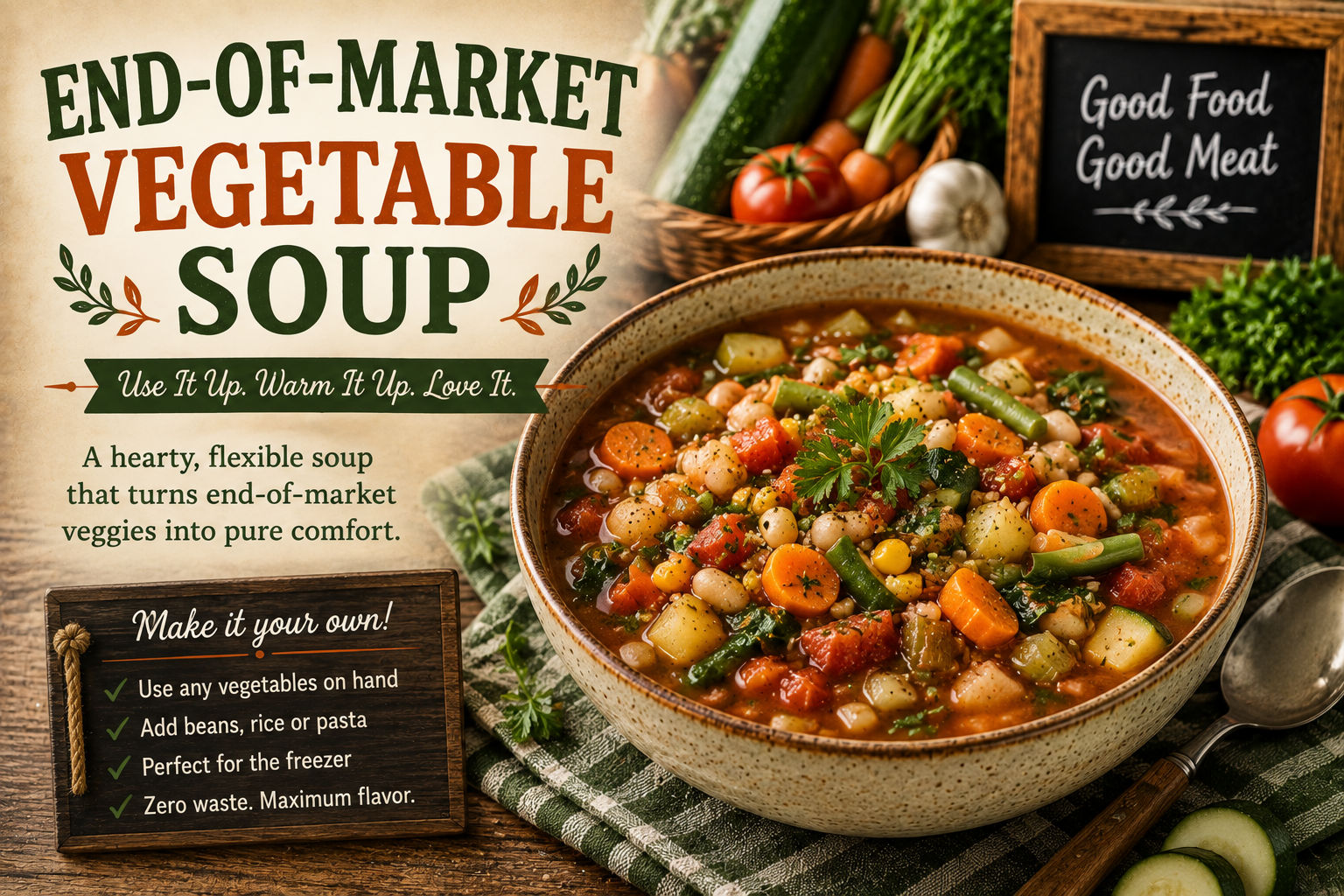
That’s where End-of-Market Vegetable Soup comes in.
There isn’t one perfect vegetable combination for this soup. In fact, the whole idea is that you use what you have.
It’s a practical, flexible soup for the end of the week, when the refrigerator contains a collection of odds and ends that are all still perfectly good but don’t necessarily make a complete meal on their own.
Put them in a pot.
Add some broth and tomatoes.
Season it simply.
And suddenly those little bits and pieces become dinner.
That’s Waste Not, Want Not in action.
simplegoodfood
End-of-Market Vegetable Soup
A flexible, no-waste vegetable soup designed for all those little bits of produce left after market day.
Heat the olive oil in a large soup pot or Dutch oven over medium heat. Add the onion, carrots, and celery. Cook for 4–5 minutes, stirring occasionally, until the vegetables begin to soften.
Add the garlic.
Stir in the garlic and cook for about 30 seconds, just until fragrant.
Add the vegetables.
Add your remaining vegetables to the pot. If you’re using potatoes or other firm vegetables, add those first. More delicate vegetables such as zucchini, spinach, or already-roasted vegetables can be added later.
Add tomatoes and broth.
Pour in the diced tomatoes and broth. Stir in the Italian seasoning, parsley, black pepper, and salt.
Simmer.
Bring the soup to a gentle boil, then reduce the heat and simmer for 20–25 minutes, or until the firmest vegetables are tender.
Add delicate vegetables.
If you’re using spinach, leftover roasted vegetables, or other already-cooked vegetables, stir them in during the last 5 minutes.
Taste and adjust.
Taste the broth and add additional salt or seasoning if needed.
Serve.
Ladle into bowls and finish with fresh parsley.
Notes
🌾 The End-of-Market RuleThere are really only three rules for this soup:Use what you have.Use what needs to be used first.Don’t overthink it.If the zucchini needs to be used today but the carrots will be perfectly happy for another week, the zucchini goes into the soup.If you have leftover roasted vegetables from earlier in the week, they can go in, too.If you have a lonely tomato sitting on the counter, dice it up and add it.This is not a recipe where someone needs to run to the grocery store because they are missing one particular vegetable.The refrigerator is the ingredient list.
🥔 Make It Heartier
Want to turn this vegetable soup into more of a complete meal?
Add one of these:
1 cup cooked rice
1 cup cooked pasta
1 cup cooked barley
1 cup diced cooked potatoes
1 cup cooked beans
1 cup shredded cooked chicken
1/2 pound cooked ground beef
If adding cooked ingredients, stir them in during the final few minutes just long enough to heat them through.
🧊 Freeze the Extras
This soup is a great candidate for freezing.
If you’re cooking for one or two, portion the cooled soup into individual freezer containers rather than freezing the entire batch together.
Label each container with the name and date.
Then future-you has a homemade lunch or light dinner waiting in the freezer.
That’s one of my favorite forms of food preservation because the preservation and the meal happen at the same time.
🏕️ Campground Version
You can make this soup almost anywhere you have a pot and a heat source.
An electric skillet with a deep lid, Dutch oven, or large saucepan will all work.
And because the vegetables are flexible, this is particularly handy when you’re cooking with limited refrigerator space.
Instead of trying to keep every little leftover ingredient until it becomes a complete meal, turn several small leftovers into one pot of soup.
Less storage.
Less waste.
More dinner.
🫙 Pantry Builder Connection
This soup also shows why a practical pantry doesn’t need to contain dozens of specialty ingredients.
If you have:
Canned tomatoes
Broth
Rice or another grain
A few basic seasonings
you already have the foundation for turning a refrigerator full of vegetables into a meal.
That’s the idea behind Pantry Builder this month.
We’re not trying to create a perfect emergency pantry.
We’re building a collection of useful ingredients that help us make good meals from whatever happens to be available.