Posted in Jar Mixes (Meal Starters)

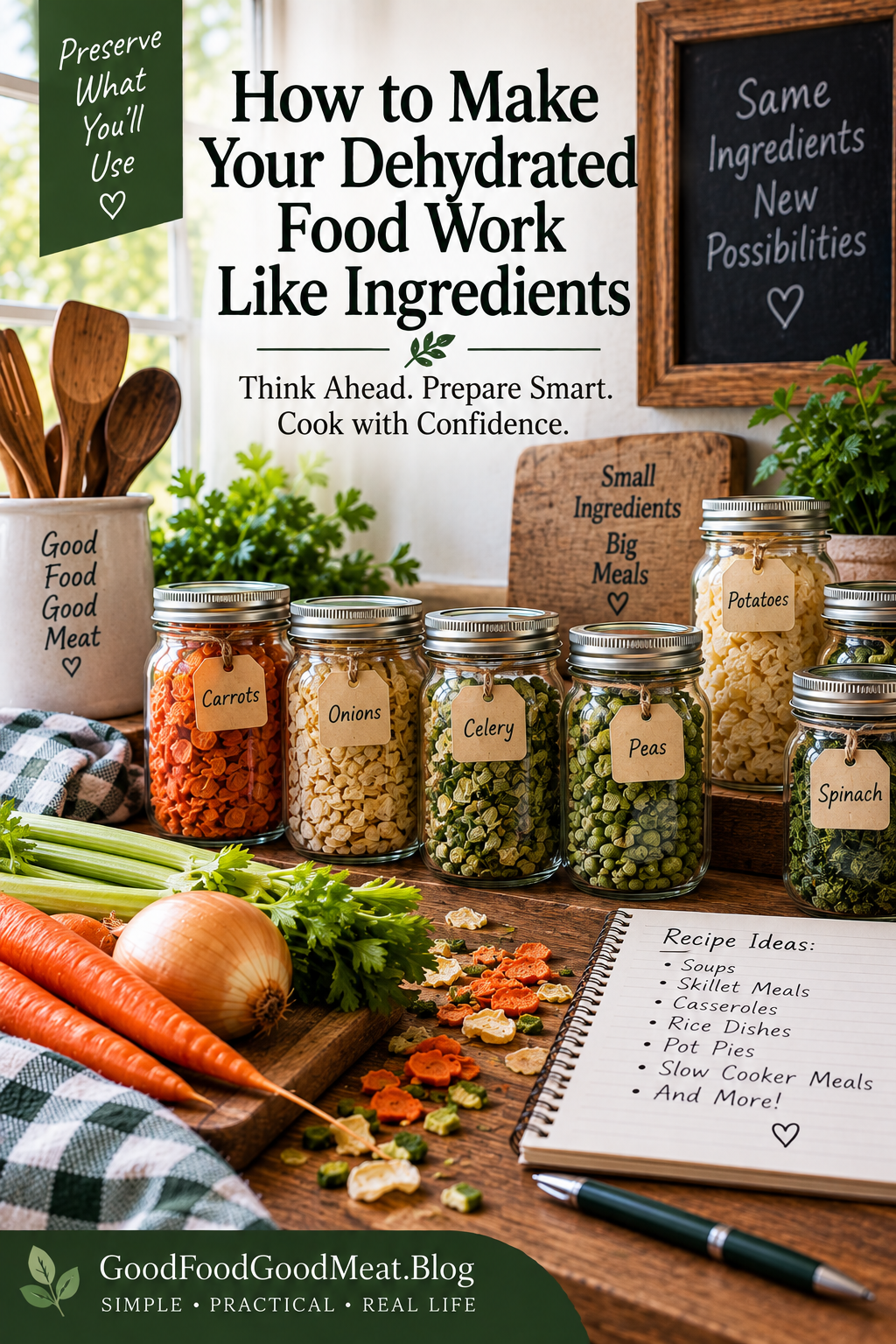
How to Make Your Dehydrated Food Work Like Ingredients

The most useful dehydrated foods aren’t the ones that simply look good in a jar. They’re the ones that make your next meal easier.

There is a point in food preservation when you have to stop thinking about the food you’re preserving today and start thinking about the meal you’ll make with it later.

That’s especially true with dehydrating.

It’s easy to get caught up in the process.

How do I dry carrots?

How do I dry onions?

How do I dry zucchini?

How long does everything take?

Those are useful questions.

But I think there’s another question that’s even more useful:

What can I make with this six months from now?

That’s the question that turns dehydrated food into ingredients.

A Jar of Carrots Isn’t Dinner

Let’s take carrots.

You can dehydrate a batch, put them in a jar, label it, and feel good about putting some of the harvest away.

But the real value comes later.

Those carrots could become part of:

  • Chicken soup
  • Beef stew
  • Chicken and rice
  • A casserole
  • A pot pie
  • A skillet meal
  • A rice bowl

The jar isn’t the finished product.

It’s an ingredient waiting for a recipe.

That small change in how you think about dehydrating can make a big difference in what you choose to preserve.


Think About the Future Recipe First

Before putting something into the dehydrator, ask yourself:

How am I going to use this?

If the answer is soup, prepare it for soup.

If the answer is casseroles, think about what size pieces work best in a casserole.

If you’re making meal starters, consider how the ingredients will work together in the same jar.

This is why I’ve started paying more attention to how I cut vegetables before dehydrating them.

For example, diced onions are much easier to measure later than onions that were sliced before drying.

Both can be used.

But one is much more convenient when you’re trying to measure a specific amount for a recipe.

The potatoes I’ve dehydrated were diced, too, and that makes them immediately useful for soups and other dishes.

The dehydrator doesn’t get the final say. The future recipe does.


Some Ingredients Are Meant to Disappear

One of the things I’ve learned from actually cooking with dehydrated vegetables is that they don’t all behave the same way.

Some come back looking remarkably recognizable.

Carrots, celery, potatoes, and other vegetables can retain enough shape and texture that you can clearly tell what you’re eating.

Others have a different job.

Spinach is a good example.

When I added dehydrated spinach to my soup, it essentially disappeared into the broth.

At first glance, that might sound like a problem.

It isn’t.

The spinach didn’t need to remain a recognizable green leaf.

It became part of the soup.

That’s a useful ingredient.

So when you’re evaluating dehydrated food, don’t judge everything by whether it looks exactly like the fresh version.

Ask instead:

Does it perform the job I want it to perform?


Texture Matters

Another reason to think about the finished recipe is texture.

Some vegetables need to remain recognizable.

Others can be softer.

Some are perfectly happy simmering in soup.

Others might be better added toward the end of cooking.

That’s something you learn by using your dehydrated food.

And that experimentation is valuable.

My first small batch of dehydrated-vegetable soup taught me that the vegetables themselves were actually working very well.

The carrots, celery, onions, peas, and potatoes rehydrated without becoming gummy.

The problem wasn’t the vegetables.

It was the balance of the finished recipe.

That’s an important distinction.

Sometimes the answer isn’t to change the preservation method.

Sometimes you simply need to change how much of an ingredient you use.


Don’t Overfill the Jar

When you’re creating a meal starter, it’s tempting to put a little bit of everything into the jar.

More vegetables must be better, right?

Not necessarily.

I’ve learned that lesson with peas.

A smaller amount worked better in my soup than the original amount.

That’s why I like the idea of small experimental batches.

You don’t have to commit a dozen jars to a recipe before you know whether you like it.

Make one.

Cook it.

Taste it.

Then change it.

Maybe next time you want:

  • More carrots
  • Less peas
  • More celery
  • No spinach
  • Different seasonings

That’s not failure.

That’s recipe development.


Seasonings Can Be Part of the Experiment, Too

You can certainly put seasonings into a meal-starter jar.

But I’d be cautious about making the seasoning too strong.

I learned that one the hard way.

My first soup experiment included thyme.

There was too much.

In fact, there was enough thyme that it completely overwhelmed the flavor of the chicken.

The next batch was much better without it.

That’s why I’m leaning toward keeping meal-starter jars relatively neutral and allowing the cook to season the finished dish.

A little garlic powder, parsley, or another mild seasoning can work.

But you don’t have to decide the final flavor of the meal six months before you eat it.


Think in Combinations

Once you begin thinking of dehydrated food as ingredients, you can start looking at combinations.

Soup Starter

Carrots
Celery
Onion
Potatoes
Spinach
Lentils

Add broth and chicken later.

Chicken & Rice

Carrots
Celery
Onion
Spinach

Add rice, broth, and chicken later.

Rustic Vegetable Stew

Carrots
Green beans
Potatoes
Onion

Add broth and protein later.

The combinations don’t have to be complicated.

In fact, simple is probably better.


Shelf Space Matters

If you don’t have a huge pantry, refrigerator, or freezer, this approach becomes even more useful.

A small jar of dehydrated vegetables takes up very little room.

A bag of dry lentils takes up very little room.

A few cans of commercially prepared meat take up a manageable amount of shelf space.

Together, they give you options.

And because you’re storing ingredients rather than complete meals, the same ingredients can be used in several different ways.

That’s important when every inch of storage space matters.


You Don’t Have to Dehydrate Everything Yourself

This is worth repeating because food preservation can sometimes turn into an exercise in doing everything the hard way.

I don’t think that’s necessary.

If something is already available in a safe, shelf-stable form and it works for the way you cook, use it.

Dry lentils are already shelf-stable.

Rice is already shelf-stable.

Commercially canned chicken is shelf-stable.

And a rotisserie chicken can be a very practical way to get cooked chicken for several meals without spending hours dehydrating meat yourself.

The goal is a useful pantry—not a collection of complicated projects.

🧮 Ask One More Question: Is It Worth It?

When we’re talking about making dehydrated food useful, there’s another question worth asking:

Is making this ingredient myself actually the best use of my money and time?

That’s an especially important question for small households.

You might save money by dehydrating vegetables from your garden or by buying seasonal produce at a very good price.

But if you’re buying fresh vegetables at regular grocery-store prices, running the dehydrator for hours, and ending up with a small amount of finished food, the savings may disappear.

Commercially dried foods can sometimes be surprisingly inexpensive when purchased in larger quantities.

So don’t assume that homemade = cheaper.

Instead, compare.

If the commercial version is inexpensive, shelf-stable, convenient and something you use regularly, buying it may be the thrifty choice.

Save your dehydrator time for the foods where you actually gain something—whether that’s lower cost, better quality, using up excess produce, preserving something you can’t easily buy, or simply having the exact ingredient you want on hand.

That, to me, is much more useful than trying to make everything from scratch.


Build Meal Starters Around Your Life

A meal starter should fit the way you actually eat.

If you cook for one or two, make two-serving starters.

If you love soup, build soup starters.

If rice bowls are something you make regularly, create combinations that can become rice bowls.

If you don’t like a particular vegetable, don’t preserve it simply because it’s available.

Your pantry should reflect your meals, not somebody else’s idea of the perfect pantry.


What About Six Months From Now?

This is my favorite question to ask when I’m putting something away.

Imagine opening that jar six months from now.

Would you know immediately what to do with it?

If yes, you’ve probably created a useful pantry ingredient.

If you’re standing there thinking, “Now what am I supposed to do with this?”—maybe that’s not something you need to preserve again.

There’s no rule that says every vegetable needs to become a dehydrated vegetable.

Preserve what you’ll use.


The Little Jar Test

If you’re trying this for the first time, don’t make ten jars.

Make one.

Choose a combination of ingredients you already enjoy.

Put them into a small jar.

Label it with the contents and date.

Then actually cook with it.

Pay attention to:

  • How well everything rehydrates
  • How much liquid it needs
  • How long it takes
  • Which vegetables keep their shape
  • Which ones disappear into the dish
  • Whether the flavors work together
  • How much finished food the jar produces

Then make your next jar better.

That’s how you build a pantry that actually works.


The Pantry Is Really a Collection of Future Meals

That’s the way I’m beginning to look at dehydrated food.

Not as jars of vegetables.

Not as food that I’m preserving simply because I can.

But as ingredients waiting for their turn in the kitchen.

A little jar of carrots can become soup.

A jar of onions can become a casserole.

Dried potatoes can become part of a hearty meal.

Lentils can provide substance without taking up freezer space.

And a can of chicken can supply the protein.

Put them together, and you have something much more valuable than a collection of preserved foods.

You have options for dinner.

And when space is limited, options are worth a lot.

So the next time you’re standing in front of your dehydrator, don’t just ask:

“What can I dry?”

Ask:

“What can I make with this?”

That’s when dehydrating starts working like a pantry instead of just a preservation project.

And that’s how you put a little back—one useful ingredient at a time. 🫙🥕🍲

Posted in Jar Mixes (Meal Starters)

Put a Little Back: Dehydrated Vegetables

Build a Harvest Vegetable Soup Starter

One small jar of dehydrated vegetables can become the beginning of a future dinner. Here’s how to turn the harvest into a practical meal starter for your pantry.

There is a difference between preserving food and preserving something useful.

You can fill your pantry with jars of dehydrated vegetables, and that’s certainly a way to put food away. But I think there’s an even better approach:

Put together ingredients with a future meal already in mind.

That’s what I mean by a meal starter.

Instead of asking, “How much food can I preserve?” I’m asking:

“What can I put away today that will make dinner easier later?”

For someone with limited pantry, refrigerator, or freezer space, that can make a surprising amount of sense.

And sometimes, one little jar is enough.


🫙 What Is a Meal Starter?

A meal starter isn’t necessarily a complete meal.

Think of it as the foundation.

You put several compatible ingredients together, store them in a compact container, and later add the ingredients that need to be fresh or shelf-stable.

For soup, that might mean:

Dehydrated vegetables + dried lentils + seasonings

Later, you add:

Broth + protein

And dinner comes together.

That’s a whole lot more useful to me than having six different jars sitting on the shelf and having to figure out what to do with each one.


🥕 Harvest Vegetable Soup Starter

For this particular starter, we’re using vegetables that work well together in a simple soup.

Dry ingredients

For one 1-pint wide-mouth Mason jar:

  • ¼ cup dehydrated carrots
  • ¼ cup dehydrated celery
  • 2 tablespoons dehydrated onions
  • 2 tablespoons dehydrated peas
  • 2 tablespoons dehydrated spinach
  • 2 tablespoons dehydrated potatoes
  • ¼ cup dry lentils

That’s a small amount of food.

But once those ingredients are rehydrated and cooked, they become considerably more substantial.

Why a pint jar?

Because small is the point.

If you’re working with limited storage space, you don’t need a quart jar containing enough soup starter for a family of eight.

A pint jar is compact, easy to store, and makes enough starter for a couple of servings.

It also makes it easier to experiment.

If you don’t like the combination, you haven’t filled an entire shelf with it.


Think About the Cut Before You Dehydrate

This is one of those details that doesn’t sound important until you actually start using dehydrated food.

Prepare the vegetables with their future use in mind.

For example, I’ve found that diced onions are much easier to measure and use than onions that were sliced before dehydrating.

The sliced onions still work, but they don’t fit into a measuring cup quite as neatly.

Diced potatoes, on the other hand, are already in a useful form for soup.

The same principle applies to other vegetables.

Before you put something into the dehydrator, ask:

“What will this look like when I use it six months from now?”

That question can save you a surprising amount of fuss later.


What Goes Into the Jar?

The beauty of this starter is that you don’t need to put everything required for the finished soup into the jar.

We’re only putting away the ingredients that make sense to preserve together.

In the jar:

Vegetables + lentils

When you’re ready to cook:

Broth + cooked chicken

That’s important because it keeps the jar small and flexible.

You could use leftover chicken.

You could use rotisserie chicken.

You could use commercially canned chicken.

Or you could leave the chicken out entirely and make a vegetable and lentil soup.

The jar doesn’t dictate the entire meal.

It simply gives you a head start.


What About the Seasonings?

You can put seasonings in the jar, but I’m going to make a slightly different recommendation after testing this soup myself.

I originally added thyme to my first batch.

Way too much thyme.

It overwhelmed the other flavors and completely covered up the chicken.

The second batch was much better without it.

That’s one reason I like the idea of keeping the basic meal starter relatively neutral.

You can always season the finished soup to suit the meal you’re making.

If you want to include seasoning in the jar, I’d keep it very simple—perhaps a small amount of garlic powder or dried parsley.

But don’t feel obligated to season the jar.

Flexibility is part of the point.


🍲 Turning the Jar Into Soup

When you’re ready to make the soup, empty the contents of the jar into a small slow cooker.

Add:

3½ cups chicken or vegetable broth

Then cook until the lentils and vegetables are tender.

For my 1–2 quart slow cooker, about 3½ hours on HIGH worked well.

The dehydrated vegetables rehydrated surprisingly well.

The carrots, celery, onions, potatoes, and peas returned to recognizable shapes without becoming gummy.

The spinach behaved differently—it essentially disappeared into the soup.

And that’s perfectly fine.

It becomes part of the broth and adds another vegetable without leaving obvious pieces of spinach in the bowl.


Then Add Your Protein

Once the soup is nearly finished, add about ½ cup cooked shredded chicken for two servings.

Rotisserie chicken works beautifully here.

So does leftover chicken or commercially canned chicken.

Heat until the chicken is warmed through.

And suddenly that little pint jar has become four cups of soup—two generous two-cup servings.

That’s quite a transformation for something that took up very little pantry space.


Don’t Expect Fresh Vegetables to Come Back Looking Fresh

This is worth mentioning because it’s something you notice immediately when you start cooking with dehydrated vegetables.

They don’t always come back looking exactly like the fresh vegetables they started as.

The flavor and texture can be excellent while the color is less vibrant.

That’s simply part of the process.

If appearance matters, you can give the finished soup a little fresh color with:

  • Chopped parsley
  • Green onion
  • A fresh herb
  • A few fresh vegetables

The important thing is that the preserved ingredients are doing the heavy lifting.

The fresh addition is simply the finishing touch.


🥫 Small Pantry, Big Possibilities

This is where I think meal starters become especially useful.

A small pantry doesn’t mean you have to settle for boring meals.

You just have to think in terms of components.

A pint jar of dehydrated vegetables.

A bag of rice.

Some dried lentils.

A few cans of shelf-stable protein.

Some broth.

A little cooked chicken when you have it.

Those ingredients can be combined in different ways to create different meals.

And because you’re storing ingredients instead of complete meals, you’re not locked into one recipe.


You Don’t Have to Dehydrate Everything

This is another lesson I’ve learned along the way.

There are foods I enjoy dehydrating myself.

There are also foods where I think buying the shelf-stable version makes more sense for me.

Meat is a good example.

Dehydrating meat at home can take a long time. If I can pick up a package of cooked rotisserie chicken and turn it into several meals, that’s a perfectly reasonable shortcut.

Commercially canned meats can serve the same purpose.

The goal isn’t to make preservation harder.

The goal is to make your pantry more useful.


How Much Should You Put Back?

This is where I think small batches really shine.

You don’t need to dehydrate enough vegetables to last for years.

Try one batch.

Put it into one jar.

Use it.

Then decide whether you’d make it again.

Maybe you’ll discover that you want more carrots.

Maybe fewer peas.

Maybe no spinach.

Maybe you prefer chicken soup to vegetable soup.

That’s information.

And every little experiment teaches you how to build a pantry that fits your cooking.


The Real Point of Putting a Little Back

For me, food preservation isn’t about seeing how many jars I can fill.

It’s about opening a cupboard on a busy evening and finding something useful waiting for me.

A little jar of vegetables.

Some lentils.

A can of chicken.

A carton of broth.

Suddenly dinner doesn’t require a trip to the grocery store.

That’s what makes this worthwhile.

Today’s harvest becomes tomorrow’s ingredient.

And eventually, those ingredients become tomorrow’s dinner.


Start Small

If you’re new to dehydrating, don’t start by trying to preserve everything in sight.

Pick one vegetable.

Prepare it in a form you’ll actually use.

Dehydrate a small batch.

Put it in a labeled jar.

Then cook with it.

Once you know what you like, you can start combining ingredients into meal starters.

That’s how I’m approaching my own pantry.

One small batch.
One useful jar.
One future meal at a time.

That’s enough.

After all, we’re not building a bunker.

We’re just putting a little back. 🫙🥕🍲

Posted in Preservation

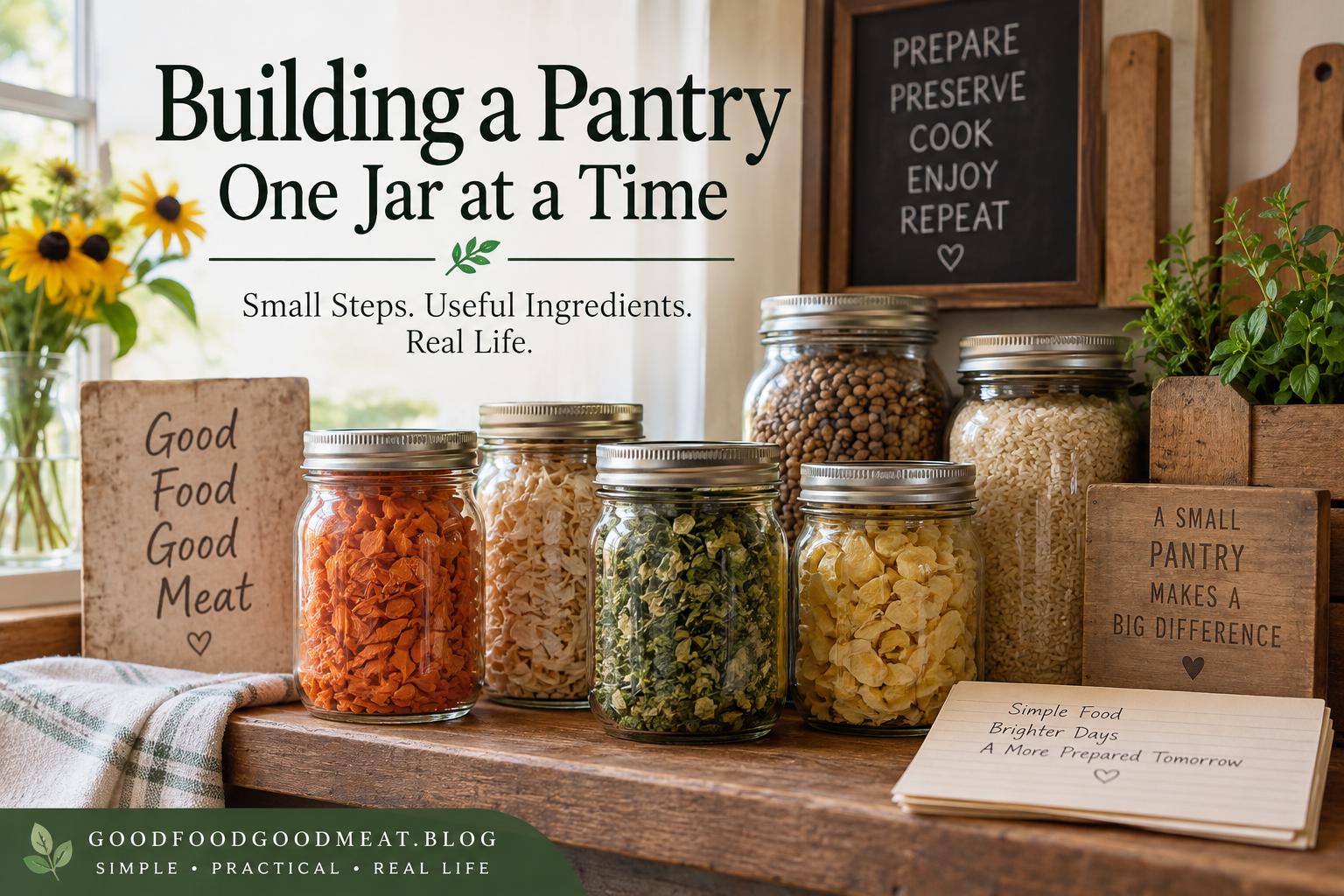
Building a Pantry One Jar at a Time

You don’t need a pantry full of food to have a well-stocked pantry. Sometimes, a few small jars of useful ingredients can make all the difference.

There is something satisfying about putting a little food away for later.

Not a year’s supply. Not a basement full of buckets. Not a pantry that looks like you’re preparing for the end of the world.

Just a little something put back while it’s inexpensive and available, so that when you need it later, part of dinner is already waiting for you.

That is the kind of pantry I’m interested in building.

Especially when you don’t have a lot of refrigerator, freezer, or storage space, every little bit counts.

A Pantry Doesn’t Have to Be Big

I’ve come to think of a practical pantry less as a collection of things I might need someday and more as a collection of ingredients I know I’ll actually use.

A jar of dehydrated carrots.

Some dried onions.

A little celery.

A few potatoes.

A bag of lentils.

A can of chicken.

None of those things takes up much room individually. But put them together and they can become a meal.

That’s where the idea of building a pantry one jar at a time really starts to make sense.

You aren’t trying to store everything.

You’re simply creating a little breathing room between buying the food and needing the food.

Put a Little Back

This is the idea behind this month’s Put a Little Back theme.

When produce is plentiful and reasonably priced, preserve some.

When you have a little extra time, prepare something for later.

When you find a shelf-stable ingredient that fits the way you cook, keep a little on hand.

It doesn’t have to be complicated.

It doesn’t even have to involve preserving food yourself.

Sometimes buying a shelf-stable ingredient is the practical choice.

That’s an important part of pantry building, too.

Think Ingredients, Not Just Food

One of the biggest shifts in the way I think about a pantry is to stop asking:

“What foods should I store?”

and start asking:

“What ingredients would make a future meal easier?”

That’s a very different question.

A jar of dehydrated carrots isn’t necessarily exciting by itself.

But those carrots could become part of:

  • Vegetable soup
  • Chicken and rice
  • A stew
  • A pot pie
  • A casserole
  • A skillet meal

Suddenly, that little jar has possibilities.

And that’s what I want from the food taking up my limited storage space: possibilities.

Small Jars Can Do a Lot

This week I’m experimenting with small-batch dehydrated vegetables and a little 1–2 quart slow cooker.

The first experiment was a simple lentil and vegetable soup.

The dry ingredients fit into a 1-pint Mason jar. Once broth and cooked chicken were added and everything had time to cook, that little collection of dried ingredients turned into four cups of soup—two generous servings.

That surprised me a little.

It also made me think about how useful small pantry projects can be.

The jar didn’t contain a complete meal in the traditional sense. It contained the ingredients that made the meal easy to put together later.

That’s the distinction I want to explore this week.

You Don’t Have to Preserve Everything

I also don’t think every ingredient needs to be dehydrated at home.

I’ve dehydrated meat before, and while it can certainly be done, I’ve found that it takes considerably more time than I want to spend for the way I cook.

For me, buying some cooked rotisserie chicken and using it for several meals makes more sense.

Commercially canned meats can serve a similar purpose.

Canned chicken, tuna, salmon, or other shelf-stable proteins can give you options without taking up valuable freezer space.

The same principle applies to dried beans and lentils. They’re already shelf-stable pantry ingredients. They don’t need to be dehydrated to earn their place on the shelf.

Preserving food isn’t about doing everything yourself. It’s about making good use of what you have.

Build Around the Way You Actually Cook

This might be the most important pantry rule of all:

Don’t build a pantry for the person you think you should be. Build one for the person you actually are.

If you make soup often, keep ingredients for soup.

If you eat a lot of rice bowls, keep ingredients that can become rice bowls.

If you cook for one or two, don’t fill your shelves with ingredients designed for feeding twelve people.

If freezer space is limited, look for shelf-stable ingredients that can take some of the pressure off the freezer.

And if you have limited storage space, small jars and small batches can be an advantage rather than a limitation.

You can put away a little at a time without having to find room for a mountain of food.

The Pantry Is There to Help You

A well-stocked pantry shouldn’t become another source of work.

It should make life easier.

Maybe it’s a night when you don’t feel like going to the grocery store.

Maybe the weather makes a trip inconvenient.

Maybe you’re trying to stretch the grocery budget until payday.

Maybe you simply have a little chicken left over and a jar of vegetables waiting on the shelf.

That’s when the pantry earns its keep.

A few ingredients that have already been put away can turn “What are we going to have for dinner?” into a much easier question.

One Jar at a Time

I don’t expect to build my pantry all at once.

I don’t need to.

A jar of dehydrated vegetables here.

A few dried beans there.

Some rice.

A can or two of chicken.

A little something preserved when it’s in season.

Over time, those small additions begin to add up.

And that’s really the heart of Put a Little Back:

You don’t have to put away a lot. You just have to put away something useful.

One jar at a time.


A Simple Way to Start

If you’re interested in building a small pantry of your own, start with something you already eat.

Choose one vegetable that’s inexpensive and plentiful.

Dehydrate a small batch.

Store it properly.

Label it.

Then, sometime later, actually cook with it.

That’s the part that matters.

Because the goal isn’t to have jars sitting on a shelf.

The goal is to have ingredients waiting to become dinner. 🍲

And that’s exactly what we’ll be exploring throughout this week.