
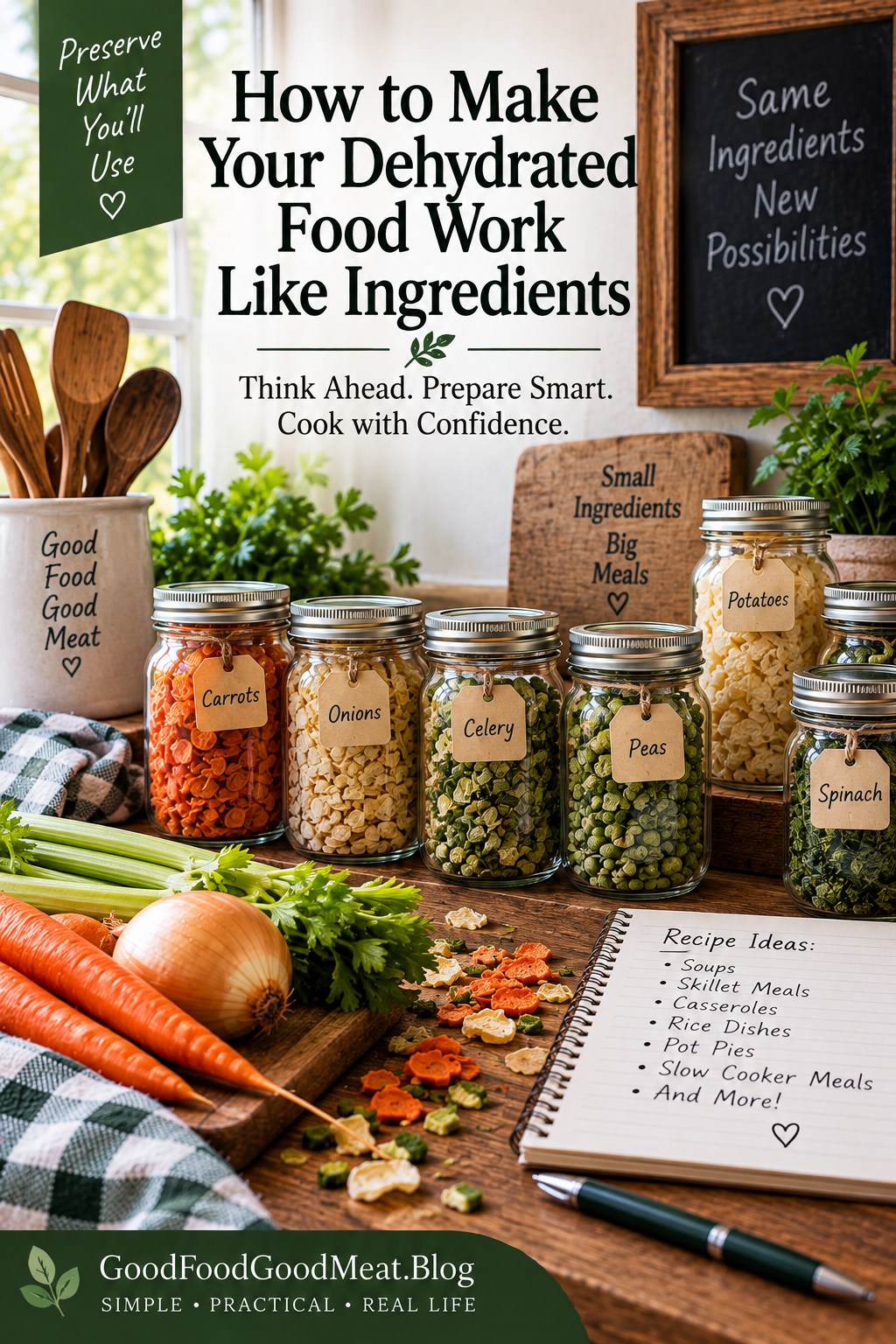
The most useful dehydrated foods aren’t the ones that simply look good in a jar. They’re the ones that make your next meal easier.
There is a point in food preservation when you have to stop thinking about the food you’re preserving today and start thinking about the meal you’ll make with it later.
That’s especially true with dehydrating.
It’s easy to get caught up in the process.
How do I dry carrots?
How do I dry onions?
How do I dry zucchini?
How long does everything take?
Those are useful questions.
But I think there’s another question that’s even more useful:
What can I make with this six months from now?
That’s the question that turns dehydrated food into ingredients.
A Jar of Carrots Isn’t Dinner
Let’s take carrots.
You can dehydrate a batch, put them in a jar, label it, and feel good about putting some of the harvest away.
But the real value comes later.
Those carrots could become part of:
- Chicken soup
- Beef stew
- Chicken and rice
- A casserole
- A pot pie
- A skillet meal
- A rice bowl
The jar isn’t the finished product.
It’s an ingredient waiting for a recipe.
That small change in how you think about dehydrating can make a big difference in what you choose to preserve.
Think About the Future Recipe First
Before putting something into the dehydrator, ask yourself:
How am I going to use this?
If the answer is soup, prepare it for soup.
If the answer is casseroles, think about what size pieces work best in a casserole.
If you’re making meal starters, consider how the ingredients will work together in the same jar.
This is why I’ve started paying more attention to how I cut vegetables before dehydrating them.
For example, diced onions are much easier to measure later than onions that were sliced before drying.
Both can be used.
But one is much more convenient when you’re trying to measure a specific amount for a recipe.
The potatoes I’ve dehydrated were diced, too, and that makes them immediately useful for soups and other dishes.
The dehydrator doesn’t get the final say. The future recipe does.
Some Ingredients Are Meant to Disappear
One of the things I’ve learned from actually cooking with dehydrated vegetables is that they don’t all behave the same way.
Some come back looking remarkably recognizable.
Carrots, celery, potatoes, and other vegetables can retain enough shape and texture that you can clearly tell what you’re eating.
Others have a different job.
Spinach is a good example.
When I added dehydrated spinach to my soup, it essentially disappeared into the broth.
At first glance, that might sound like a problem.
It isn’t.
The spinach didn’t need to remain a recognizable green leaf.
It became part of the soup.
That’s a useful ingredient.
So when you’re evaluating dehydrated food, don’t judge everything by whether it looks exactly like the fresh version.
Ask instead:
Does it perform the job I want it to perform?
Texture Matters
Another reason to think about the finished recipe is texture.
Some vegetables need to remain recognizable.
Others can be softer.
Some are perfectly happy simmering in soup.
Others might be better added toward the end of cooking.
That’s something you learn by using your dehydrated food.
And that experimentation is valuable.
My first small batch of dehydrated-vegetable soup taught me that the vegetables themselves were actually working very well.
The carrots, celery, onions, peas, and potatoes rehydrated without becoming gummy.
The problem wasn’t the vegetables.
It was the balance of the finished recipe.
That’s an important distinction.
Sometimes the answer isn’t to change the preservation method.
Sometimes you simply need to change how much of an ingredient you use.
Don’t Overfill the Jar
When you’re creating a meal starter, it’s tempting to put a little bit of everything into the jar.
More vegetables must be better, right?
Not necessarily.
I’ve learned that lesson with peas.
A smaller amount worked better in my soup than the original amount.
That’s why I like the idea of small experimental batches.
You don’t have to commit a dozen jars to a recipe before you know whether you like it.
Make one.
Cook it.
Taste it.
Then change it.
Maybe next time you want:
- More carrots
- Less peas
- More celery
- No spinach
- Different seasonings
That’s not failure.
That’s recipe development.
Seasonings Can Be Part of the Experiment, Too
You can certainly put seasonings into a meal-starter jar.
But I’d be cautious about making the seasoning too strong.
I learned that one the hard way.
My first soup experiment included thyme.
There was too much.
In fact, there was enough thyme that it completely overwhelmed the flavor of the chicken.
The next batch was much better without it.
That’s why I’m leaning toward keeping meal-starter jars relatively neutral and allowing the cook to season the finished dish.
A little garlic powder, parsley, or another mild seasoning can work.
But you don’t have to decide the final flavor of the meal six months before you eat it.
Think in Combinations
Once you begin thinking of dehydrated food as ingredients, you can start looking at combinations.
Soup Starter
Carrots
Celery
Onion
Potatoes
Spinach
Lentils
Add broth and chicken later.
Chicken & Rice
Carrots
Celery
Onion
Spinach
Add rice, broth, and chicken later.
Rustic Vegetable Stew
Carrots
Green beans
Potatoes
Onion
Add broth and protein later.
The combinations don’t have to be complicated.
In fact, simple is probably better.
Shelf Space Matters
If you don’t have a huge pantry, refrigerator, or freezer, this approach becomes even more useful.
A small jar of dehydrated vegetables takes up very little room.
A bag of dry lentils takes up very little room.
A few cans of commercially prepared meat take up a manageable amount of shelf space.
Together, they give you options.
And because you’re storing ingredients rather than complete meals, the same ingredients can be used in several different ways.
That’s important when every inch of storage space matters.
You Don’t Have to Dehydrate Everything Yourself
This is worth repeating because food preservation can sometimes turn into an exercise in doing everything the hard way.
I don’t think that’s necessary.
If something is already available in a safe, shelf-stable form and it works for the way you cook, use it.
Dry lentils are already shelf-stable.
Rice is already shelf-stable.
Commercially canned chicken is shelf-stable.
And a rotisserie chicken can be a very practical way to get cooked chicken for several meals without spending hours dehydrating meat yourself.
The goal is a useful pantry—not a collection of complicated projects.
🧮 Ask One More Question: Is It Worth It?
When we’re talking about making dehydrated food useful, there’s another question worth asking:
Is making this ingredient myself actually the best use of my money and time?
That’s an especially important question for small households.
You might save money by dehydrating vegetables from your garden or by buying seasonal produce at a very good price.
But if you’re buying fresh vegetables at regular grocery-store prices, running the dehydrator for hours, and ending up with a small amount of finished food, the savings may disappear.
Commercially dried foods can sometimes be surprisingly inexpensive when purchased in larger quantities.
So don’t assume that homemade = cheaper.
Instead, compare.
If the commercial version is inexpensive, shelf-stable, convenient and something you use regularly, buying it may be the thrifty choice.
Save your dehydrator time for the foods where you actually gain something—whether that’s lower cost, better quality, using up excess produce, preserving something you can’t easily buy, or simply having the exact ingredient you want on hand.
That, to me, is much more useful than trying to make everything from scratch.
Build Meal Starters Around Your Life
A meal starter should fit the way you actually eat.
If you cook for one or two, make two-serving starters.
If you love soup, build soup starters.
If rice bowls are something you make regularly, create combinations that can become rice bowls.
If you don’t like a particular vegetable, don’t preserve it simply because it’s available.
Your pantry should reflect your meals, not somebody else’s idea of the perfect pantry.
What About Six Months From Now?
This is my favorite question to ask when I’m putting something away.
Imagine opening that jar six months from now.
Would you know immediately what to do with it?
If yes, you’ve probably created a useful pantry ingredient.
If you’re standing there thinking, “Now what am I supposed to do with this?”—maybe that’s not something you need to preserve again.
There’s no rule that says every vegetable needs to become a dehydrated vegetable.
Preserve what you’ll use.
The Little Jar Test
If you’re trying this for the first time, don’t make ten jars.
Make one.
Choose a combination of ingredients you already enjoy.
Put them into a small jar.
Label it with the contents and date.
Then actually cook with it.
Pay attention to:
- How well everything rehydrates
- How much liquid it needs
- How long it takes
- Which vegetables keep their shape
- Which ones disappear into the dish
- Whether the flavors work together
- How much finished food the jar produces
Then make your next jar better.
That’s how you build a pantry that actually works.
The Pantry Is Really a Collection of Future Meals
That’s the way I’m beginning to look at dehydrated food.
Not as jars of vegetables.
Not as food that I’m preserving simply because I can.
But as ingredients waiting for their turn in the kitchen.
A little jar of carrots can become soup.
A jar of onions can become a casserole.
Dried potatoes can become part of a hearty meal.
Lentils can provide substance without taking up freezer space.
And a can of chicken can supply the protein.
Put them together, and you have something much more valuable than a collection of preserved foods.
You have options for dinner.
And when space is limited, options are worth a lot.
So the next time you’re standing in front of your dehydrator, don’t just ask:
“What can I dry?”
Ask:
“What can I make with this?”
That’s when dehydrating starts working like a pantry instead of just a preservation project.
And that’s how you put a little back—one useful ingredient at a time. 🫙🥕🍲
Discover more from Simple, Practical Meals for Real Life
Subscribe to get the latest posts sent to your email.
