
A good pantry doesn’t need to be packed to the ceiling.
In fact, when you’re cooking for one or two people, I think there’s a lot to be said for keeping it fairly simple.
The goal isn’t to own every pantry staple ever invented.
It’s to have a handful of ingredients that can step in when you need them and help turn what you already have into dinner.
After a week of Pantry to Table, I’ve been thinking about the ingredients that do the most work in my own kitchen.
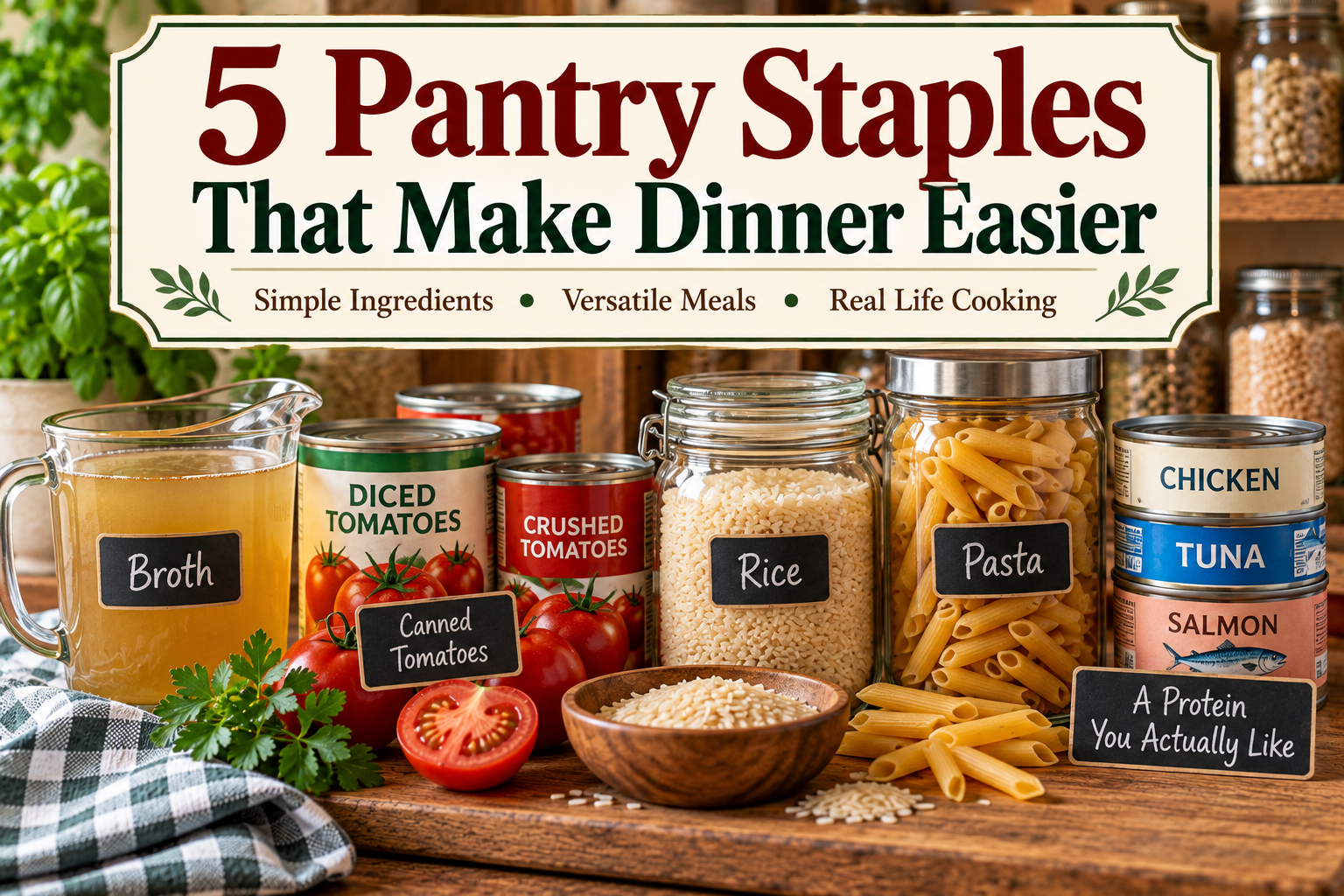
Here are five pantry staples that earn their shelf space.
1. Broth
Broth may not sound exciting, but it’s one of those ingredients that can quietly rescue a meal.
A carton or can of broth can become:
- Soup
- The cooking liquid for rice or barley
- The base for a sauce
- A way to loosen a skillet meal
- A starting point for gravy
- Part of a casserole
- The liquid for rehydrating dehydrated vegetables
And that’s exactly why broth belongs near the top of my pantry list.
Remember Thursday’s Chicken & Vegetable Soup Mix?
Broth is what turns that jar of dehydrated ingredients into lunch or dinner.
Small-household tip
If you don’t use large amounts of broth at once, look for packaging that fits your cooking habits.
Shelf-stable broth also means you don’t have to use valuable refrigerator space until you’ve opened it.
2. Canned Tomatoes
Canned tomatoes are another hardworking pantry ingredient.
Depending on the type you keep, they can become:
- Pasta sauce
- Soup
- Chili
- Skillet meals
- Casseroles
- Rice dishes
- Bean dishes
A can of tomatoes can add moisture, flavor, and substance without requiring fresh produce.
That’s especially helpful when refrigerator space is limited.
And you don’t necessarily need every variety.
If diced tomatoes are what you use most often, buy diced tomatoes.
If tomato sauce is more useful in your kitchen, stock that instead.
Think about what you actually cook.
The best pantry staple is the one that repeatedly finds its way into your meals.
3. Rice
Rice is one of those pantry staples that can look pretty unremarkable sitting in a container.
Then dinner needs a little help.
Suddenly it’s useful.
Rice can be:
- A side dish
- The base for a bowl
- Combined with chicken
- Combined with beans
- Added to soup
- Used in casseroles
- Turned into fried rice
It’s also an excellent way to stretch a small amount of protein.
A little chicken and a cup of cooked rice can become a meal.
The same is true of tuna, beans, or leftover vegetables.
Small-household tip
You don’t have to commit to a giant bag if you don’t have the storage space or don’t use rice often.
Choose the size and variety that fits your kitchen.
4. Pasta
Pasta has a similar advantage.
It stores easily, cooks quickly, and can become an entirely different meal depending on what you add.
Tuna and pasta.
Chicken and pasta.
Tomatoes and pasta.
Beans and pasta.
Vegetables and pasta.
Broth and pasta can even become soup.
Wednesday’s Pantry Tuna & Tomato Pasta is a perfect example.
There wasn’t anything particularly unusual in that recipe.
Pasta.
Tuna.
Tomatoes.
Broth.
Seasonings.
Yet those ordinary pantry ingredients became dinner.
That’s exactly the kind of workhorse ingredient we’re looking for.
5. A Protein You Actually Like
I’m deliberately making the fifth item a category rather than naming one particular food.
Your pantry needs a dependable protein.
For some people that’s canned chicken.
For others it’s tuna.
Maybe it’s canned salmon.
Maybe mackerel.
Maybe beans.
Maybe peanut butter.
There isn’t one right answer.
The important thing is having something shelf-stable that you can reach for when fresh meat isn’t available or when you simply don’t want to cook a larger piece of meat.
And this is where the whole Pantry to Table philosophy comes together.
Don’t stock a protein because someone told you it belongs in a pantry.
Stock the one you’ll actually turn into dinner.
What These Five Ingredients Can Do Together
Here’s where things get interesting.
Take just those five categories:
Broth + tomatoes + rice + pasta + protein
You already have the foundation for quite a few meals.
Chicken + rice + broth
Chicken and rice soup
Tuna + pasta + tomatoes
Pantry Tuna & Tomato Pasta
Beans + tomatoes + rice
Bean and tomato rice bowl
Chicken + pasta + broth
Chicken noodle soup
Beans + pasta + tomatoes
A simple pasta and bean skillet
You can add vegetables, seasonings, cheese, sauces, or whatever else you happen to have.
But the foundation is already there.
What About Vegetables?
I’m leaving vegetables off this particular list deliberately.
Not because they’re unimportant.
They’re incredibly important to a practical pantry.
But vegetables are a category where the best choice depends heavily on your storage space and household size.
Some households can keep several bags of frozen vegetables.
Some have room for fresh produce.
Others rely more heavily on canned or dehydrated vegetables.
And for a household of one, even a regular can may sometimes be more than you want to eat at once.
That’s a topic worth giving its own attention as we continue through October.
The Five-Staple Test
Here’s a little test you can use the next time you’re looking at your pantry.
Pick an ingredient.
Then ask:
How many meals can I make with this?
If the answer is one, it may be a recipe ingredient.
If the answer is five or ten, you’ve probably found a pantry workhorse.
That doesn’t mean every versatile ingredient belongs in your kitchen.
It simply gives you a way to think about pantry space.
Pantry Space Is Valuable
Especially in a small kitchen, every shelf has a job.
That’s why I don’t want a pantry full of things that sounded like a good idea when I bought them.
I want ingredients that make cooking easier.
Ingredients that work together.
Ingredients that help me use leftovers.
Ingredients that don’t require me to buy six more things before I can make dinner.
And ingredients that I actually enjoy eating.
Build From What You Use
If you’re looking at your pantry and thinking it needs an overhaul, don’t start with a giant shopping list.
Start with your meals.
What do you cook most often?
What ingredients disappear quickly?
What do you repeatedly find yourself wishing you had?
And what sits untouched for months?
Those answers are far more useful than a generic list of pantry essentials.
Your pantry should reflect your kitchen.
Not somebody else’s.
One Week of Pantry to Table
That’s really what this first week has been about.
We started with a simple chicken meal starter.
Then we talked about building a pantry around the way a small household actually cooks.
We looked at shelf-stable proteins.
We turned tuna, tomatoes, and pasta into dinner.
And we made a homemade chicken and vegetable soup mix from dehydrated ingredients.
Now we’ve narrowed it down to five basic pantry workhorses:
Broth.
Tomatoes.
Rice.
Pasta.
A protein you actually like.
That’s not a complete pantry.
It doesn’t need to be.
It’s a starting point.
Because a useful pantry isn’t built in one shopping trip.
It’s built meal by meal.
And the best pantry is the one that makes tonight’s dinner easier.
Discover more from Simple, Practical Meals for Real Life
Subscribe to get the latest posts sent to your email.
