
Posted in Home & Pantry

The Pantry Challenge: Start With Three Ingredients

Have you ever looked at three perfectly good ingredients and had absolutely no idea what to do with them?

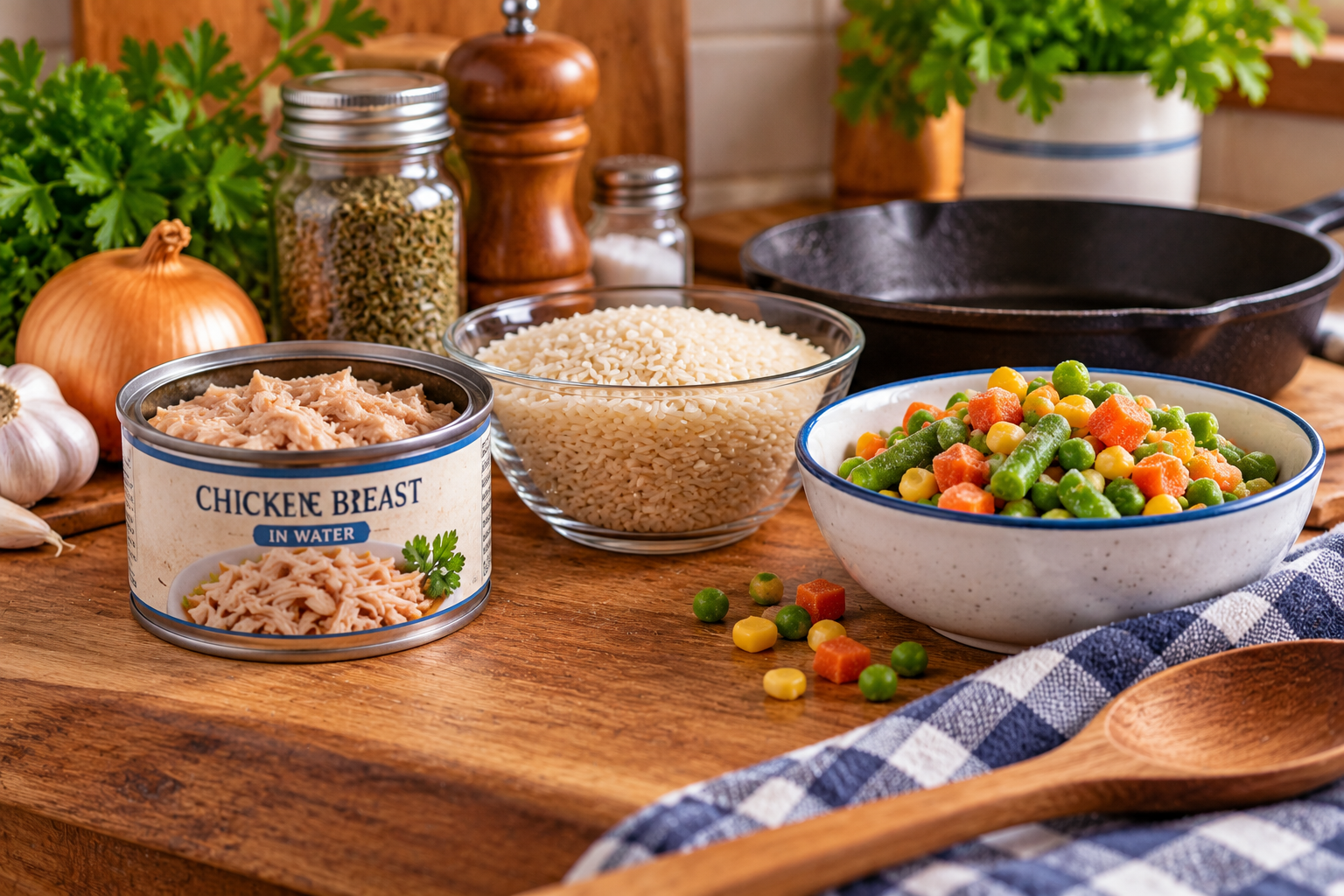
Maybe there’s a can of chicken in the pantry, a little rice in the cupboard, and a bag of frozen vegetables in the freezer. You know you have enough food to make something, but you’re not sure where to begin.

Here’s a little secret about pantry cooking: you don’t need to start with a recipe. You can start with three ingredients.

Welcome to Day Two of our Pantry Challenge!

Yesterday, we talked about making dinner from what you already have. Today, we’re going to take that idea a step further and learn how to build a meal around just three ingredients.

You might be surprised at how many possibilities are hiding in your pantry.

Why Start With Three Ingredients?

When you open the pantry and see dozens of possibilities, deciding what to cook can feel harder than actually preparing the meal.

Starting with three ingredients simplifies the process.

Instead of asking, “What can I make for dinner?” try asking:

  • What protein do I have available?
  • What starch or vegetable could go with it?
  • What other ingredient would help bring the meal together?

You don’t have to answer all three questions in that order. Sometimes the ingredient that needs to be used first will determine the direction of your meal.

The important thing is to give yourself a starting point.

Three ingredients are enough to begin planning. You’ll probably use a few additional items, such as oil, broth, or seasonings, but you don’t need to build an elaborate shopping list before you start cooking.

And if you’re cooking for one or two, this approach can help you avoid opening several packages just to prepare one supper.

Step One: Choose Your Three Ingredients

Let’s look at three different ways to get started.

Option 1: Begin With a Protein

This is probably the most familiar approach.

Choose a protein you already have, then look for two ingredients that complement it.

For example:

Ingredient OneIngredient TwoIngredient ThreePossible Meal
Canned chickenRiceFrozen mixed vegetablesChicken and rice skillet
Ground turkeyPastaCanned tomatoesTurkey and tomato pasta
Canned tunaPastaFrozen peasTuna and pea pasta
Cooked chickenPotatoesFrozen green beansChicken and vegetable skillet
Canned salmonRiceFrozen vegetablesSalmon and rice bowl

These combinations are starting points, not complete recipes. You’ll still need to consider cooking times, seasonings, and whether you need a little broth or another ingredient to bring everything together.

But notice how quickly the possibilities begin to take shape.

You don’t have to start with a particular recipe and then shop for every ingredient it requires.

You can start with what you have.

Option 2: Begin With a Vegetable

Sometimes the ingredient that needs attention isn’t a protein at all.

Perhaps you have half an onion, a few potatoes, or a bag of frozen broccoli that you’d like to use.

Start there!

Ingredient OneIngredient TwoIngredient ThreePossible Meal
PotatoesOnionCanned chickenPotato and chicken skillet
Frozen broccoliPastaCanned chickenChicken, broccoli, and pasta
Canned tomatoesRiceCanned beansTomato and rice bowl with beans
Frozen spinachPastaCanned tomatoesSpinach and tomato pasta
CarrotsPotatoesBrothVegetable soup

The last example doesn’t include a protein, but that doesn’t automatically make it an unsuitable meal. You could add cooked chicken, beans, or another protein if you have one and want to make the soup more substantial.

Remember, the three ingredients are your starting point. You can add what makes sense for the meal.

Option 3: Begin With a Starch

Rice, pasta, potatoes, and other starches are excellent foundations for pantry meals.

They’re often inexpensive, versatile, and easy to portion for a small household.

Try starting with one of these:

  • Rice, canned chicken, and frozen vegetables.
  • Pasta, canned tomatoes, and canned tuna.
  • Potatoes, cooked ground turkey, and frozen corn.
  • Barley, canned chicken, and dehydrated vegetables.
  • Pasta, leftover cooked chicken, and a little shredded cheese.

You may already have everything you need to make one of these combinations work.

If not, see whether another ingredient in your pantry can fill the same role.

Step Two: Decide What Kind of Meal You Want

Once you’ve chosen your three ingredients, think about how you’d like to serve them.

The same ingredients can sometimes become different meals simply by changing the cooking method or adding a little liquid.

Let’s use canned chicken, rice, and mixed vegetables as our example.

Turn Them Into a Skillet Meal

If you have cooked rice, this is an easy option.

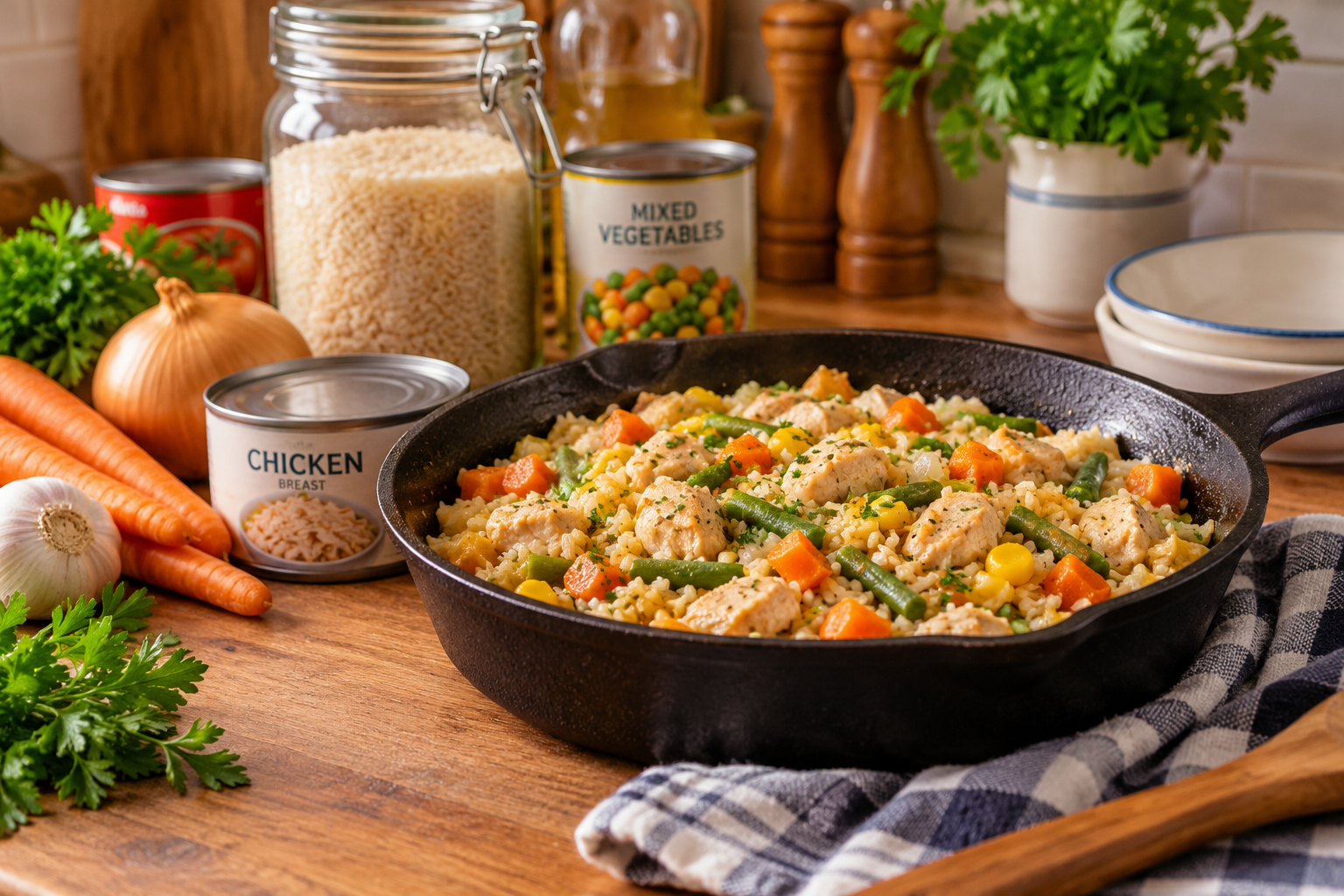
Warm the vegetables in a skillet with a little oil or broth. Add the chicken and cooked rice, then season to taste.

Stir everything together until hot.

If the mixture seems dry, add a little more broth. If you have soy sauce, garlic, or another seasoning you enjoy, you can use a small amount to add flavor.

You have a simple chicken and rice skillet without needing a complicated recipe.

Make a Soup

If you’d rather have soup, start with broth or water and suitable seasonings.

Add the vegetables and cook until tender. Stir in the chicken and rice, allowing everything to heat thoroughly.

Adjust the liquid to get the consistency you prefer.

If you’re using uncooked rice, remember that it needs additional cooking time and liquid. You may find it easier to cook the rice separately and add it to the soup near the end.

Build a Bowl

You can also serve the rice as a base, add the chicken and vegetables, and finish with a little sauce or seasoning.

A bowl meal is especially useful when you’re cooking for one because you can assemble a single portion without making a large batch of anything.

The lesson? Your three ingredients don’t dictate just one meal. They give you a starting point from which you can choose the preparation that suits your appetite and your available time.

Step Three: Build Outward

Now it’s time to consider what else the meal might need.

You don’t have to add everything on this list. Think of these as tools you can use when they’re appropriate.

Add Flavor

Seasonings can make familiar ingredients taste completely different.

Consider:

  • Garlic and onion.
  • Italian seasoning.
  • Parsley and thyme.
  • Chili powder and cumin.
  • Black pepper, if you enjoy it.
  • A small amount of your favorite sauce.

Choose flavors that complement the ingredients rather than adding seasonings simply because they’re available.

Add Moisture

Some combinations need additional liquid to cook properly or keep the finished meal from becoming dry.

Depending on the dish, you might use:

  • Chicken or vegetable broth.
  • Water.
  • Canned tomato liquid.
  • A little milk for an appropriate creamy dish.
  • A small amount of sauce you already have.

Use the liquid that suits the meal. A skillet may need only a splash, while a soup will need considerably more.

Add Something Fresh

If you have fresh ingredients that need to be used, consider adding them.

A little chopped onion, parsley, lemon juice, or another suitable ingredient can brighten a meal.

But don’t make fresh produce a requirement for the challenge. Frozen and canned vegetables are useful pantry companions, too.

Add a Finishing Touch

Sometimes a meal benefits from one small addition.

A sprinkle of cheese, a spoonful of salsa, some chopped herbs, or a few crushed crackers can provide extra flavor or texture.

These are optional touches, not reasons to abandon the challenge because you don’t have the perfect garnish.

Step Four: Make It Work for One or Two

Cooking for a small household means thinking about quantities before you start.

You don’t want to open three large packages and end up with enough food for six people when you only need one or two servings.

Here are a few ways to keep the challenge manageable.

Use small amounts first. Measure out what you need before opening additional packages.

Choose ingredients you can save. Frozen vegetables and frozen proteins are particularly helpful because you can take out what you need and keep the rest frozen.

Use leftovers thoughtfully. If you have cooked chicken or rice, consider whether you can use a portion without preparing an entirely new batch.

Don’t force a combination. If your three ingredients won’t make a meal you actually want to eat, choose another starting point.

Plan for the extra food. If your pantry meal produces two servings, decide whether the second serving will be tomorrow’s lunch or a portion for the freezer.

The point is to make cooking easier, not to create a new problem with excess leftovers.

Three More Pantry Combinations to Try

Need a little inspiration? Here are three more combinations you might be able to make with ingredients already in your kitchen.

1. Turkey, Potatoes, and Corn

If you have ground turkey, potatoes, and corn, consider making a skillet supper.

Cook the ground turkey thoroughly, then add cooked or partially cooked potatoes and the corn. Season with onion, garlic, or herbs that suit your tastes.

If the potatoes are raw, cut them into small pieces so they cook more quickly. You may need a little water and a lid to help them become tender.

2. Pasta, Tomatoes, and Tuna

Canned tuna, pasta, and canned tomatoes can become a simple pasta supper.

Cook the pasta according to its package directions. Meanwhile, warm the tomatoes and tuna together with seasonings you enjoy.

Combine the sauce with the drained pasta and heat through.

If you have spinach, peas, or another vegetable, you can add a little. If you don’t, the basic combination can still make a straightforward meal.

3. Barley, Chicken, and Dehydrated Vegetables

If you’ve been building a pantry with homemade dehydrated ingredients, this combination is worth remembering.

Combine barley, suitable dehydrated vegetables, and chicken with broth or water in a saucepan or Dutch oven.

Cook until the barley is tender, adding liquid as necessary. If you’re using cooked chicken, add it at an appropriate point so it heats through without becoming unnecessarily dry.

Check the instructions for your particular barley and dehydrated ingredients because cooking times vary.

This combination could become a hearty soup or a thicker one-pot meal, depending on the amount of liquid you use.

Stretch Every Grocery Dollar

One of the best things about learning to build meals from a few ingredients is that you can use the same pantry staples in different ways.

A bag of rice might become a side dish on Sunday, a chicken skillet on Monday, and the foundation of a soup later in the week.

A can of tomatoes might become pasta sauce, chili, or part of a vegetable soup.

A package of ground turkey could supply several small meals if you divide it into appropriate portions before freezing.

You don’t have to buy a different ingredient for every recipe.

Instead, think about which ingredients can serve several purposes and how much you realistically need for your household.

When you’re cooking for one or two, that kind of flexibility can make a real difference in your grocery budget.

Waste Not, Want Not

The Pantry Challenge is also a good opportunity to look at those ingredients you keep putting aside.

Perhaps there’s a little rice left in the bag, a small amount of frozen corn, or a few tablespoons of dehydrated vegetables in a jar.

Before opening a new package, see whether one of those small quantities could complete your meal.

You don’t need to use every last bit at once. Just make a note of what’s left and think about how you might use it next time.

For perishable ingredients, follow safe storage practices and use them within recommended time limits. For shelf-stable ingredients, check the package directions and keep them properly stored.

The goal is to use food thoughtfully rather than letting it disappear into the back of a cupboard.

Kitchen Confidence: Learn to See Possibilities

The more you practice pantry cooking, the easier it becomes to recognize ingredients that work well together.

You’ll begin to see that rice can be a side dish, a soup ingredient, or the foundation of a bowl meal. You’ll recognize that cooked chicken can go into a skillet, a soup, a sandwich, or a casserole.

And you’ll discover that a recipe is a useful guide, not always a list of requirements you must follow exactly.

Of course, some recipes depend on precise ingredient ratios or specific cooking methods. Baking is a good example, and food preservation requires tested recipes and approved procedures.

But many everyday skillet meals and soups offer room for flexibility.

Start with familiar ingredients, make sensible adjustments, and taste as you go.

That’s how confidence grows.

Your Pantry Challenge for Today

Let’s put this into practice!

Your assignment is simple: Find three ingredients and turn them into the beginning of a meal.

  1. Look in your pantry, refrigerator, and freezer.
  2. Choose three ingredients that could work together.
  3. Decide whether you’d prefer a skillet meal, soup, bowl, or another simple dish.
  4. Add only the seasonings, liquid, and other ingredients needed to make the meal work.
  5. Write down the combination if you enjoy it.

You don’t have to cook anything elaborate, and you don’t have to make a large quantity.

The point is to practice looking at your available ingredients in a new way.

Tomorrow, we’ll take the next step with Pantry Challenge: The Skillet Meal, where we’ll explore a flexible formula for turning available ingredients into a satisfying skillet supper.

Because sometimes the best dinner starts with just three things.
Posted in Home & Pantry

The Pantry Challenge: Make Dinner From What You Have

Have you ever stood in front of an open refrigerator, looked through your pantry, and decided there was absolutely nothing to eat?

I think we’ve all been there!

Maybe you have half a package of pasta, a can of chicken, a few potatoes, some frozen vegetables, and a jar of broth. Nothing seems to go together, and you can’t find a recipe that uses exactly what you have.

Before you head to the grocery store, let’s try something different.

This week, we’re going to challenge ourselves to make dinner with what we already have on hand.

Welcome to the Pantry Challenge!

Throughout October, we’ve explored building a practical pantry, cooking one-pot meals, making soups and chili, and preparing homemade mixes. Now it’s time to put those ideas to work.

You don’t need a perfectly stocked pantry or a kitchen full of expensive ingredients. You need a few useful staples, a willingness to experiment, and a plan for turning those ingredients into a satisfying meal.

And the best part? You might save yourself a trip to the grocery store and a little money along the way.

Why Try a Pantry Challenge?

Pantry cooking isn’t just about using up food. It’s about learning to make the most of what you have.

A pantry challenge can help you:

  • Save money. Use ingredients you’ve already purchased instead of buying more food for a single recipe.
  • Reduce food waste. Give those half-used packages, leftover vegetables, and small amounts of cooked meat another purpose.
  • Simplify dinner. You don’t always need a complicated recipe to put a good meal on the table.
  • Become a more flexible cook. Learn which ingredients work well together and which substitutions make sense.
  • Discover new favorites. Some surprisingly good meals begin with ingredients that weren’t originally intended to go together.

You don’t have to empty your pantry or go an entire week without shopping. The goal is simply to become more comfortable using what you have.

Think of it as a little kitchen creativity exercise!

Step 1: Take Inventory Before You Plan Dinner

Before deciding what to cook, take a few minutes to see what’s available.

You don’t need to empty every cabinet or reorganize the entire kitchen. Just check three places.

Look in the Pantry

Start with the shelf-stable ingredients you use regularly.

Look for:

  • Canned chicken, tuna, salmon, or other proteins you enjoy.
  • Pasta, rice, barley, oats, and other grains.
  • Canned vegetables, tomatoes, and broth.
  • Dried onions, potatoes, and other dehydrated vegetables.
  • Homemade soup starters and meal mixes.
  • Seasonings, herbs, and sauces.
  • Crackers, cornbread mix, or other ingredients that could round out a meal.

Don’t overlook small quantities. A cup of rice or half a package of pasta can still be the beginning of dinner.

Check the Refrigerator

Look for ingredients that should be used soon.

Perhaps you have leftover cooked chicken, half an onion, a little shredded cheese, some cooked rice, or a container of vegetables from another meal.

These ingredients deserve special attention because using them now may prevent them from going to waste.

Don’t Forget the Freezer

Your freezer can provide the missing piece that turns a collection of pantry ingredients into a complete meal.

Check for:

  • Frozen vegetables.
  • Ground turkey or another frozen protein.
  • Cooked shredded chicken.
  • Individual portions of soup or broth.
  • Bread, tortillas, or other items that can complete a meal.

For a small household, frozen ingredients are especially helpful because you can use only what you need.

Kitchen tip: Make a short list of ingredients you’d like to use rather than trying to remember everything you saw. You’ll find it easier to spot combinations when the possibilities are written down.

Step 2: Choose One Ingredient to Build Around

You don’t need to start with an entire recipe. Start with one ingredient.

This is your anchor ingredient: the food that will determine the direction of your meal.

It might be a protein, a vegetable, or a starch.

Here are a few possibilities.

If You Have…Consider Making…
Canned chickenChicken and rice skillet, chicken soup, or a chicken casserole
Canned tunaTuna pasta, a tuna melt, or a simple tuna and vegetable bowl
Ground turkeyA skillet meal, turkey and rice bowl, or a small batch of chili
Cooked chickenChicken soup, chicken and noodles, or a quick skillet supper
PotatoesA potato and vegetable skillet, potato soup, or a small shepherd’s pie
PastaA one-pot pasta meal, pasta soup, or a simple pasta and vegetable dish
RiceA rice bowl, chicken and rice, or a vegetable and rice skillet
Canned tomatoesTomato-based soup, a small pot of chili, or a tomato and pasta skillet

These are starting points, not rules.

If you don’t have the ingredients for the first idea that comes to mind, look for another combination.

And remember, your anchor ingredient doesn’t always have to be meat. A satisfying supper can begin with potatoes, rice, pasta, or vegetables.

Step 3: Build the Meal Around What You Have

Once you’ve chosen your starting ingredient, look for two or three things that will complement it.

A simple meal often needs only a few basic components.

A protein + a starch or vegetable + flavor = a good starting point for dinner.

You can add broth, sauce, seasonings, or another vegetable if the meal needs them.

For example, suppose you find these ingredients:

  • One can of chicken.
  • One cup of cooked rice.
  • Half a cup of frozen mixed vegetables.

You already have the makings of a chicken and rice skillet.

Warm the vegetables in a skillet with a little oil or broth. Stir in the chicken and cooked rice, then season with garlic, onion, parsley, or whatever flavors you enjoy. Add a splash of broth if the mixture seems dry.

Heat everything thoroughly, taste, and adjust the seasonings.

That’s dinner!

You could add a little shredded cheese if you have some, but you don’t need to run to the store because you don’t have it.

The meal is complete enough without it.

Think About Flavor, Too

Sometimes the difference between a collection of ingredients and a meal you actually want to eat is a little flavor.

Look through your seasonings, sauces, and other pantry staples.

For example:

  • Garlic, onion, and parsley work well in many chicken and vegetable dishes.
  • Italian seasoning can bring together tomatoes, pasta, and vegetables.
  • Chili powder and cumin can turn ground turkey, tomatoes, and rice into a Tex-Mex-inspired skillet.
  • Thyme and sage can add a familiar, comforting flavor to chicken soup.
  • A little vinegar or lemon juice can brighten a dish that tastes flat.

You don’t need every seasoning listed in a recipe. Use what you have and what you enjoy.

If you don’t like a particular flavor, leave it out. Your pantry should reflect your tastes, not somebody else’s idea of what belongs in a recipe.

Step 4: Choose a Cooking Method That Fits the Ingredients

Once you know what you’re working with, decide how to cook it.

You don’t have to use the same method every time.

Make It a Skillet Meal

A skillet is ideal for cooked proteins, vegetables, rice, pasta, and small quantities of other ingredients.

It’s particularly useful when you’re cooking for one or two because you can make a modest portion without dirtying several pots and pans.

Start with ingredients that need the most cooking, then add cooked ingredients near the end so they don’t become overcooked.

For more ideas, look for our upcoming post, Pantry Challenge: The Skillet Meal.

Turn It Into Soup

Soup is one of the most forgiving ways to combine pantry ingredients.

Broth, cooked meat, vegetables, rice, pasta, or barley can become a satisfying meal with very little fuss.

Start with enough liquid for the amount of food you’re using. Add ingredients according to their cooking times, and taste as you go.

If the soup is too thin, you may be able to add a little more rice, pasta, or potato. If it’s too thick, add broth or water.

For more guidance, see our upcoming post, Pantry Challenge: The Soup Pot.

Use Your Dutch Oven

A Dutch oven works well for stews, braised dishes, chili, and other meals that benefit from longer cooking.

It’s a good choice when you’re starting with raw ingredients that need time to become tender.

However, if your ingredients are already cooked, a skillet or saucepan may be quicker and more practical.

Choose the cooking method that suits the ingredients rather than making the ingredients fit a particular pot.

Keep It Simple

Not every pantry meal needs to be a recipe.

A baked potato topped with leftover chili, a bowl of rice with vegetables and chicken, or a grilled sandwich with a cup of soup can make a perfectly good supper.

Sometimes the best solution is the simplest one.

Step 5: Learn to Substitute Without Starting Over

One of the biggest obstacles to pantry cooking is the belief that every ingredient in a recipe is essential.

Some ingredients are important for food safety, texture, or the way a recipe works. Others are there to provide flavor or variety.

Learning the difference makes pantry cooking much easier.

Here are a few practical substitutions to consider.

If You Don’t Have…You Might Use…
RicePasta, barley, or another grain that suits the dish
Fresh onionDried or dehydrated onion
Fresh vegetablesFrozen or canned vegetables
Chicken brothWater with suitable seasonings, or another broth you have
Ground beefGround turkey, if it suits the recipe
Cooked chickenAnother cooked protein that complements the other ingredients
A particular seasoning blendIndividual herbs and spices you already enjoy

These substitutions depend on the dish, so use your judgment. Pasta, rice, and barley don’t all cook in the same amount of time, for example.

You may need to adjust the liquid and cooking time when you change ingredients.

A useful rule: Substitute with something that performs a similar job in the recipe, not simply something that happens to be available.

And don’t be afraid to leave out an optional ingredient entirely.

Step 6: Make the Most of Small Quantities

Small households often have a different pantry challenge from larger families.

We may have just a little of several ingredients, but not enough of any one thing to make a full meal.

The answer is to combine those small quantities thoughtfully.

A few tablespoons of vegetables can add color and flavor to a soup. A small amount of cooked chicken can stretch into a rice bowl. Leftover roasted vegetables can become part of a skillet meal or an omelet.

Here are a few more ideas:

  • Add a small amount of cooked meat to a vegetable soup rather than making meat the main component.
  • Combine leftover rice with vegetables and an egg, if you have one.
  • Use a little pasta to stretch a soup.
  • Turn leftover chili into a baked potato topping.
  • Combine small amounts of different vegetables in a skillet.
  • Use a little shredded cheese as a finishing touch rather than making it the main ingredient.

The point isn’t to make every ingredient disappear at once. It’s to use the right ingredients together so that you have a meal you’ll enjoy.

For more ideas, we’ll be exploring this subject in Pantry Challenge: The “Almost Empty” Pantry later this week.

Step 7: Know When a Pantry Meal Is Complete

It’s easy to get carried away trying to use every ingredient you have.

But a good meal doesn’t need to contain everything in the refrigerator.

If you have chicken, rice, and vegetables, you don’t need to add beans, pasta, tomatoes, and three kinds of cheese simply because they’re available.

Choose ingredients that work together.

Think about the texture, flavor, and balance of the finished meal. If it already tastes good and provides a satisfying supper, stop there.

You can save the remaining ingredients for another day.

A Quick Food Safety Reminder

Pantry cooking still requires good food safety practices.

Check expiration and quality information on packaged foods, inspect cans for damage, and follow safe storage and reheating practices for leftovers.

Refrigerate perishable ingredients promptly, and don’t rely on smell or appearance alone to determine whether food is safe.

Most importantly, don’t try to rescue food that has been stored unsafely. The Pantry Challenge is about reducing waste responsibly, not taking chances with food safety.

Your Pantry Challenge: Try One Meal This Week

Now it’s your turn!

You don’t have to plan an entire week of pantry meals. Start with just one supper.

Here’s your assignment:

1. Choose three ingredients you already have.

Look in your pantry, refrigerator, or freezer. Pick three ingredients that might work together.

2. Decide what kind of meal they could become.

Would a skillet work? Could you make soup? Would a baked potato, rice bowl, or simple pasta dish be a better choice?

3. Identify what else you need.

You may already have everything. If not, see whether a reasonable substitution will work.

4. Cook a meal that suits your household.

Keep the quantity manageable, especially if you’re cooking for one or two.

5. Make a note of what worked.

If you discover a combination you enjoy, write it down. You may have found a new regular supper.

Don’t worry if your first attempt isn’t spectacular. The goal is to practice thinking creatively about the ingredients you have.

The more often you do it, the easier it becomes.

Stretch Every Grocery Dollar

A well-stocked pantry isn’t necessarily a pantry filled with dozens of products.

It’s a pantry that supports the way you actually cook.

For some households, that means canned chicken, rice, pasta, broth, and frozen vegetables. For others, it might mean beans, potatoes, oats, canned fish, and homemade soup mixes.

Build your pantry around foods you enjoy, meals you prepare regularly, and ingredients you can use in more than one way.

When you shop, think about how each item will fit into your existing supplies.

Can it become part of several different meals? Can you use a small quantity without opening a package you’ll struggle to finish? Will it store well until you need it?

Those questions can help you make more thoughtful purchases and avoid buying ingredients that eventually go unused.

And remember: you don’t have to stock everything at once. Add useful items gradually as your budget allows.

Waste Not, Want Not

Before you put away the ingredients you didn’t use, take another look at what remains.

Is there a half can of vegetables that should be refrigerated in a suitable covered container? A little cooked rice that could become tomorrow’s lunch? A package of meat that needs to be divided into smaller portions?

Handle leftovers safely and make a plan to use them.

If you opened a package for the challenge, consider whether you can freeze the remaining portion or incorporate it into another meal.

A little planning now can make the next pantry challenge even easier.

Cooking for One or Two

Pantry cooking is particularly helpful when you’re preparing meals for a small household.

You can choose ingredients from several food groups without having to cook a large quantity of each one.

Here are three ways to make the challenge work for you:

Start small. Use a single serving of protein or a modest amount of vegetables rather than opening several packages at once.

Use what you can measure. If you have half a cup of cooked rice or a small handful of frozen vegetables, start there. Build the meal around those amounts.

Plan for one useful leftover. If you make enough soup for two meals, decide when you’ll eat the second portion. Refrigerate or freeze it appropriately rather than leaving it forgotten at the back of the refrigerator.

You can also make a pantry challenge easier by keeping a running list of ingredients you want to use soon.

That list becomes your starting point whenever you need a quick supper.

Kitchen Confidence: You Don’t Need a Recipe for Everything

Recipes are wonderful tools. They teach techniques, introduce new combinations, and help us reproduce dishes we enjoy.

But cooking doesn’t always have to begin with a recipe.

Once you understand how proteins, starches, vegetables, liquids, and seasonings work together, you can start making decisions based on what’s available.

You may discover that you prefer more vegetables in your skillet meals, less salt in your soup, or a different seasoning blend from the one a recipe recommends.

That’s part of learning to cook confidently.

The goal isn’t to stop using recipes. It’s to understand them well enough that you can adapt when your pantry doesn’t contain every ingredient on the list.

What’s Next in the Pantry Challenge?

Throughout the rest of this week, we’ll put these ideas into practice.

We’ll start with three ingredients, explore flexible skillet meals and soup combinations, and learn how to use those almost-empty packages that accumulate in every pantry.

On Friday, we’ll bring everything together with 10 Pantry Meals for When You Don’t Want to Go Shopping.

Then, on Saturday, we’ll revisit October’s Pantry to Table series and gather the month’s lessons and recipes into one convenient resource.

By the end of the week, I hope you’ll feel more comfortable looking at the food you have and seeing possibilities rather than problems.

Because dinner doesn’t have to start with a shopping list.

Sometimes, it starts with opening the pantry door.

Now it’s your turn: What three ingredients would you use to make dinner tonight?

Posted in Home & Pantry, Kitchen Tips

Freezer Inventory: Know What You Put Back

There’s a moment in every freezer owner’s life when something gets pushed toward the back.

Then something else gets pushed in front of it.

Then another thing.

And eventually, you find yourself staring into the freezer wondering:

“What is that?”

If you’ve ever discovered a container of something frozen so long that you can’t remember making it, you already understand why a freezer inventory can be useful.

But I’m not talking about creating another complicated household management system.

For a small household, a freezer inventory can be as simple as knowing what you have, where it is, and what needs to be used first.

Because putting food back is only half the job.

The other half is using it.

Your Freezer Is Part of Your Pantry

I’ve been thinking about the freezer a little differently this September.

Instead of seeing it as the place where leftovers and extra groceries go, think of it as an extension of your pantry.

Your pantry might contain:

  • Rice
  • Pasta
  • Flour
  • Canned tomatoes
  • Broth
  • Dried beans
  • Spices

Your freezer might contain:

  • Green beans
  • Corn
  • Peppers
  • Cooked chicken
  • Ground turkey
  • Fruit
  • Broth
  • Leftovers

Together, those ingredients give you a lot more possibilities for dinner.

But only if you know they’re there.

Start With What You Already Have

You don’t need to empty the freezer onto the kitchen counter and create a giant project.

Start with a quick inventory.

Open the freezer and make a list.

You might discover:

Vegetables

  • Green beans — 2 packages
  • Corn — 1 package
  • Mixed vegetables — 1 package

Meat

  • Cooked chicken — 2 portions
  • Ground turkey — 1 package

Fruit

  • Blueberries — 1 bag

Prepared Foods

  • Vegetable soup — 2 servings
  • Leftover casserole — 1 serving

That’s enough.

You’ve already learned something useful:

You have food.

Now you can start planning meals around it.

Label Everything

If there’s one freezer habit worth developing, this is probably it.

Label your packages.

The National Center for Home Food Preservation’s guidance on packaging and labeling frozen foods recommends labeling each package with the name of the food, packaging date, amount or number of servings, and the form of the food when that information is useful.

So instead of:

“What’s in this bag?”

you get:

Green Beans — 2 cups — Sept. 2026

Or:

Cooked Chicken — 1½ cups — Sept. 2026

Or:

Vegetable Soup — 2 servings — Sept. 2026

Future-you will appreciate the effort.

Especially at 5:30 on a Tuesday evening.

Date It, Even If You Think You’ll Remember

This is another one of those little jobs that’s easy to skip.

You think you’ll remember when you froze something.

You probably won’t.

And even if you do remember, having the date right there makes freezer management much easier.

The date isn’t necessarily a countdown to when the food suddenly becomes unsafe. Properly frozen food maintained at 0°F or below remains safe indefinitely, although quality can decline over time. The USDA recommends keeping the freezer at 0°F or below for best quality.

Think of the date as a quality and rotation tool.

It tells you what has been waiting the longest.

Use the Oldest Food First

This is where the inventory becomes useful.

The NCHFP recommends a simple first-in, first-out approach: use older frozen foods before newer ones so you enjoy them at their best quality.

You don’t have to arrange your entire freezer like a grocery store.

Just make the older packages easier to see.

When you add a new package of green beans, don’t bury last month’s green beans behind it.

Put the newer package toward the back.

Move the older one forward.

That’s it.

Give Different Foods Different Homes

One of the easiest ways to make a freezer inventory manageable is to give things a general place.

You might have:

One Area for Vegetables

Green beans, corn, peas, mixed vegetables, broccoli, peppers, and other frozen produce.

One Area for Proteins

Chicken, turkey, pork, beef, seafood, and cooked meats.

One Area for Prepared Foods

Soups, casseroles, cooked grains, leftovers, and other ready-to-use foods.

One Area for Fruit

Berries, sliced fruit, smoothie ingredients, or fruit prepared for baking.

You don’t need fancy bins to do this.

If you have them, great.

If you don’t, simply creating a rough mental map of the freezer can make finding things easier.

Meal-Sized Portions Make Inventory Easier

This is one reason I’ve been emphasizing meal-sized portions throughout this week’s freezer conversation.

A large package of frozen vegetables can be useful.

But four clearly labeled two-cup packages can be even more useful if that’s how you actually cook.

The NCHFP specifically recommends packaging frozen foods in quantities that will be used for a single meal.

That means your inventory can become a list of meals waiting to happen:

Green beans — 2 cups

Cooked chicken — 2 cups

Vegetable soup — 2 servings

Corn — 1½ cups

Now your freezer isn’t just a collection of ingredients.

It’s a collection of possibilities.

Keep a Simple Inventory Outside the Freezer

If your freezer is small, you may not need this at all.

But if you’re building a larger freezer stash, a simple list on the freezer door—or in a notebook nearby—can save time.

It could look like this:

FoodAmountDateLocation
Green beans2 cupsSept. 16Vegetable bin
Cooked chicken2 cupsSept. 15Protein bin
Corn1½ cupsSept. 10Vegetable bin
Vegetable soup2 servingsSept. 5Prepared foods
Blueberries3 cupsSept. 2Fruit bin

That’s all you need.

You don’t need a barcode scanner.

You don’t need an app.

You don’t need a complicated spreadsheet.

Unless, of course, you enjoy spreadsheets.

Then by all means, have fun. 😉

Don’t Forget the “Use Soon” List

This is the part I think can make a freezer inventory really helpful.

Instead of simply recording what you have, identify the things you should use next.

Maybe you have:

Use Soon

  • Vegetable soup
  • Older package of green beans
  • Cooked chicken
  • Opened bag of frozen corn

Now you have a built-in meal-planning list.

Instead of asking:

“What should I make for dinner?”

you can ask:

“What needs to be used?”

That’s a much easier question.

Your Freezer Shouldn’t Become a Museum

There’s a difference between preserving food and collecting food.

A freezer full of carefully labeled packages might look wonderfully productive.

But if those packages sit there for two years while you keep buying more food, something has gone wrong.

The purpose of preservation is to extend the usefulness of food—not to create a permanent exhibit of everything you’ve ever frozen.

The NCHFP notes that freezing preserves food by slowing microbial growth and chemical changes, but freezing does not sterilize food. It also recommends using older foods first for best quality.

So use what you put away.

Make the soup.

Cook the green beans.

Use the chicken.

Bake with the berries.

And then replace those ingredients when you have another opportunity to put something back.

Give Yourself a Freezer Reset

Every so often, take ten or fifteen minutes and look through the freezer.

Ask:

  • What do I have?
  • What’s oldest?
  • What’s nearly forgotten?
  • What needs to be used soon?
  • What am I running low on?
  • What do I actually want to preserve more of?

That last question is important.

Your freezer inventory isn’t just a record of what you’ve stored.

It’s information about how you really eat.

If your green beans disappear quickly but the frozen zucchini never gets used, that’s useful information.

Next time you have a choice, put more green beans back.

Maybe don’t bother with as much zucchini.

That’s practical preservation.

A Freezer Inventory Should Make Dinner Easier

That’s the real test.

If keeping an inventory makes your life more complicated, simplify it.

If a handwritten list works, use a handwritten list.

If a dry-erase board on the freezer door works, use that.

If you can remember what’s inside because your freezer is small and well organized, you may not need a list at all.

The system isn’t the important part.

Knowing what you have is.

Because the whole purpose of putting food back is to make future meals easier.

Put It Back. Keep Track. Use It.

That’s our freezer philosophy in three simple steps:

Put it back.

Preserve good food while it’s plentiful.

Keep track.

Label it, date it, and know what you have.

Use it.

Turn those ingredients into actual meals.

That’s how a freezer becomes more than a cold storage box.

It becomes part of your meal plan.

And that’s the goal we’ve been working toward all week:

Today’s harvest. Tomorrow’s dinner.

Not someday.

Not eventually.

Dinner.