
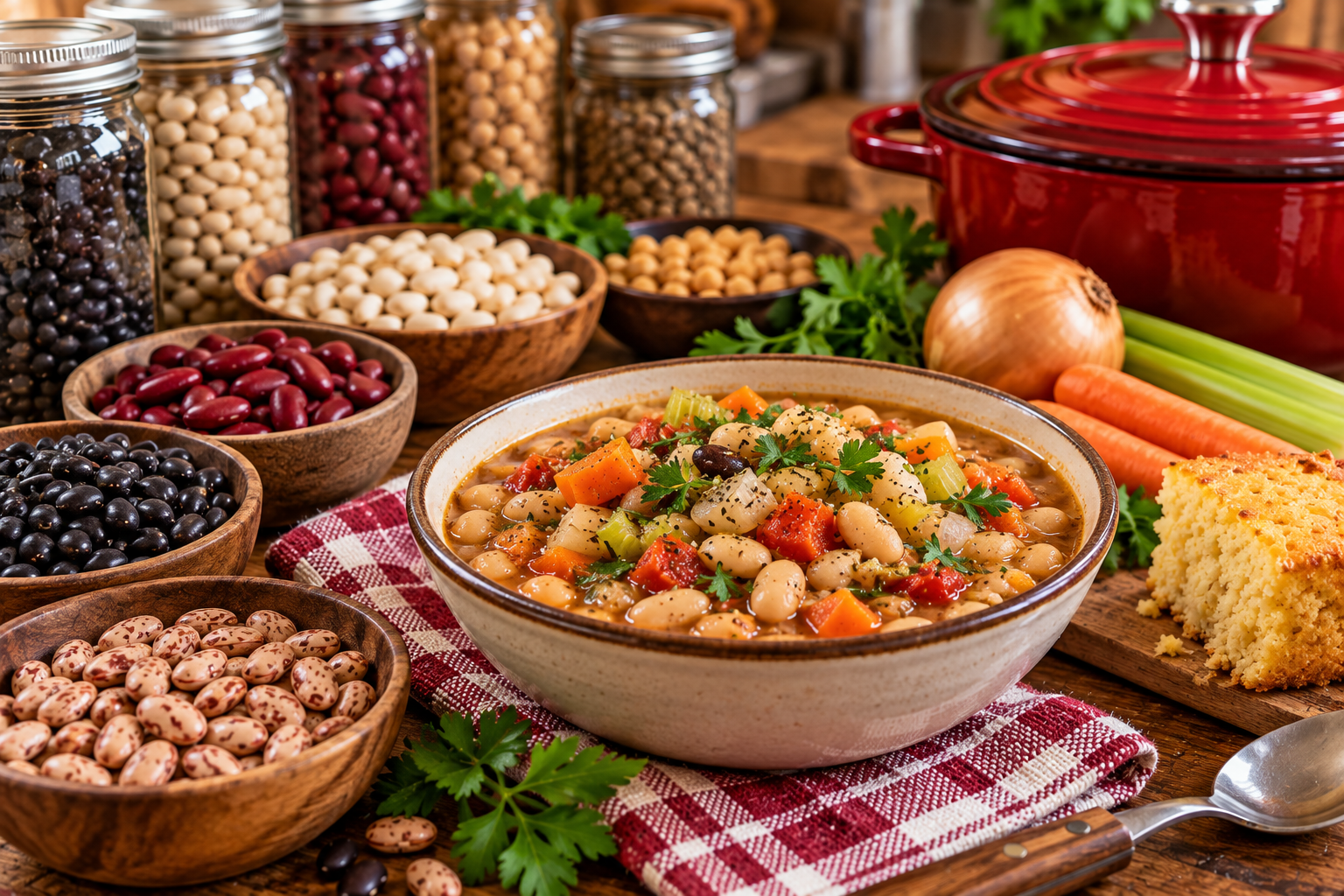
Beans have a reputation for being a side dish.
Put a spoonful of beans next to a piece of chicken. Add them to a plate of barbecue. Maybe serve them alongside cornbread.
But beans can do a lot more than sit quietly at the edge of the plate.
For a small household, beans are one of the most useful foods you can keep in the pantry. They’re inexpensive, versatile, filling, and available in forms that make sense whether you’re cooking from scratch or trying to get dinner on the table quickly.
And when you’re trying to stretch the grocery dollar, beans can help you make a little meat go a lot further.
Beans Can Be Dinner
One of the biggest mistakes we make with pantry cooking is thinking that every meal needs a large piece of meat in the center of the plate.
It doesn’t.
Beans can be the main protein in a meal, or they can share the job with a smaller amount of meat.
Think of:
- Beans with rice
- White beans with chicken
- Black beans with corn and rice
- Beans in soup
- Beans in chili
- Beans with pasta
- Beans folded into a skillet meal
- Beans served with cornbread
A half-can of beans can turn a small amount of leftover chicken into another meal.
That’s not just convenient.
That’s smart grocery shopping.
Choosing the Right Beans for Your Pantry
You don’t need ten different kinds of beans.
Buy the ones you actually enjoy eating.
Some useful choices include:
- Black beans
- Kidney beans
- Pinto beans
- Great Northern beans
- Cannellini beans
- Navy beans
- Chickpeas
- Black-eyed peas
- Lentils
And there’s no rule saying you have to like all of them.
Your pantry should reflect your tastes, not somebody else’s idea of a perfectly stocked pantry.
If you don’t enjoy a particular bean preparation, don’t buy it just because it’s cheap.
An inexpensive ingredient that never gets eaten isn’t a bargain.
Canned or Dried?
Both have a place in a practical pantry.
Canned Beans
Canned beans are hard to beat for convenience.
They’re already cooked, they don’t require soaking, and they’re ready to add to a meal.
For one or two people, smaller cans can also be useful because you aren’t committed to finding a use for a huge batch of cooked beans.
Drain and rinse canned beans before using them in most recipes. This removes some of the excess sodium and the liquid they are packed in.
Look for lower-sodium varieties when available, especially if you use beans frequently.
Dried Beans
Dried beans are usually economical when purchased in larger quantities, and they can be an excellent pantry staple if you have the time and inclination to cook them.
They’re particularly useful for soups, stews, and larger batches that can be portioned and frozen.
But don’t assume dried is automatically better.
For a small household, convenience has value, too.
If a can of beans means you’re willing to make dinner instead of reaching for takeout, that can be the better choice.
Beans + Rice = A Pantry Classic
There is a reason beans and rice show up in so many food traditions around the world.
They’re inexpensive, filling, and adaptable.
You can keep the combination simple:
Beans + rice + vegetables + seasoning
Or turn it into something more substantial with a little chicken, sausage, or ground turkey.
You can also change the flavor profile completely.
Southwestern
Black beans, rice, corn, cumin, garlic, and a little chili powder.
Mediterranean-Inspired
White beans, rice, garlic, oregano, spinach, and lemon.
Rustic
Great Northern beans, carrots, celery, onion, and herbs in a savory broth.
The basic ingredients don’t have to change much.
The seasonings can take dinner in a completely different direction.
Beans Are Excellent Meat Stretchers
This is where beans become particularly useful for budget-conscious cooking.
Suppose you have four ounces of cooked chicken.
That’s not necessarily enough for two complete meals.
But add a half-cup of beans, some vegetables, and a little rice, and suddenly that chicken can become the protein component of two satisfying servings.
The same idea works with:
- Ground turkey
- Ground beef
- Sausage
- Leftover pork
- Shredded rotisserie chicken
You aren’t trying to disguise the beans.
You’re simply allowing the beans and meat to share the workload.
What About Black-Eyed Peas?
Black-eyed peas deserve special mention because they are often treated as a Southern side dish when they can easily become the foundation of a meal.
You can combine them with:
- Rice
- Greens
- Corn
- Onions
- Peppers
- Ham or leftover pork
- Smoked turkey
- A little sausage
And here’s another important pantry rule:
Cook beans the way you actually like them.
If you don’t enjoy black-eyed peas cooked with ketchup or stewed tomatoes, don’t put them in that combination simply because somebody’s recipe says you should.
There are plenty of other ways to season them.
Your pantry should serve you.
Pantry Bean Meal Ideas
Here are some easy combinations to keep in mind when you need dinner but don’t have a recipe planned.
White Bean & Chicken Skillet
White beans + leftover chicken + carrots + spinach + broth + garlic.
Black Bean Rice Bowl
Black beans + rice + corn + peppers + cumin + a little cheese.
Rustic Bean Soup
White beans + carrots + onion + celery + potatoes + broth + herbs.
Bean & Sausage Skillet
A small amount of sausage + white beans + cabbage + onion.
Black-Eyed Pea Supper
Black-eyed peas + rice + sautéed vegetables + a small amount of leftover pork.
Chickpea Pasta
Chickpeas + pasta + garlic + vegetables + broth or a light sauce.
The point isn’t to memorize these combinations.
It’s to start recognizing the possibilities.
Beans Don’t Have to Mean a Vegetarian Meal
There’s sometimes an assumption that adding beans means you’re making a meatless meal.
Not necessarily.
A small amount of meat combined with beans can make a particularly satisfying meal for a small household.
Think:
4 ounces chicken + ½ cup beans
instead of:
8 ounces chicken
The first combination can give you a meal that is every bit as satisfying while making the meat stretch farther.
Pantry Beans and the Dutch Oven
Beans fit beautifully into the Dutch oven theme we’re exploring this week.
They’re especially good in:
- Soups
- Stews
- Chili
- Casseroles
- Slow-simmered skillet meals
- Bean and vegetable dishes
And because cooked beans don’t require long cooking, canned beans can often be added toward the end of a recipe rather than simmered for an hour.
That’s useful when you’re cooking a small batch.
Stretch Every Grocery Dollar
Beans are one of those ingredients where the savings come from how you use them, not simply from their price.
A can of beans may not seem like a dramatic grocery savings by itself.
But if it allows you to:
- Use less meat
- Turn leftovers into another meal
- Bulk up a soup
- Make a small amount of protein feed two people
- Create a meatless meal when you want one
the savings add up.
And because beans are shelf-stable, they can wait patiently in the pantry until you need them.
That’s exactly what we want from a pantry staple.
Waste Not, Want Not
Once you’ve opened a can of beans, you don’t have to use the whole thing in one recipe.
For one or two people, divide the beans between two meals.
Use some in today’s skillet.
Save the rest for tomorrow’s soup.
You can also freeze cooked beans if you know you won’t use them within a few days.
Small portions are particularly useful for small households.
Cooking for One or Two
Beans are almost tailor-made for small-batch cooking.
If a recipe calls for a whole can and you only need half, use half.
Don’t automatically double a recipe because that’s how the original recipe was written.
A half-cup of beans can be enough to change a single serving of leftovers into a completely different meal.
And if you cook dried beans, freeze them in small portions rather than one giant container.
That way you can pull out exactly what you need.
Kitchen Confidence: Learn to See Beans Differently
The next time you’re looking at a can of beans in the pantry, don’t automatically think:
“What side dish can I make?”
Ask:
“What meal can I build around these?”
That small change in perspective can make a big difference.
Beans can be the protein.
They can stretch the protein.
They can add substance to soup.
They can replace part of the meat.
They can turn leftovers into something new.
They can help you make dinner when the pantry is looking a little sparse.
That’s a pretty impressive little pantry staple.
Pantry to Table
A well-stocked pantry isn’t about having every ingredient imaginable.
It’s about having a collection of ingredients that can work together.
Beans are one of those ingredients.
Keep a few varieties you actually enjoy. Pair them with rice, potatoes, vegetables, broth, or a modest amount of meat, and you’ve got the foundation for dozens of practical meals.
That’s Pantry to Table at its best: simple ingredients, a little creativity, and dinner without a special grocery-store trip.
Discover more from Simple, Practical Meals for Real Life
Subscribe to get the latest posts sent to your email.
