Posted in Preservation

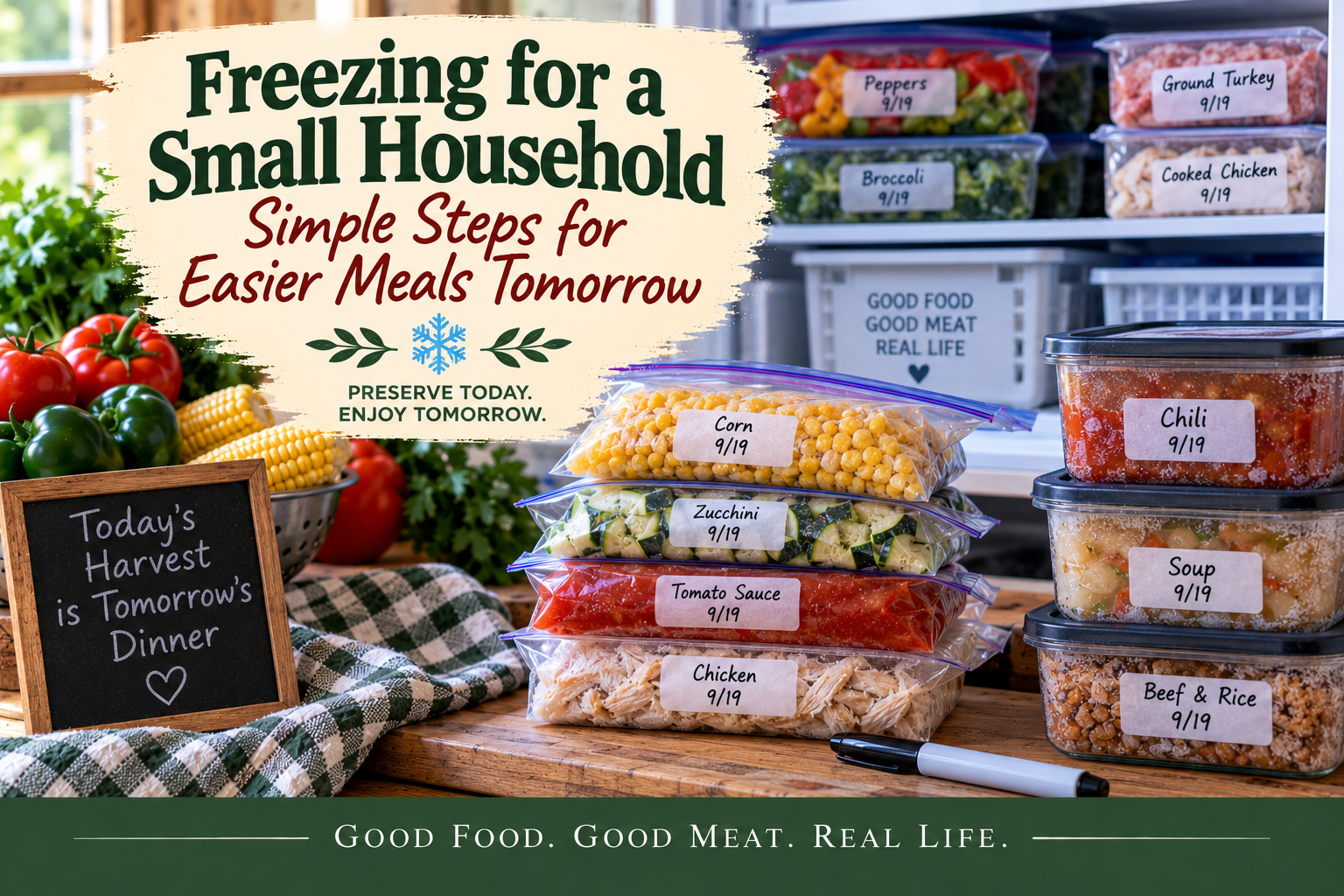
Freezing for a Small Household

Freezing food sounds simple enough: buy it, prepare it, put it in the freezer, and you’re done.

But when you’re cooking for one or two people, there’s another question to answer:

How much do I really need to freeze?

A freezer can be one of the best tools for stretching a grocery budget and making seasonal food last longer. But a small household doesn’t need six-quart bags of everything. The goal is to put food back in useful amounts — portions that make sense for the meals you actually cook.

This week, we focused on making the freezer work for real life.

❄️ This Week’s Freezing Roundup

Why Freezing Might Be the Best Preservation Method for a Small Household
Read the Article!
The September Freezer: What to Put Back When Produce Is Plentiful
Read the Article!
Chicken & Vegetable Pot Pie Skillet
There are nights when you want chicken pot pie, but you don't necessarily want to make an entire pie.
Check out this recipe
Put a Little Back: Green Beans for Future Dinners
Read the Article!
Freezer Inventory: Know What You Put Back
Read the Article!
Harvest Chicken & Green Bean Rice Bowls
A portion of frozen green beans, some cooked chicken, rice, and a handful of pantry staples come together in a warm, satisfying bowl.
Check out this recipe
Freezer Clean-Out Vegetable Soup
This Freezer Clean-Out Vegetable Soup is exactly the kind of meal I want waiting at the end of a week like this.
Check out this recipe

The week’s posts looked at freezing from a practical perspective: what is worth freezing, how much to put away, how to package it, and how to make sure those frozen foods actually get used later.

Freeze for the Meals You Make

One of the easiest mistakes to make when preserving food is thinking only about the food itself.

Instead, think about the meal.

If you usually cook for one or two, freezing several small portions may be much more useful than putting one enormous package into the freezer.

A bag of corn in one-cup portions gives you options.

A few portions of cooked chicken can become soup, a skillet meal, a wrap, or a rice bowl.

Frozen vegetables can be pulled out in exactly the amount you need instead of thawing a whole container and wondering what to do with the leftovers.

That’s the kind of freezer we’re building: a freezer that helps make supper easier.

A Little Today Can Become a Lot Later

You don’t have to fill your freezer in one afternoon.

A bag of seasonal corn here.

A couple of portions of cooked chicken there.

Some vegetables when they’re plentiful and reasonably priced.

Before long, those small additions become a collection of ingredients that can save both time and money.

And that’s especially useful when you’re cooking for a small household. You’re not trying to stock a restaurant freezer. You’re building a little reserve of ingredients that fit your life and your meals.

The Real Goal: Less Waste, Easier Meals

Putting food in the freezer isn’t the finish line.

Using it is.

The best freezer stash is one you can actually see, identify, and use. Labeling matters. Portion size matters. Keeping track of what you have matters.

And perhaps most importantly, frozen food should eventually come back out of the freezer and become dinner.

That’s why this month’s theme isn’t simply about preservation.

It’s about putting a little something back today so tomorrow’s meals are easier.

What’s Next?

We’ve been working our way through the harvest — choosing what to buy, deciding what to use now, and learning how to save some for later.

Next week, we’ll take that idea one step further as The Pantry Gets Bigger.

Because not everything needs to live in the freezer.

Some foods can become shelf-stable pantry ingredients, meal starters, and little pieces of future suppers waiting for us when we need them.

And that’s where the real payoff of putting food back begins.

Today’s harvest can become tomorrow’s dinner.

Pinterest Caption

Freezing for a small household doesn’t have to mean filling your freezer with oversized packages. Learn how to freeze useful portions, reduce food waste, stretch your grocery budget, and build a freezer stash that actually makes future meals easier.

Social Media Excerpt

Freezing food is one thing. Freezing it in portions that actually work for a household of one or two is another. This week’s roundup is all about making the freezer useful — not just full.

Hashtags

#GoodFoodGoodMeat, #SimplePracticalMeals, #RealFoodRealLife, #CookingForOneOrTwo, #BudgetFriendlyMeals, #FreezerMeals, #FreezerCooking, #FoodPreservation, #MealPrep, #SmallHouseholdCooking, #HarvestCooking, #PutALittleBack,

Posted in Kitchen Tips

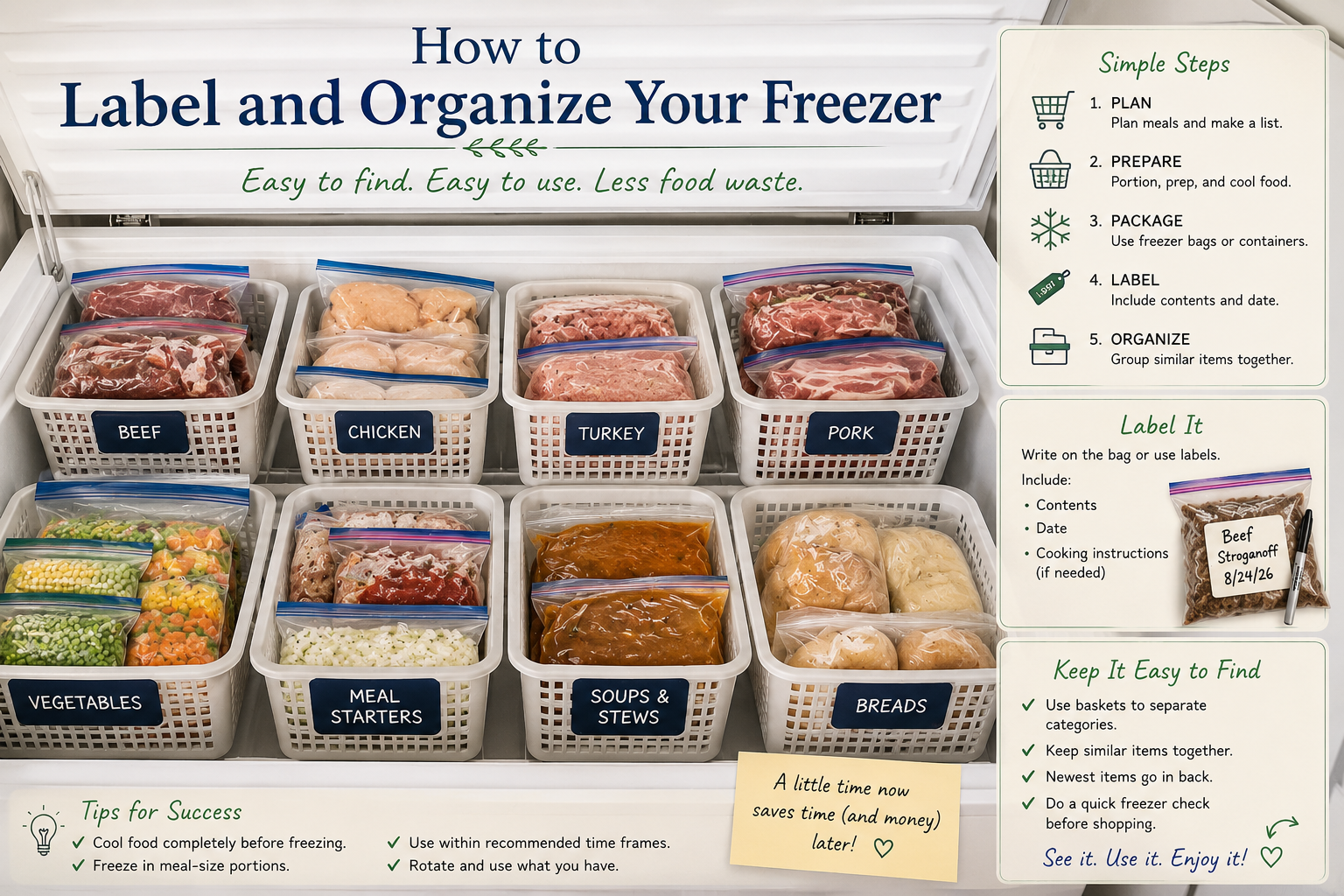
How to Label and Organize Your Freezer

There is organizing a freezer.

And then there is organizing a freezer so you can actually find dinner.

I learned the difference the hard way.

At one point, I had a chest freezer that held 7 cubic feet. One day, I wanted something that was buried at the very bottom — ribs, I think. Getting to them meant digging through everything that was stacked on top.

That’s when I realized my freezer didn’t necessarily need more space.

It needed better access to the space I already had.

So I bought baskets designed specifically for a 7-cubic-foot chest freezer.

I ended up with eight baskets.

And suddenly, instead of digging through a frozen pile every time I wanted something, I could pull out a basket, find what I needed, and put it back.

Even better, I discovered that those baskets could do more than keep things tidy. They could help me organize the freezer around the way I actually cook.

That’s when freezer organization became meal planning.


First: What Kind of Freezer Do You Have?

Not everyone stores frozen food the same way.

Some households have a chest freezer. Others have an upright freezer. Some have a freezer attached to the refrigerator and perhaps a separate freezer somewhere else.

The good news is that the organizing principles are the same, even though the physical setup is different.

If You Have a Chest Freezer

A chest freezer can hold a surprising amount of food, but without some kind of organization, the food at the bottom can become nearly impossible to reach.

That’s where baskets can make a tremendous difference.

Rather than stacking food directly on top of food, use baskets that are designed to fit the size and shape of your freezer.

The baskets essentially become removable drawers.

You can lift one out, find what you need, and put it back without excavating the entire freezer.

And don’t assume that every inch of the freezer needs to be packed with food.

Leave room between and around the baskets for air to circulate properly.

If You Have an Upright Freezer

An upright freezer gives you a different starting point because shelves and drawers already divide the space vertically.

You can use those existing sections as zones and add appropriately sized bins or baskets where they make things easier to reach.

The goal is the same:

Don’t organize food according to where it happens to fit. Organize it according to how you use it.


The Freezer Basket Revelation

My freezer baskets solved one immediate problem:

I could finally get to the food at the bottom.

But once I had them, I realized they could do something even more useful.

I could give each basket a purpose.

Instead of one giant chest freezer containing an assortment of frozen food, I had smaller sections that I could actually manage.

For example, one basket could hold proteins.

Another could hold vegetables.

Another could hold meal starters.

Another could hold prepared meals.

The exact categories don’t matter nearly as much as the fact that you know what belongs where.

And that’s the key.

A good organization system should help you answer:

“Where is the food I need?”

without requiring a search expedition.


Organize Around How You Cook

This is where freezer organization becomes more than housekeeping.

Think about the meals you actually make.

If you regularly plan several meals around a protein and vegetable, consider keeping those foods together.

For example, you might have:

Basket 1: This Week’s Proteins

  • chicken
  • ground beef
  • pork
  • sausage
  • fish

Basket 2: This Week’s Vegetables

  • green beans
  • broccoli
  • corn
  • peas
  • mixed vegetables

Put the baskets beside each other if your freezer allows it.

Now meal planning becomes much easier.

Pull out the protein basket.

Pull out the vegetable basket.

Choose what you’re going to make.

You’re no longer searching through the entire freezer.

You’re choosing from a small, visible collection of possibilities.


Think of Your Freezer as a Collection of Meal-Building Blocks

This is particularly useful when you’re cooking for one or two people.

You don’t necessarily need to freeze a complete meal every time.

Instead, think in terms of components.

Your freezer might contain:

  • browned ground beef
  • shredded chicken
  • cooked pork
  • frozen vegetables
  • sautéed onions
  • cooked beans
  • homemade broth
  • tomato sauce
  • prepared meal starters

Those ingredients can become several different meals.

For example, a container of cooked ground beef might eventually become:

  • a rice bowl
  • fried rice
  • a skillet meal
  • pasta
  • soup
  • tacos
  • stuffed vegetables

That’s much more flexible than filling your freezer with six identical dinners.


Label Everything

Even if you know exactly what something is today, future-you may not.

And future-you has other things to worry about.

A good freezer label should answer three basic questions.

What Is It?

Be specific.

Instead of:

Beef

try:

Browned Ground Beef

Or:

Garlic Herb Beef & Vegetables

When Was It Frozen?

Write the date.

Frozen: 8/23/26

That gives you useful information when you’re deciding what to use first.

What Does It Need?

This is one of the most useful things you can put on a freezer label.

For example:

Garlic Herb Beef & Vegetables
Frozen: 8/26/26
Add rice + fresh parsley

Or:

Cooked Chicken
Frozen: 8/20/26
Use for wraps, bowls, or soup

That little note can save you from standing in front of the freezer trying to remember what you originally had in mind.


Label the Baskets, Too

Individual food packages aren’t the only things worth labeling.

If your baskets have specific jobs, label them.

You might have:

  • This Week
  • Proteins
  • Vegetables
  • Meal Starters
  • Prepared Meals
  • Breakfast
  • Bread & Baked Goods

If you’re using a chest freezer, you might also organize baskets according to how frequently you use them.

Foods you reach for often should be easiest to access.

Foods you use less frequently can go farther down or toward the back.

There is no single perfect system.

The best system is the one that makes sense when you’re standing in front of your freezer looking for dinner.


Portion Food for the People You’re Actually Feeding

If you’re cooking for one or two people, freezer organization becomes even more important.

A giant package of cooked meat isn’t necessarily convenient if you only need enough for two servings.

Whenever practical, freeze food in portions that match the meals you actually make.

That might mean:

  • one serving
  • two servings
  • enough for one skillet meal
  • enough for a pot of soup
  • enough for four rice bowls

Smaller portions also give you more flexibility.

You can thaw exactly what you need instead of turning one freezer container into four meals simply because that’s how it was originally packaged.


Use the First-In, First-Out Rule

You don’t need to memorize everything that’s in your freezer.

Instead, make older food easier to find.

When possible, put newer packages behind older ones.

When you add something to a basket, check what’s already there.

If you discover something that’s been sitting around for a while, move it toward the front and make a plan to use it.

This simple habit can help prevent the freezer from becoming a place where food disappears for months.


Keep a Simple Freezer Inventory

If you have a lot of frozen food, a simple inventory can be helpful.

It doesn’t need to be fancy.

A piece of paper attached to the freezer can work just fine.

For example:

Proteins

  • Ground beef — 2 packages
  • Chicken — 3 packages
  • Pork chops — 2 packages
  • Fish — 2 packages

Vegetables

  • Green beans
  • Corn
  • Peas
  • Broccoli
  • Mixed vegetables

Meal Starters

  • Cooked beef — 2 portions
  • Shredded chicken — 2 portions
  • Soup starter — 1 container

Cross things off as you use them.

Add things when you restock.

The point isn’t to create another household chore.

It’s simply to keep your freezer from becoming a mystery box.


The Weekly Basket Method

One of my favorite ways to use freezer baskets is to think in terms of one week at a time.

If you have enough freezer space, put the proteins you’re planning to use together.

Then keep the vegetables for those meals in a nearby basket.

For example:

Protein Basket

  • chicken
  • ground beef
  • pork chops
  • sausage

Vegetable Basket

  • green beans
  • broccoli
  • corn
  • peas

Now you have a visual reminder of what you already have available.

You can look at the baskets before going grocery shopping.

You can choose meals based on what’s already there.

And you can avoid buying another package of something you forgot was hiding at the bottom of the freezer.

That’s where organization starts saving money.


Use Your Freezer to Prevent Meal-Planning Déjà Vu

When I first started using freezer baskets, I was still shopping and planning meals for an entire month. The baskets turned out to be useful for more than simply finding food.

They gave me a visual inventory of what I had purchased.

I could look at the proteins and vegetables and see the possibilities for the weeks ahead. More importantly, I could see what I had already planned and make sure I wasn’t serving the same type of meal on the same day every week.

If we’d had beef on Monday one week, I could choose chicken or pork for the following Monday. If one week’s Thursday meal was a skillet, I could choose a rice bowl or casserole the next week.

The freezer wasn’t telling me what to cook. It was giving me enough information to make better choices.

That’s one of the biggest benefits of an organized freezer: visibility creates variety.

You don’t have to follow a rigid meal plan. You just need to be able to see what you’ve already got.


Don’t Overfill Your Freezer

A well-organized freezer doesn’t have to be packed from wall to wall.

You need to be able to move food around and retrieve what you need.

You also don’t want to block vents or interfere with the freezer’s ability to circulate cold air.

With a chest freezer, this is another reason I like appropriately sized baskets.

You can create sections without filling every available inch with loose packages.

My eight baskets fit my 7-cubic-foot chest freezer while still leaving plenty of room for air circulation.

The baskets gave me organization without turning the freezer into a solid block of frozen food.


Your Freezer Doesn’t Have to Be Pretty

This may be the most important rule of all.

Your freezer does not need matching containers.

It does not need professionally printed labels.

It does not need to look like one of those perfectly staged refrigerator photographs.

It needs to work for you.

Freezer baskets don’t have to be expensive.

Labels can be as simple as masking tape and a permanent marker.

An old container may be exactly the right container for a particular food.

The goal isn’t perfection.

The goal is being able to open the freezer and quickly answer:

What do I have?

and

What can I make with it?


Turn Freezer Organization Into Meal Planning

This is where the whole system comes together.

Imagine opening your freezer and seeing:

Protein Basket: ground beef, chicken, pork

Vegetable Basket: green beans, broccoli, corn

Meal Starter Basket: cooked beef, shredded chicken, soup starter

Instead of thinking:

I don’t know what to make.

you can think:

I have ground beef and green beans. What sounds good?

Maybe tonight they’re a skillet meal.

Tomorrow, chicken and broccoli become a rice bowl.

Later in the week, the pork and vegetables become a soup.

The freezer isn’t dictating your meals.

It’s giving you options.

And that’s exactly what good organization should do.


The Real Goal

I didn’t buy freezer baskets because I wanted a beautifully organized freezer.

I bought them because the ribs were at the bottom.

What I discovered was that making the food easier to reach also made it easier to use.

And that’s the real purpose of freezer organization.

Not a perfect-looking freezer.

Not a freezer filled with matching containers.

Not an elaborate inventory system that takes longer to maintain than the freezer is worth.

Just a freezer where you can see what you have, reach what you need, and make good use of the food you’ve already paid for.

Because when your freezer is organized around the way you actually cook and eat, it becomes more than a place to store food.

It becomes part of your meal plan.

And sometimes, the best organization system starts with something as simple as:

“I really don’t want to dig all the way to the bottom for those ribs again.” 🌿

Posted in Kitchen Tips

How to Build a Better Freezer Meal Kit

Introduction

Freezer meal prep can sound like a much bigger project than it really is.

There are freezer-meal plans that involve shopping for dozens of ingredients, spending an entire afternoon assembling meals, and filling the freezer with carefully labeled packages.

That works for some people.

But that’s not the kind of meal planning we’re talking about here.

For everyday cooking, a freezer meal kit can be as simple as putting a few ingredients together today so that tomorrow’s dinner takes less work.

Maybe you’ve browned extra ground beef. Maybe you have vegetables that need to be used. Maybe you cooked more chicken than you need for tonight’s dinner.

Instead of leaving those extras in the refrigerator and hoping you’ll remember to use them, turn them into a small meal kit.

It’s not about cooking everything ahead.

It’s about doing the part that’s easiest to do today so you don’t have to do it later.


What Exactly Is a Freezer Meal Kit?

Think of a freezer meal kit as a building block for a future meal.

A basic kit might contain:

  • cooked meat
  • prepared vegetables
  • seasonings or sauce
  • a label with the meal name
  • the date it was prepared
  • a note about what still needs to be added

That’s it.

The idea is to freeze the ingredients that benefit most from being prepared ahead while leaving the final cooking or assembly for later.

For example:

Beef & Vegetable Rice Bowl Kit

In the freezer:

  • cooked seasoned ground beef
  • cooked vegetables
  • sauce

Add later:

  • freshly cooked rice
  • fresh herbs
  • lemon

Now you’ve turned a future dinner into a heat, cook rice, and assemble meal instead of starting from scratch.


Why Freezer Meal Kits Work

1. You’re Already Cooking

This is the biggest advantage.

If you’re browning a pound of ground beef for tonight’s dinner, browning another half-pound doesn’t require an entirely separate cooking session.

If you’re chopping an onion, chopping another one takes almost no extra time.

If you’re washing vegetables, preparing a little extra means you’re already holding the cutting board.

That’s the kind of meal prep that fits into real life.

2. They Prevent the “I’ll Use It Tomorrow” Problem

We’ve all put leftovers in the refrigerator with good intentions.

Then tomorrow comes.

Then the next day.

And suddenly that container in the back of the refrigerator is looking suspicious.

Freezing food while it’s still fresh gives you another option.

Instead of asking:

“What am I going to do with this?”

you’ve already answered the question.

3. They Make Small-Household Cooking Easier

When you’re cooking for one or two people, recipes often produce more food than you need for one meal.

That isn’t necessarily a problem.

The trick is deciding what happens to the extra food before it becomes an oversized container of leftovers.

One dinner can become:

  • tonight’s meal
  • tomorrow’s lunch
  • a freezer meal kit
  • an ingredient for another recipe

That’s stretching the food dollar without eating the same dinner four nights in a row.


The Five Parts of a Good Freezer Meal Kit

1. The Protein

Start with a cooked protein whenever possible.

Good choices include:

  • ground beef
  • ground turkey
  • shredded chicken
  • cooked pork
  • cooked meatballs
  • cooked sausage

Season the protein fairly simply if you aren’t sure what you’ll eventually make with it.

A mildly seasoned batch of ground beef can become:

  • a rice bowl
  • fried rice
  • a skillet meal
  • pasta
  • stuffed vegetables
  • soup

The more strongly you season it, the fewer directions it can go later.


2. The Vegetables

Cooked vegetables can be an excellent freezer component, particularly when they’re destined for soups, stews, casseroles, skillet meals, or bowls.

Think:

  • carrots
  • green beans
  • peas
  • corn
  • onions
  • mushrooms
  • peppers
  • cabbage
  • zucchini

One important consideration is texture.

Some vegetables become softer after freezing and reheating. That’s perfectly fine for many meals, but it means you may want to leave certain vegetables slightly undercooked when preparing a freezer kit.

For example, zucchini doesn’t need to be cooked until completely soft if you know it’s going to be reheated later.


3. The Flavor Builder

This is where you decide what direction the meal is going.

A flavor builder might be:

  • a simple sauce
  • broth
  • gravy
  • tomato sauce
  • cooked onions and garlic
  • herbs and seasonings
  • a marinade

For maximum flexibility, you don’t always need to include a sauce.

Sometimes simply freezing the cooked meat and vegetables together is enough.

Then you can decide later whether the meal becomes a bowl, skillet, soup, or pasta dish.


4. The Label

This may be the least exciting part of freezer meal prep.

It’s also one of the most important.

Every freezer meal kit should have:

What it is
When it was prepared
What needs to be added

For example:

Garlic Herb Beef & Vegetables
Prepared: 8/26/26
Add: Rice + fresh parsley + lemon

That’s infinitely more useful than:

BEEF — 8/26

Because six weeks from now, “BEEF” isn’t exactly a detailed meal plan.


5. The Plan

Before putting the kit into the freezer, decide what it’s eventually supposed to become.

You don’t necessarily need a complete recipe.

A simple note such as:

Add cooked rice and fresh vegetables.

or:

Add pasta and Parmesan.

may be enough.

The goal is to remove the decision-making from future dinner.


What Should You Freeze Separately?

Not everything belongs in the same container.

Some ingredients are better added fresh later.

Better Added Later

  • cooked rice, when possible
  • fresh herbs
  • lettuce
  • fresh tomatoes
  • crunchy toppings
  • delicate dairy toppings
  • avocado
  • fresh lemon or lime juice

This gives the finished meal better texture and flavor.

It also keeps your freezer kit from becoming a container of everything.


A Simple Example

Let’s say you’re making Family-Style Beef & Vegetable Skillet.

You’ve already got the skillet out.

Instead of cooking exactly enough for tonight, you cook a little extra ground beef and vegetables.

Tonight’s dinner gets served.

The extra beef and vegetables become:

Freezer Meal Kit

Container: cooked beef + vegetables

Label:
Beef & Vegetable Skillet Base
Prepared: 8/23/26
Add rice, potatoes, or pasta.

Now you’ve got the beginnings of another meal without having cooked another complete dinner.

Later, you can turn that same base into something completely different.

That’s the magic of the system.


Freezer Meal Kits Don’t Have to Be Full Meals

This is probably the most important idea in the whole article.

You don’t have to freeze an entire finished dinner.

Sometimes the most useful thing to freeze is one component.

A container of:

  • cooked ground beef
  • shredded chicken
  • sautéed onions
  • cooked vegetables
  • homemade broth
  • cooked beans

can become the starting point for several different meals.

That’s especially useful for small households.

Instead of filling the freezer with six identical dinners, you can build a collection of meal starters.

And that gives you much more flexibility.


A Few Freezer Kit Ideas

Beef & Vegetable Starter

Freeze: cooked ground beef + mixed vegetables
Add later: rice, potatoes, pasta, or broth

Shredded Chicken Starter

Freeze: cooked shredded chicken + mild seasonings
Add later: tortillas, rice, pasta, soup ingredients, or vegetables

Soup Starter

Freeze: cooked meat + vegetables
Add later: broth and starch when you’re ready to make the soup

Pasta Starter

Freeze: cooked meat + sautéed vegetables
Add later: freshly cooked pasta and sauce

Rice Bowl Starter

Freeze: cooked seasoned protein + cooked vegetables
Add later: freshly cooked rice and fresh toppings


The Small-Household Advantage

For one or two people, I recommend thinking in meal components rather than family-sized freezer meals.

A full casserole might give you six servings.

That’s a lot of the same meal.

A freezer kit containing two portions of cooked chicken and vegetables gives you options.

You might turn one portion into a rice bowl and the other into soup.

Same ingredients.

Two completely different meals.

That’s a much better use of limited freezer space.


Don’t Forget the Freezer Inventory

A freezer only saves money if you actually use what’s in it.

Keep a simple inventory somewhere convenient.

It doesn’t have to be fancy.

You might have:

FREEZER

  • 2 Beef & Vegetable Kits — Aug. 23
  • 1 Garlic Herb Beef Kit — Aug. 26
  • 2 Chicken Meal Starters
  • 1 container shredded pork
  • 2 cups cooked vegetables

When you use something, cross it off.

And occasionally take a look at the list before going grocery shopping.

You might discover that you already have the beginnings of dinner sitting in your freezer.


The Golden Rule: Freeze Food While It’s Still Good

A freezer isn’t a rescue mission for food that’s already questionable.

If something is fresh and you know you aren’t going to use it soon, that’s the time to freeze it.

Don’t wait until the refrigerator becomes the final stop before the trash can.

Freezing is part of the plan — not an emergency measure.


A Better Way to Think About Meal Prep

Meal prep doesn’t have to mean:

“What meals am I going to cook for the entire week?”

Try asking:

“What can I do today that will make one future meal easier?”

That’s a much smaller question.

And it’s one you can answer while you’re already cooking.

Brown a little extra meat.

Chop another onion.

Cook another cup of vegetables.

Make enough rice for tomorrow.

Put two portions in the freezer.

None of those things takes much additional effort.

But together, they can make the next week’s cooking considerably easier.


Final Thought

Cooking today, planning for tomorrow doesn’t mean spending your weekend meal-prepping.

It means paying attention to the little opportunities that happen naturally in the kitchen.

When you’re already chopping, chop a little extra.

When you’re already cooking, cook enough for another meal.

When you realize you won’t use something soon, freeze it while it’s still good.

Those small decisions add up.

And eventually, you open the freezer on a busy evening and discover something wonderful:

Dinner is already halfway done. 🌿